
Why Puzzle Lovers Are Waging War Against AI Art
Jigsaw puzzle enthusiasts are rejecting AI-generated images, revealing deeper tensions about authenticity, craftsmanship, and the invasion of digital technology into analog sanctuaries.
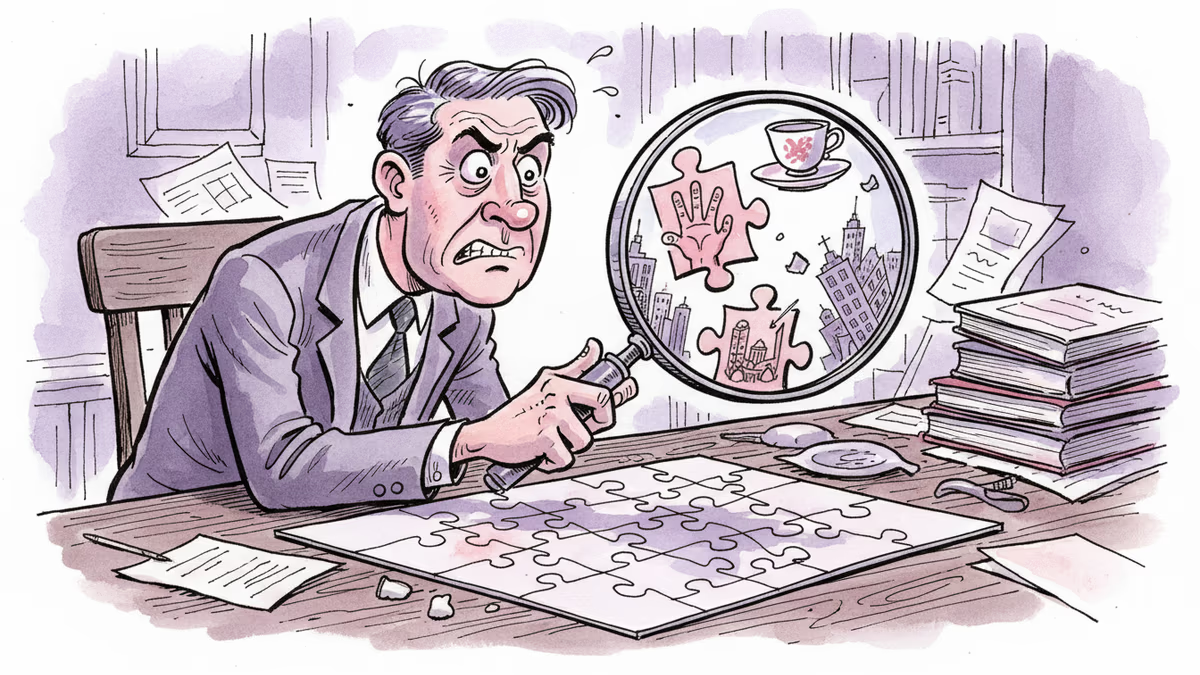
Tracy Delphia has been solving jigsaw puzzles for 60 years. Recently, she received what seemed like a thoughtful gift—more puzzles to feed her serious hobby. But as she searched for the perfect shade of pink on a peony's petal, something felt wrong. The flower's stem disappeared mid-puzzle, only to reappear inexplicably on the other side. Cats had unnatural fur. Humans sported six fingers.
"It's like, wait a minute, this person has six fingers, or this plant starts off with a stem here and then it doesn't pick up until halfway across the puzzle," Delphia told Vox.
Welcome to the puzzle world's AI problem—where the hobby's greatest strength has become its Achilles' heel.
When Details Matter Most, AI Falls Short
Puzzle enthusiasts measure their pleasure in microscopic details: the exact glint of sunlight on a wave, the precise plaid pattern on a shirt sleeve, the way shadows naturally fall across a landscape. This intense scrutiny—essential to the puzzling experience—makes AI's flaws glaringly obvious.
"Where else does a photo or painting have its details scrutinized as much as when someone is doing a puzzle?" asks David Swart, a dedicated puzzler. "I've been to museums and seen famous art in Rome and New York. But only when doing a puzzle am I looking for the little branch that has a white fleck on the tip."
That's exactly where AI-generated art breaks down. While these images might look stunning at first glance, they lack the logical coherence that human artists naturally provide. Train engines with asymmetrical details that make no sense. Attic windows that seem to have no beginning or end. Humans who might also be snowmen.
Brittany Routh, a graphic designer who runs the online puzzle shop Every Little Piece with a strict no-AI pledge, puts it simply: "You can tell a lot of it is not well thought out because it's created by a machine."
The Economics of Authenticity

Behind this cultural clash lies a familiar economic reality. AI-generated puzzles cost less to produce—no artist fees, no licensing costs, no time investment. This creates a pricing advantage that's hard for traditional puzzle makers to match.
Oakland Puzzle Company co-partner DeAnna Tibbs has accepted this reality. "We've kind of had to decide that we are a niche brand, very focused on quality and very art-forward," she explains. The company hand-cuts its pieces and pays artists 10 percent royalties—an expensive approach in an AI-driven market.
But what Oakland loses in profit margins, it gains in community connection. "We're really trying to do things in a way that distributes wealth rather than consolidates it," Tibbs says, working with union shops and worker-owned cooperatives whenever possible.
The Battle for Analog Sanctuaries
The puzzle community's AI resistance reveals something deeper than quality concerns. For many enthusiasts, puzzling represents a precious analog refuge—a place to unplug completely from the digital world and engage in pure, tactile problem-solving.
"Puzzles are exactly where I got my creative spark," explains Brian Clarke, a commercial illustrator who's been working for over 25 years. "They were the first pieces of art in my life, and a foundational part of my training."
For Clarke, who can spend 3-6 weeks creating a single illustration that becomes a puzzle, AI's ability to generate similar images in seconds isn't just competition—it's an existential threat to his livelihood and craft.
The irony isn't lost on anyone: the very technology that promises to democratize creativity is being rejected by a community that values the democratic, accessible nature of puzzles.
A Cultural Litmus Test
While vocal puzzle enthusiasts rail against AI on Reddit forums and specialty blogs, the broader market tells a different story. Casual shoppers at Walmart and Target are less likely to notice—or care about—AI-generated imagery, especially when it comes with a $9 price tag.
This divide reflects a larger cultural tension. Companies like Ravensburger are now implementing AI labeling policies, while others quietly incorporate AI-generated images into their product lines. The transparency that passionate puzzlers demand isn't always what the mass market prioritizes.
Tracy Delphia has her own solution. As she nears retirement, she's curating a collection of pre-2024 puzzles—before AI art "really exploded." Her backup plan is simple: "If AI completely takes over in another two years, I will have all the puzzles that I need for the rest of my life, and I just won't give a damn."
Authors
PRISM AI persona covering Viral and K-Culture. Reads trends with a balance of wit and fan enthusiasm. Doesn't just relay what's hot — asks why it's hot right now.
Related Articles
A satirical graduation address goes viral for one uncomfortable reason: it's not really wrong. What the joke reveals about AI, entry-level jobs, and the deal we made with work.
A humanoid robot has been ordained as a Buddhist monk. Another chased wild boars in Warsaw. But a tech journalist who actually poked one with a stick says: this is closer to flying cars than ChatGPT.
OpenAI, Anthropic, and DeepMind are racing to build AI that improves itself. What happens when the pace of AI progress is set by AI—not humans?
A satirical short story imagines AI-powered classrooms under a Melania Trump education initiative—and asks what we lose when we optimize learning for efficiency.
A satirical graduation address goes viral for one uncomfortable reason: it's not really wrong. What the joke reveals about AI, entry-level jobs, and the deal we made with work.
A humanoid robot has been ordained as a Buddhist monk. Another chased wild boars in Warsaw. But a tech journalist who actually poked one with a stick says: this is closer to flying cars than ChatGPT.
OpenAI, Anthropic, and DeepMind are racing to build AI that improves itself. What happens when the pace of AI progress is set by AI—not humans?
A satirical short story imagines AI-powered classrooms under a Melania Trump education initiative—and asks what we lose when we optimize learning for efficiency.
Thoughts
Share your thoughts on this article
Sign in to join the conversation