
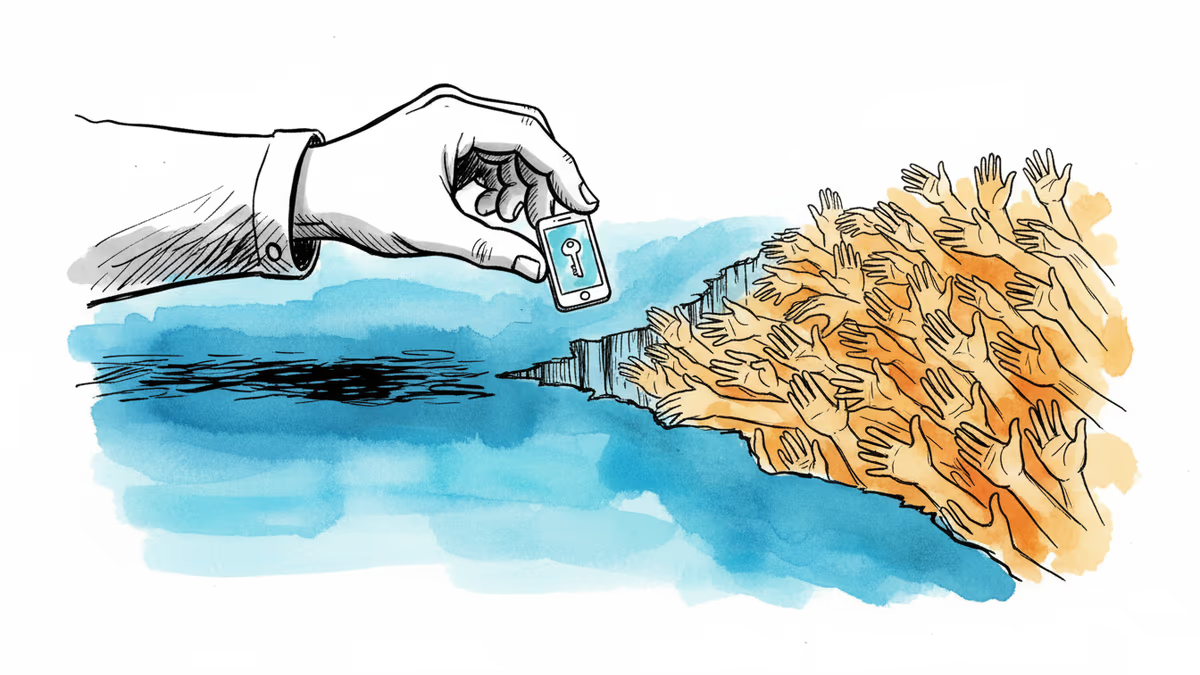
Can a $40 Smartphone Close the Digital Divide?
A GSMA-led coalition is pushing ultra-low-cost 4G phones into six African markets. The target price is bold. The obstacles — component costs, taxes, thin margins — are real.
Hundreds of millions of people in sub-Saharan Africa already live within reach of a mobile broadband signal. They just can't afford the device to use it.
The Number That Changes Everything — If It's Real
At MWC 2026 in Barcelona this week, the GSMA announced it is working with some of Africa's biggest mobile operators — Airtel, Axian Telecom, Ethio Telecom, MTN Group, Orange, and Vodafone — to pilot ultra-low-cost 4G smartphones in six countries: the Democratic Republic of the Congo, Ethiopia, Nigeria, Rwanda, Tanzania, and Uganda. The target price: $30–$40. The ambition: bring 20 million more people online.
That gap between ambition and reality is significant. The average selling price of a smartphone in the Middle East and Africa was $188 in Q4 2025, according to Counterpoint Research — roughly five times the target. The GSMA says it has engaged with more than 15 smartphone manufacturers, with seven expressing interest. It has not named any of them. Commercial negotiations, the group says, are still ongoing.
Why $40 Is So Hard
The economics are unforgiving. Ahmad Shehab, a research analyst at Counterpoint Research, put it plainly: pushing smartphones into the $30–$40 range "could have been historically feasible when memory costs were significantly lower." Today, that's no longer the case. Suppliers are increasingly prioritizing high-capacity chips, making low-capacity components — exactly what a budget device would need — harder to source, not easier.
Then there's the tax problem. In some markets, smartphones are classified as luxury goods, with import duties and taxes adding as much as 30% to the final retail price. Alix Jagueneau, the GSMA's head of external affairs, confirmed that none of the six pilot countries has yet committed to reducing those levies. She pointed to South Africa's decision last year to scrap a 9% luxury excise duty on handsets priced below R2,500 (roughly $150) as a model worth following — but acknowledged no one has followed it yet.
Financing structures add another layer of complexity. Development banks, donors, and financial institutions could absorb some of the risk for operators investing in subsidized devices. Installment payment schemes could lower the upfront cost to consumers. But these mechanisms are still being designed, not deployed.

The GSMA hopes proof-of-concept devices could be produced this year, with early consumer offerings potentially reaching markets by late 2026.
We've Seen This Movie Before
The industry has tried this before. In 2014, Google launched Android One — a program to bring affordable smartphones to India, Pakistan, Bangladesh, and Indonesia, later expanding to Africa in 2015. It never achieved the scale its backers hoped for. The program limped along in select markets for years before quietly fading as a meaningful platform for entry-level devices.
What's different this time? The GSMA coalition puts mobile operators — not a Silicon Valley platform company — at the center of the effort. Operators have direct relationships with consumers, distribution infrastructure, and a financial stake in growing their subscriber base. That alignment of incentives didn't exist in the Android One era in the same way. Whether it's enough to overcome the cost barriers is a different question.
Who Wins, Who Worries
For operators, the calculus is straightforward: more connected users means more data revenue. The risk is subsidizing devices that don't generate enough ARPU (average revenue per user) to justify the investment.
For manufacturers, the picture is murkier. Thin margins on a $40 device leave almost no room for error. Chinese brands — particularly Transsion, which operates the Tecno, Itel, and Infinix labels and already dominates Africa's budget segment — are best positioned to compete at this price point. For global players, the question is whether volume and ecosystem lock-in can compensate for near-zero per-unit margins.
For governments, the calculus should be simple: taxing smartphones as luxuries actively undermines digital inclusion goals. Yet the revenue dependency on those duties makes reform politically difficult, even when the economic case is clear.
For development organizations and donors, this initiative represents a potential leverage point — but only if the commercial framework is solid enough to sustain itself after initial funding runs out. Subsidized pilots that collapse when grant money dries up have a long history in development economics.
Authors
Related Articles

The Xiaomi 17 Ultra, Honor Magic 8 Pro, and other global flagships are outspeccing Samsung and Apple—but US consumers can't legally buy them. Here's what that means.
OpenClaw, an open-source AI agent, has sparked a cottage industry in China—from installation services to pre-loaded hardware. What does this grassroots AI adoption wave reveal about where the technology is really headed?
Apple's full iPhone 17 lineup is here, from the $599 17e to the $1,199 Pro Max. We break down which model actually fits your life—and what the pricing gap says about Apple's strategy.

MWC 2026 unveiled a smartphone with built-in fire starter. Is this the future of mobile innovation or a step too far?
The Xiaomi 17 Ultra, Honor Magic 8 Pro, and other global flagships are outspeccing Samsung and Apple—but US consumers can't legally buy them. Here's what that means.
OpenClaw, an open-source AI agent, has sparked a cottage industry in China—from installation services to pre-loaded hardware. What does this grassroots AI adoption wave reveal about where the technology is really headed?
Apple's full iPhone 17 lineup is here, from the $599 17e to the $1,199 Pro Max. We break down which model actually fits your life—and what the pricing gap says about Apple's strategy.
MWC 2026 unveiled a smartphone with built-in fire starter. Is this the future of mobile innovation or a step too far?
Thoughts
Share your thoughts on this article
Sign in to join the conversation