

China's 'Lobster' Craze: When AI Meets the Masses
OpenClaw, an open-source AI agent, has sparked a cottage industry in China—from installation services to pre-loaded hardware. What does this grassroots AI adoption wave reveal about where the technology is really headed?
A 77-year-old man in Beijing called his son asking for help installing a "lobster." That's when the son knew something had shifted.
What Is This 'Lobster,' Exactly?
OpenClaw is an open-source AI agent—software that takes autonomous control of a device to complete tasks on a user's behalf. Browse the web, open files, run apps, draft emails: the kind of things a person does sitting at a computer, delegated entirely to an AI. Chinese users nicknamed it "lobster" after its logo, and the phrase "raising a lobster" has become shorthand for the whole experience of setting one up and watching it work.
What started as a niche experiment among Beijing and Shenzhen tech workers in January has, within two months, become a nationwide phenomenon. A February livestream demo by tech influencer Fu Sheng drew 20,000 viewers. A self-organized meetup in Shenzhen on March 7 packed more than 1,000 attendees into a venue with no seats to spare. Tencent held a public installation event that drew long lines—including elderly users and children. The district government of Longgang in Shenzhen rolled out policies offering free computing credits and cash rewards for standout OpenClaw projects. Other cities, including Wuxi, are following suit.
The Gap That Became a Market
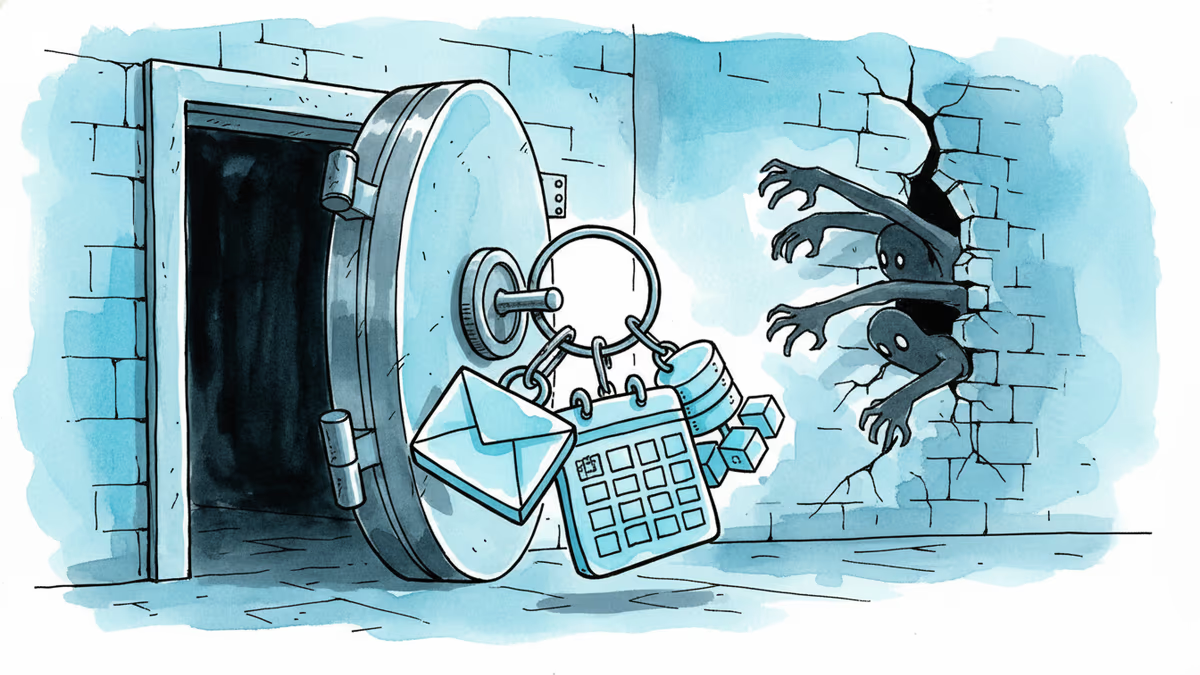
Here's the catch: OpenClaw isn't easy to set up. You need to type commands into a terminal, navigate developer platforms, and understand how to partition data so the agent doesn't have unguarded access to your entire hard drive. Get it wrong, and you've handed a powerful autonomous tool the keys to your personal files—a risk the Chinese cybersecurity regulator CNCERT flagged officially on March 10, warning of heightened data breach exposure.
That technical barrier created an opening. On Taobao and JD.com, hundreds of listings now offer installation guides and support packages, priced between 100 and 700 RMB (roughly $15–$100). At the higher end, vendors show up at your door.
Feng Qingyang, a 27-year-old software engineer in Beijing, spotted this early. In January, he posted an OpenClaw installation service on Xianyu, a secondhand marketplace: "No coding knowledge needed. Fully remote. Ready in 30 minutes." By the end of February, he'd quit his day job. Today, his operation has grown to over 100 employees and processed 7,000 orders at roughly 248 RMB ($34) each.
In Shenzhen, developer Xie Manrui spent a Saturday afternoon installing OpenClaw for an e-commerce worker with no technical background—and walked away with 600 RMB ($87). Hardware reseller Li Gong started selling refurbished Mac minis and MacBooks with OpenClaw pre-installed; orders have increased eightfold in the past two weeks alone.

"Opportunities are always fleeting," Feng says. "As programmers, we are the first to feel the winds shift."
Not Everyone Is Convinced
The enthusiasm isn't universal. Jiang Yunhui, a tech worker in Ningbo, thinks the hype in China's first-tier cities is getting ahead of reality. "The agent is still a proof of concept," he says. "Using it safely and getting anything meaningful out of it requires technical fluency and independent judgment that most new users simply don't have yet."
Tianyu Fang, a PhD candidate in the history of technology at Harvard, offers useful context: this kind of behavior isn't new in China. Users there have long paid for one-off IT support—installing Adobe software, jailbreaking a Kindle. OpenClaw is riding an existing cultural comfort with informal tech services, not creating it from scratch.
The security concern is real. An AI agent with deep, continuous access to a device is a significant attack surface. The CNCERT warning wasn't hypothetical; it reflects genuine risk that many enthusiastic first-time users may be underestimating.
Three Tensions Worth Watching
This story isn't just about a viral tool in China. It surfaces three tensions that will define how AI agents roll out everywhere.
Openness vs. safety.OpenClaw's open-source nature is exactly what made this grassroots boom possible—and exactly what makes it hard to secure. Closed, corporate AI products trade flexibility for guardrails. Which model actually serves users better?
Access vs. expertise. The installation economy that's sprung up around OpenClaw is, in one reading, democratizing access to powerful AI. In another, it's monetizing a knowledge gap that shouldn't exist in a well-designed product. If the tool required a paid intermediary to use safely, is it really accessible?
Speed vs. readiness. Government bodies in Shenzhen are actively subsidizing OpenClaw adoption while the national cybersecurity regulator is issuing warnings about it—simultaneously. That tension between promotion and caution is one regulators everywhere will have to navigate as agentic AI moves from developer circles to the general public.
Feng, now building toward what he calls a "one-person company" powered by AI agents, has given himself one year to find out what's possible. "I want to see if I can run a full operation alone," he says.
Authors
Related Articles
A critical vulnerability in Starlette—downloaded 325 million times per week—puts millions of AI agent servers at risk, exposing stored credentials for email, databases, and third-party services.

Ollama now supports Apple's MLX framework, bringing meaningfully faster local AI to Apple Silicon Macs. Here's why that matters beyond the benchmark numbers.

Malware found in LiteLLM, a core AI developer tool downloaded 3.4M times daily. A supply chain attack, credential theft, and a compliance certification scandal wrapped into one story.

Northeastern University researchers manipulated AI agents into divulging data, crashing systems, and spiraling into loops—just by exploiting their built-in good behavior.
A critical vulnerability in Starlette—downloaded 325 million times per week—puts millions of AI agent servers at risk, exposing stored credentials for email, databases, and third-party services.
Ollama now supports Apple's MLX framework, bringing meaningfully faster local AI to Apple Silicon Macs. Here's why that matters beyond the benchmark numbers.
Malware found in LiteLLM, a core AI developer tool downloaded 3.4M times daily. A supply chain attack, credential theft, and a compliance certification scandal wrapped into one story.
Northeastern University researchers manipulated AI agents into divulging data, crashing systems, and spiraling into loops—just by exploiting their built-in good behavior.
Thoughts
Share your thoughts on this article
Sign in to join the conversation