
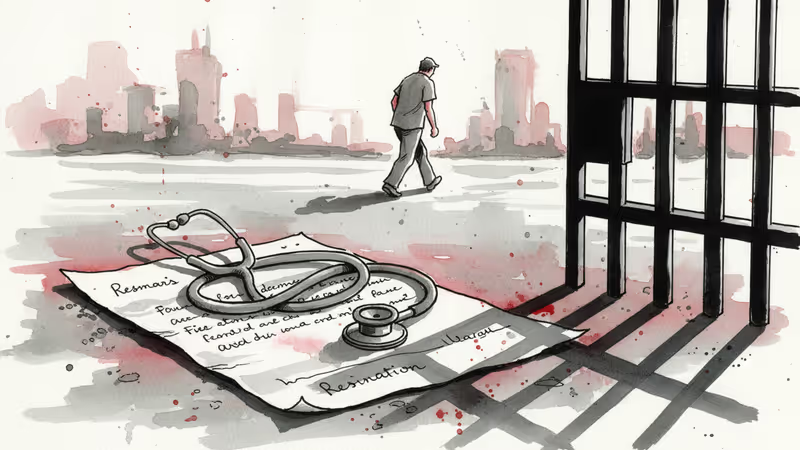
When Doctors Say No: Medical Staff Resign Over Guantánamo Immigration Detention
Trump administration's use of Guantánamo Bay for immigrant detention forces US Public Health Service officers to choose between conscience and career, with some resigning rather than participate.
780 immigrants now sit in cells at Guantánamo Bay—the same facility that once housed suspected Al Qaeda terrorists. But these aren't suspected terrorists. They're people who were living in America, now detained in a prison where sunlight never reaches.
Rebekah Stewart broke down crying when she got the call last April. The US Public Health Service nurse had been selected for deployment to Trump's new immigration detention operation at Guantánamo. "Deployments are typically not something you can say no to," Stewart said. She pleaded until another nurse agreed to go in her place.
That phone call would ultimately end her decade-long career in public health.
Inside the Dark: Medical Care in Camp 6
Public health officers who worked at Guantánamo describe treating immigrants detained in Camp 6—a dark prison where no sunlight filters in. It previously held people with suspected ties to Al Qaeda. Some detainees first learned they were in Cuba from the nurses and doctors sent to care for them.
The officers weren't briefed beforehand about their duties. They arrived to find conditions that challenged everything they'd sworn to uphold as medical professionals.
Currently, 71,000 immigrants are detained across the US, with most having no criminal record. Homeland Security Secretary Kristi Noem has said Guantánamo "will hold the worst of the worst," yet multiple news organizations report that many shipped to the base had no criminal convictions. As many as 90 percent were described as "low-risk" in internal reports.
The Conscience Crisis
After avoiding Guantánamo, Stewart received orders to report to an ICE detention center in Texas. The pattern was clear: Public Health Service officers were increasingly being deployed to immigration enforcement.
"Public health officers are being asked to facilitate a man-made humanitarian crisis," Stewart said.
Faced with assignments she found morally objectionable and no apparent way to refuse, Stewart resigned. She gave up her dream job and the prospect of a pension after 20 years of service.
Her colleague, nurse Dena Bushman, faced a similar dilemma after receiving deployment orders to Guantánamo following the CDC shooting in August. She got a medical waiver for stress and grief but ultimately resigned too.

"This may sound extreme," Bushman said, "but when I was making this decision, I couldn't help but think about how the people who fed those imprisoned in concentration camps were still part of the Nazi regime."
Those Who Stay
Not everyone left. Some officers remain, believing detained people need medical care regardless of the circumstances.
"We do the best we can to provide care to people in this shit show," said one PHS nurse who worked in detention facilities. "I respect people and treat them like humans. I try to be a light in the darkness, the one person that makes someone smile in this horrible mess."
But their power to protect people is limited in a system marked by overcrowding, disorganization, and the psychological trauma of uncertainty, family separations, and sleep deprivation.
Admiral Brian Christine, who oversees the Public Health Service, made the administration's position clear: "Our duty is clear: say 'Yes Sir!', salute smartly, and execute the mission." Christine, recently appointed from his previous role as a urologist specializing in male fertility, added that pursuing "subjective morality" risks "abandoning the very individuals we pledged to serve."
A History of Medical Ethics Conflicts
Guantánamo has long been a flashpoint for medical ethics. In 2014, the Navy threatened court martial against a nurse who refused to force-feed prisoners on hunger strike. The procedure was brutal: shackling a person to a five-point restraint chair while nurses shoved a tube through their nostrils into their stomach.
The American Nurses Association and Physicians for Human Rights sided with the nurse, calling it a violation of medical ethics. After a year, the military dropped the charges.
ICE shift reports obtained through Freedom of Information Act requests note ongoing concerns about hunger strikes and self-harm among current detainees. Entries describe "welfare checks with potential hunger strike" situations and efforts to "de-escalate potential pod wide hunger strike/potential riot."
In 2025, 32 people died in ICE custody—the second-highest number on record.
The Bigger Picture: When Systems Demand Complicity
This crisis reveals a fundamental tension in American governance: What happens when professional ethics collide with government orders? The Public Health Service operates like "stethoscope-wearing soldiers," deploying during hurricanes, wildfires, and health emergencies. But immigration detention represents a new type of emergency—one that's entirely man-made.
Stephen Xenakis, a retired Army general and psychiatrist who has advised on Guantánamo medical care for two decades, warns that health workers should understand their duties before deployment. "Until he saw it, he didn't understand how painful it was for detainees," he said of the nurse who refused force-feeding.
The consequences of going in blind can be severe, both for medical professionals and the people they're meant to serve.
Authors
Related Articles
The prestigious medical journal The Lancet delivered a scathing critique of RFK Jr.'s first year as US Health Secretary, highlighting concerns over vaccine misinformation and politicized health policy.
Phone hacking tool maker Cellebrite has shifted its response to abuse allegations. After cutting off Serbia, why is it dismissing similar claims from Kenya and Jordan?
As Trump's immigration crackdown intensifies, tech CEOs remain strategically silent while employees describe a culture of fear and uncertainty about their companies' commitment to protecting them.
A 23-year-old right-wing YouTuber's viral video led to federal immigration raids and frozen childcare funding. The case reveals social media's growing influence on government policy.
The prestigious medical journal The Lancet delivered a scathing critique of RFK Jr.'s first year as US Health Secretary, highlighting concerns over vaccine misinformation and politicized health policy.
Phone hacking tool maker Cellebrite has shifted its response to abuse allegations. After cutting off Serbia, why is it dismissing similar claims from Kenya and Jordan?
As Trump's immigration crackdown intensifies, tech CEOs remain strategically silent while employees describe a culture of fear and uncertainty about their companies' commitment to protecting them.
A 23-year-old right-wing YouTuber's viral video led to federal immigration raids and frozen childcare funding. The case reveals social media's growing influence on government policy.
Thoughts
Share your thoughts on this article
Sign in to join the conversation