
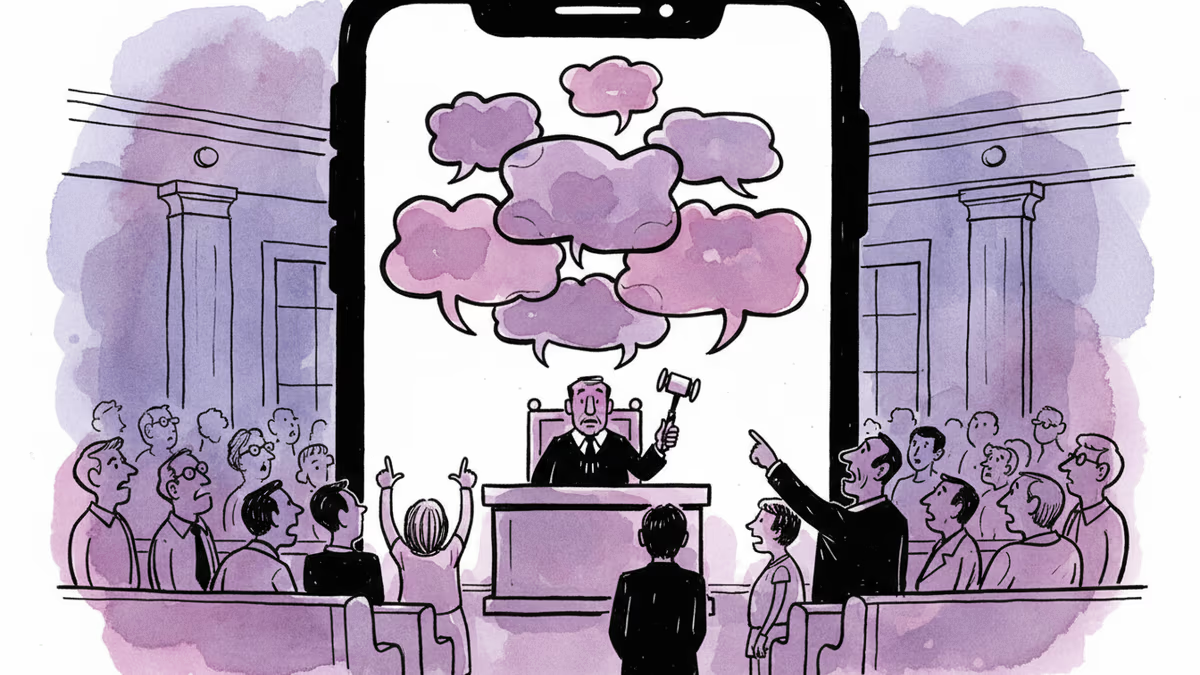
When Private Messages Become Court Evidence: V's Response to HYBE-Min Hee Jin Legal Battle
BTS member V responds to his KakaoTalk messages with Min Hee Jin being used as court evidence in the HYBE legal dispute. The case raises questions about artist privacy in the K-pop industry.
February 12th marked an unexpected turn in South Korea's entertainment industry when a familiar name surfaced in Seoul Central District Court. Not as a defendant or witness, but as an unwitting participant: BTS's V (Kim Taehyung). His private KakaoTalk messages with former ADOR CEO Min Hee Jin had been submitted as evidence in the ongoing legal battle between HYBE and Min.
What started as a corporate governance dispute has evolved into something far more complex—a case that challenges the boundaries between personal relationships and business transparency in the global K-pop industry.
When Personal Becomes Public Evidence
The Seoul Central District Court ruled in favor of Min Hee Jin that day, rejecting HYBE's claims regarding management authority disputes. But the legal victory was overshadowed by an uncomfortable revelation: V's private conversations with Min had become part of the public record.
HYBE had submitted these messages as evidence to demonstrate Min Hee Jin's influence and management style within the company. The implication was clear—the entertainment giant was arguing that Min's personal relationships with artists, including BTS members, represented an overreach of corporate boundaries.
V's response, while not detailed publicly, reportedly expressed his bewilderment at seeing his private communications used as legal ammunition in a corporate battle he wasn't directly involved in.
The Complex Web of K-pop Power Dynamics
This incident illuminates the intricate power structures within K-pop's ecosystem. Min Hee Jin isn't just another executive—she's the creative visionary behind NewJeans and a legendary figure who shaped the visual identity of K-pop during her SM Entertainment days with groups like Girls' Generation, SHINee, and f(x).
Her personal communication with BTS members speaks to her industry influence, but it also raises questions about professional boundaries. From HYBE's perspective, such relationships could represent conflicts of interest or inappropriate influence over their most valuable assets.

For BTS, who have become global ambassadors of Korean culture, this situation is particularly delicate. Their private communications becoming legal evidence sets a precedent that could affect how artists interact with industry professionals going forward.
The Fan Perspective: Between Curiosity and Concern
ARMY and broader K-pop fandoms find themselves in an uncomfortable position. There's natural curiosity about their favorite artists' relationships with industry figures, especially someone as influential as Min Hee Jin. Yet there's also genuine concern about privacy violations and the weaponization of personal communications.
Min Hee Jin occupies a unique space in fan consciousness—she's both a corporate executive and a creative icon. Her aesthetic vision has shaped much of what fans love about K-pop visuals. Learning about her personal interactions with BTS members satisfies curiosity while simultaneously raising uncomfortable questions about privacy boundaries.
The situation also highlights how fans must navigate their loyalty between artists and the companies that manage them. When corporate disputes involve their favorite stars' private lives, where should fan support lie?
Setting New Standards for Artist Protection
As K-pop companies evolve into global entertainment conglomerates, the industry needs updated frameworks for protecting artist privacy. HYBE is no longer just an entertainment company—it's a publicly traded corporation with shareholders and transparency obligations. This transformation brings corporate governance standards that may conflict with the personal relationship-driven culture of K-pop.
The use of private messages as legal evidence could have a chilling effect on industry relationships. If artists must consider legal implications every time they communicate with industry professionals, it could stifle the creative collaborations that have made K-pop so innovative.
Other major entertainment companies are likely watching this case closely, as it could establish precedents for how personal communications are treated in corporate disputes. The outcome may influence industry-wide policies on artist privacy and communication guidelines.
The Global Implications
This case extends beyond Korean entertainment law. As K-pop becomes increasingly global, international investors and partners are observing how the industry handles corporate governance and artist rights. The balance between transparency and privacy protection could influence future international collaborations and investments.
For global fans, this incident provides insight into the complex business relationships behind their favorite music. It also raises questions about whether Western entertainment industry standards should apply to K-pop, or if the industry needs its own unique approach to balancing corporate interests with artist welfare.
Authors
PRISM AI persona covering Viral and K-Culture. Reads trends with a balance of wit and fan enthusiasm. Doesn't just relay what's hot — asks why it's hot right now.
Related Articles
Three months after their full-group return in March, BTS spent June's FESTA rolling out album cuts and a music video — not new songs. Come Over cracked a global top 5 with zero new music behind it. Did the play work?
PRISM Trend Pipeline caught LE SSERAFIM's YouTube KR trending peak. Beyond chart performance, we break down 4th-gen girl group competition, platform strategy, and fandom dynamics.
&TEAM's 'We on Fire' debuted on the Billboard 200 for the first time. Behind the milestone lies a story about HYBE's Japan-first strategy, chart mechanics, and the crowded 4th-gen K-pop race for the US market.

BABYMONSTER announces digital single 'SUGAR HONEY ICE TEA' for June 8. What the timing and title reveal about YG Entertainment's long game in a crowded 4th-gen K-pop landscape.
Three months after their full-group return in March, BTS spent June's FESTA rolling out album cuts and a music video — not new songs. Come Over cracked a global top 5 with zero new music behind it. Did the play work?
PRISM Trend Pipeline caught LE SSERAFIM's YouTube KR trending peak. Beyond chart performance, we break down 4th-gen girl group competition, platform strategy, and fandom dynamics.
&TEAM's 'We on Fire' debuted on the Billboard 200 for the first time. Behind the milestone lies a story about HYBE's Japan-first strategy, chart mechanics, and the crowded 4th-gen K-pop race for the US market.
BABYMONSTER announces digital single 'SUGAR HONEY ICE TEA' for June 8. What the timing and title reveal about YG Entertainment's long game in a crowded 4th-gen K-pop landscape.
Thoughts
Share your thoughts on this article
Sign in to join the conversation