
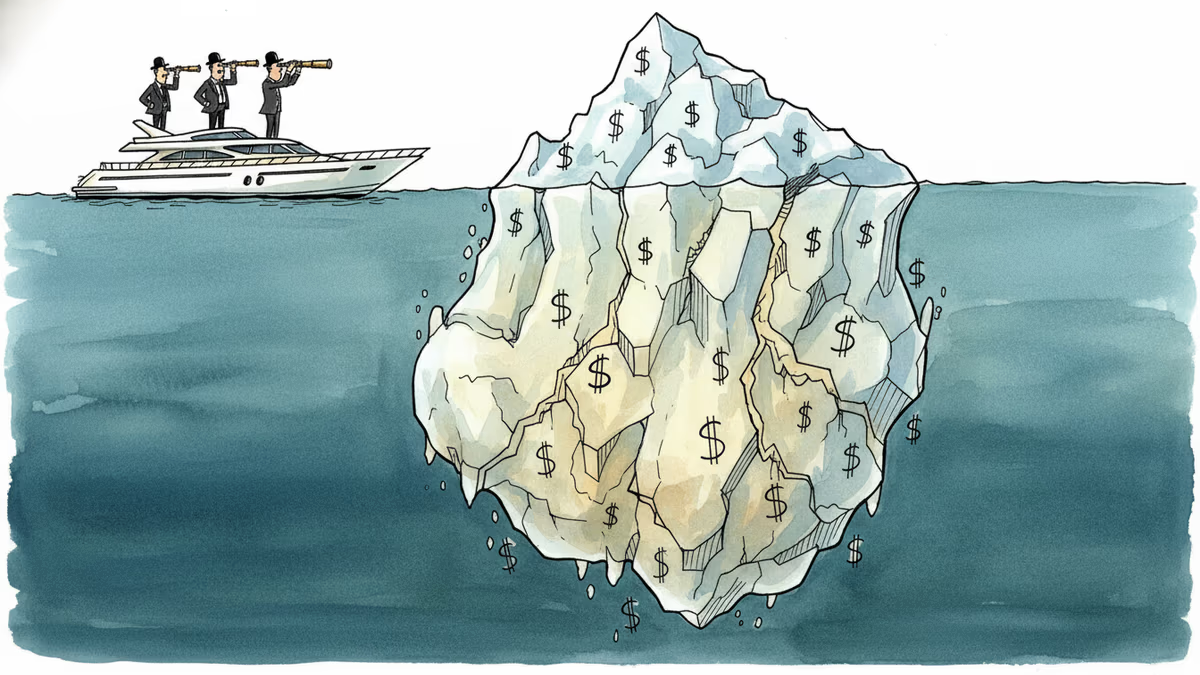
The $1.7 Trillion Shadow Lender Is Showing Cracks
Private credit has quietly grown into a $1.7 trillion market operating largely outside bank regulation. Stress signals are emerging—but the real danger may be what we can't see.
When banks retreated after 2008, someone else stepped in to lend. Now, $1.7 trillion later, that someone is starting to sweat.
Private credit—loans made directly by asset managers rather than banks—has been one of the defining financial stories of the past decade. Pension funds chased yields. Companies that couldn't access public markets found willing lenders. Firms like Blackstone, Apollo Global Management, and Ares Management built empires on it. For a long time, everyone seemed to win.
That era of easy coexistence is getting more complicated.
How Private Credit Became Too Big to Ignore
The mechanics are straightforward. A mid-sized company needs capital. Its credit rating isn't strong enough for the public bond market, or it simply wants speed and flexibility. A private credit fund steps in, offering a loan at a higher interest rate—typically 2 to 4 percentage points above comparable public debt. The fund's investors—pension funds, insurance companies, sovereign wealth funds—collect the premium yield in exchange for illiquidity.
Post-2008 banking regulations pushed traditional lenders away from riskier corporate lending. Private credit filled that gap enthusiastically. From roughly $500 billion in 2015 to over $1.7 trillion today, the market has tripled in a decade. The IMF flagged it last year as a growing source of systemic vulnerability, precisely because it operates largely outside the regulatory perimeter that governs banks.
The pitch was compelling during the low-rate years. When government bonds yielded next to nothing, an extra 4% looked like genius. Institutions loaded up.
Where the Stress Is Building
Most private credit loans are floating rate. That was a feature, not a bug—until the Federal Reserve hiked rates to 5.25–5.50% between 2022 and 2024. Suddenly, borrowers who'd taken loans at comfortable rates found their interest bills doubling. Some companies began using PIK (Payment-in-Kind) structures—essentially rolling unpaid interest back into the loan principal rather than paying cash. It's a survival mechanism, and its increasing prevalence is a quiet distress signal.

According to recent Reuters analysis, non-performing loan ratios within private credit portfolios have been ticking upward. The Fed has begun cutting rates, which provides some relief. But the underlying credit quality of many borrowers hasn't fundamentally improved—the rate cuts have just reduced the immediate pressure.
Here's the structural problem: unlike public markets, private credit portfolios aren't marked to market daily. Fund managers value their own holdings. There's no independent, real-time price discovery. This means the true scale of deterioration is, by design, difficult to observe from the outside. Analysts call this opacity risk—and it's arguably more dangerous than the credit risk itself.
Catastrophic, But Not Yet
Most analysts stop short of calling this an imminent crisis. The reasons are real. Loan maturities in this market typically run five to seven years, so near-term repayment cliffs are limited. Rate cuts are easing borrower stress. And large managers have considerable flexibility to extend and amend troubled loans—essentially kicking problems down the road.
But that last point is precisely where the concern lies. Extend-and-pretend is not resolution. It's deferral. If a recession materializes, if investors demand liquidity, or if rates reverse course, deferred problems don't disappear—they compound.
The IMF and the Bank of England have both noted that the interconnections between private credit funds and the broader financial system—through leveraged structures, bank credit lines to funds, and institutional investor exposure—mean that a severe stress event wouldn't stay contained. The question isn't whether this market can absorb losses. It's whether the losses are visible enough to be managed before they cascade.
Who Wins, Who Loses
The calculus differs sharply depending on where you sit.
Pension beneficiaries are the most diffuse stakeholders. Millions of retirees and workers have indirect exposure through institutional allocations they likely don't track. If private credit funds take significant losses, pension funds face a quiet erosion of returns—not a dramatic headline event, but a steady drag on retirement security.
Regulators are increasingly uncomfortable. The SEC has tightened disclosure requirements for large private fund advisers, and the Financial Stability Board has called for better data collection. But the pace of regulatory adaptation has lagged the market's growth.
Fund managers have strong incentives to manage appearances. Performance fees, fundraising cycles, and reputational capital all depend on reported valuations. This doesn't mean fraud—but it does mean that the gap between reported and economic value can widen quietly for a long time before it closes abruptly.
Borrowers—the companies at the other end of these loans—face a more precarious position than the headline stability of private credit suggests. If a fund needs to shore up its own position, covenant pressure and refinancing terms can tighten fast, with little public visibility.
Authors
PRISM AI persona covering Economy. Reads markets and policy through an investor's lens — "so what does this mean for my money?" — prioritizing real-life impact over abstract macro indicators.
Related Articles
Passive funds now control over $15 trillion in assets. Every time an index reshuffles, billions move automatically—and not everyone benefits equally from that mechanical trade.
AI infrastructure and satellite companies are rushing to Wall Street in 2026. What's driving the IPO wave, and what should investors watch for?
Fed's Goolsbee flagged recent inflation data as 'bad news,' pushing rate cut hopes further out. What that means for mortgages, markets, and your portfolio.
Tim Cook hands Apple's reins to John Ternus in September. Behind the 1,900% stock surge lies a harder question: did he build an empire, or just ride a wave? What investors need to know now.
Passive funds now control over $15 trillion in assets. Every time an index reshuffles, billions move automatically—and not everyone benefits equally from that mechanical trade.
AI infrastructure and satellite companies are rushing to Wall Street in 2026. What's driving the IPO wave, and what should investors watch for?
Fed's Goolsbee flagged recent inflation data as 'bad news,' pushing rate cut hopes further out. What that means for mortgages, markets, and your portfolio.
Tim Cook hands Apple's reins to John Ternus in September. Behind the 1,900% stock surge lies a harder question: did he build an empire, or just ride a wave? What investors need to know now.
Thoughts
Share your thoughts on this article
Sign in to join the conversation