
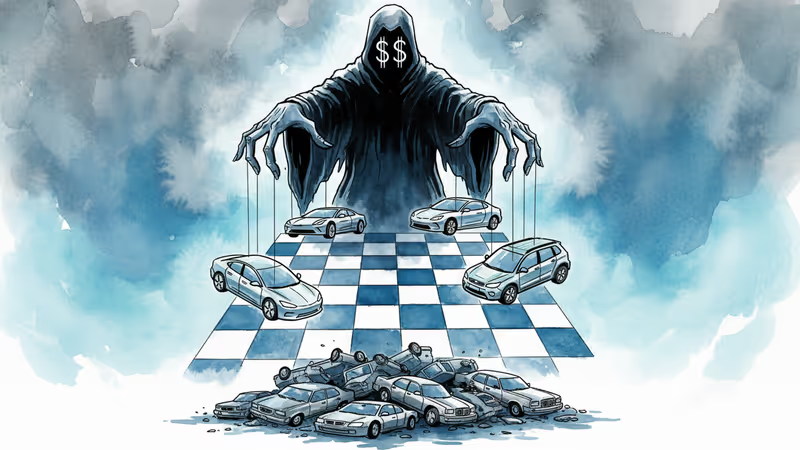
Epstein's Electric Dreams: The Hidden EV Investment Web
Newly released DOJ documents reveal Jeffrey Epstein's attempts to invest in Lucid Motors, Faraday Future, and Canoo through mysterious intermediary David Stern.
What if a convicted sex offender had become a major player in the electric vehicle revolution? Newly released Department of Justice documents containing 3 million files related to Jeffrey Epstein reveal his attempts to invest in Lucid Motors, Faraday Future, and Canoo during the height of the EV boom.
The Ghost Behind the Deals
At the center of these investment schemes was David Stern, a German businessman who operated in the shadows of high finance. Known to Epstein as "my China contact" and describing Epstein as "my mentor," Stern served as director of Prince Andrew's Pitch@Palace startup competition—a role that gave him access to emerging companies and wealthy investors.
In 2017, when Lucid Motors was struggling to close its Series D funding round, Stern saw an opportunity. Jia Yueting, founder of rival startup Faraday Future, had quietly amassed around 30% of Lucid's shares and was effectively blocking new investors from entering.
"Ford will likely be lead in $400m Series D in Lucid. Big strategic move," Stern wrote to Epstein. He explained that Jia "has massive cash issues" and needed to "sell now to make payroll for his other business."
The Fire Sale Strategy
Stern's proposal was audacious: create a fund called Monstera to acquire Jia's 32% stake for approximately $300 million—what he called a "fire sale." The plan was to either hold the position or "offload" it when Ford invested.
But the strategy never materialized. Ford ultimately pulled out, and Lucid didn't close its Series D until August 2018, when Saudi Arabia's Public Investment Fund invested more than $1 billion. Faraday Future similarly secured major investment from Chinese real estate conglomerate Evergrande in late 2017.
The documents show Stern also pitched investments in other EV startups. When former BMW and Deutsche Bank CFO Stefan Krause left Faraday Future to start Canoo (initially called Evelozcity), Stern became one of the original backers with a $1 million investment.

A Decade of Dubious Deals
The Epstein-Stern relationship began in 2008—just one month before Epstein pleaded guilty to soliciting a minor for prostitution. Stern initially approached Epstein about investing in AGC Capital, a fund designed to capitalize on China's economic boom.
Their early interactions were tense. Epstein once berated Stern for inadequate preparation: "If you want to do real deals you have to be precise and careful, every error is a fortune. Your first grade is an F."
Yet the relationship deepened over time. By 2016, Stern felt comfortable asking Epstein to become godfather to one of his children. Epstein declined, saying he was "flattered" but had promised his goddaughter he wouldn't take on the role for anyone else.
The Name-Dropping Game
Stern consistently leveraged his claimed connections to high-profile figures. He boasted of dinners with Jack Ma, planned meetings with UAE President Mohamed bin Zayed Al Nahyan, and claimed friendship with former Chinese President Jiang Zemin's grandson.
The pair explored various investment opportunities beyond electric vehicles: attempting to buy Luxembourg-based private bank Sal. Oppenheim, discussing a 2016 buyout of Deutsche Bank, considering Russian farmland purchases, and exploring the acquisition of news organization Al-Jazeera.
Most of these ventures appear to have failed. Epstein stated in 2018 that he had no "direct" or "indirect" interest in Canoo, and there's little evidence of successful investments in the other companies.
The Broader Implications
These revelations highlight the murky world of startup funding during the EV boom. Desperate for capital, companies like Lucid and Faraday Future found themselves entangled with questionable financial intermediaries who promised access to deep-pocketed investors.
The documents also reveal how Stern used his royal connections—particularly his relationship with Prince Andrew—to legitimize his business activities. Photos show him seated next to Queen Elizabeth II at Pitch@Palace events, lending credibility to his investment pitches.
Authors
Related Articles
Waymo's new Ojai robotaxi isn't just a vehicle upgrade. It's the company's most serious attempt yet at cracking the cost problem that has kept autonomous vehicles from scaling. Here's what's really at stake.
Mercedes-AMG's new GT 4-door coupe packs three YASA axial flux motors producing 1,153 hp and 1,475 lb-ft of torque. Here's what it means for the EV performance race—and who actually wins.
Auto China 2026 set records with 1,451 vehicles and 181 world premieres. But the real story isn't the size—it's how Chinese automakers stopped competing on price and started competing on brains.
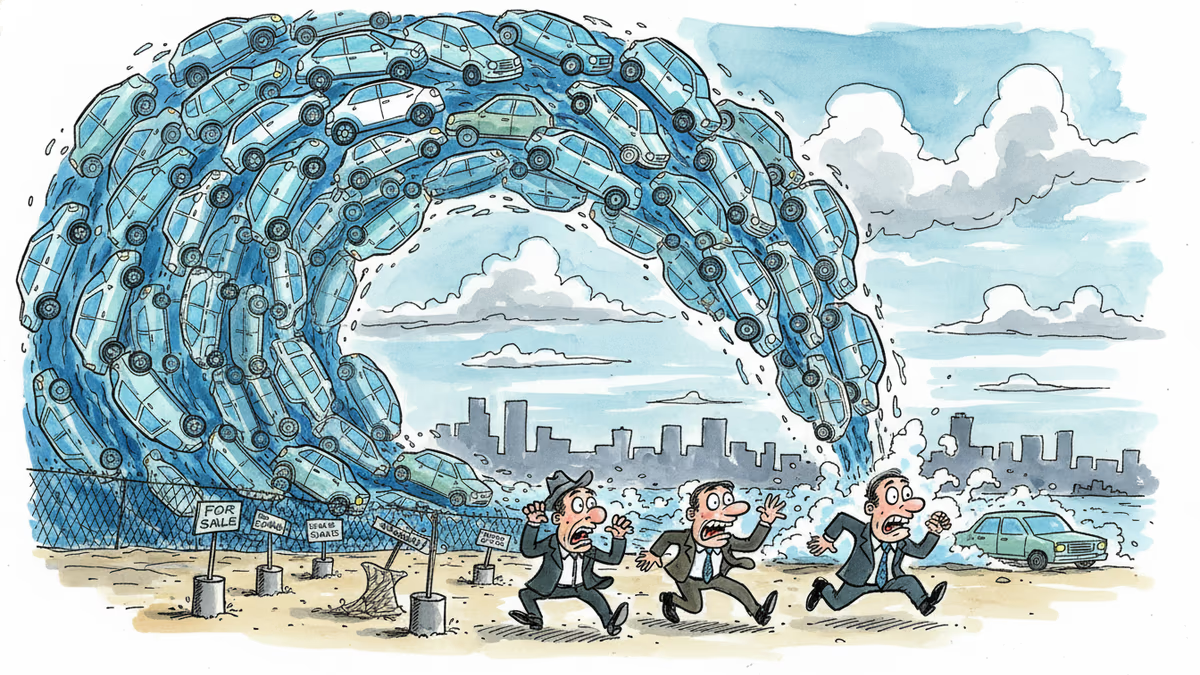
Expiring leases will flood the US used car market with over a million electric vehicles by 2028. Could this do what subsidies couldn't — make EVs genuinely affordable?
Waymo's new Ojai robotaxi isn't just a vehicle upgrade. It's the company's most serious attempt yet at cracking the cost problem that has kept autonomous vehicles from scaling. Here's what's really at stake.
Mercedes-AMG's new GT 4-door coupe packs three YASA axial flux motors producing 1,153 hp and 1,475 lb-ft of torque. Here's what it means for the EV performance race—and who actually wins.
Auto China 2026 set records with 1,451 vehicles and 181 world premieres. But the real story isn't the size—it's how Chinese automakers stopped competing on price and started competing on brains.
Expiring leases will flood the US used car market with over a million electric vehicles by 2028. Could this do what subsidies couldn't — make EVs genuinely affordable?
Thoughts
Share your thoughts on this article
Sign in to join the conversation