
The Robotaxi Price War Has Quietly Begun
Waymo cuts prices while Uber and Lyft raise theirs, narrowing the cost gap for autonomous rides. Tesla's entry could reshape the entire market dynamics.
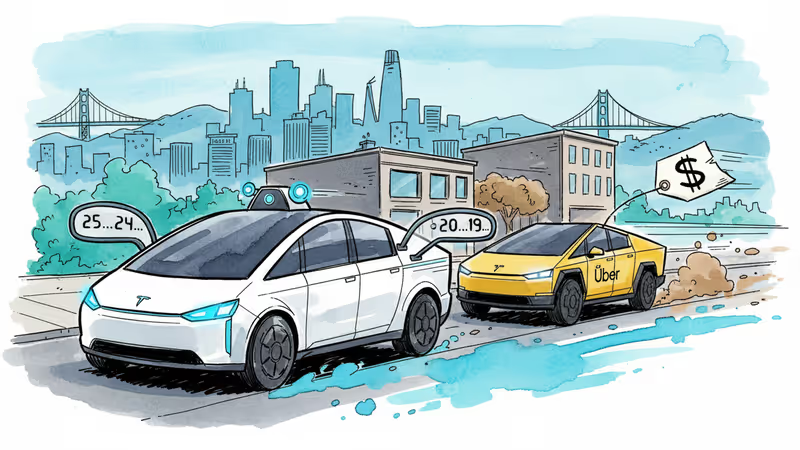
A Waymo robotaxi ride in San Francisco now costs $19.69 on average. An Uber runs $17.47, and Lyft comes in at $15.47. The autonomous option still costs more, but that premium is shrinking fast—and the reasons reveal something bigger about where this market is heading.
Obi, a company that tracks real-time pricing across ride-hailing services, analyzed over 94,000 simulated ride requests in the Bay Area between November 27 and January 1. The data shows two forces working in tandem: Waymo is cutting prices while traditional ride-hailing services are raising theirs.
Compare this to last April, and the shift becomes stark. Waymo's average fare dropped 3.6% from $20.43, while Uber's jumped 12% from $15.58 and Lyft's climbed 7% from $14.44.
The Novelty Is Wearing Off
"The novelty is wearing off for people in the Bay Area," Obi CEO Ashwini Anburajan told TechCrunch. What started as curiosity-driven demand—people willing to pay extra for the experience of riding in a driverless car—is evolving into utility-focused decision making.
This shift forces Waymo into more competitive pricing, even as traditional ride-hailing faces its own pressures. Driver shortages and rising labor costs are pushing Uber and Lyft to offer higher incentives to attract drivers, costs that inevitably get passed to consumers.
The convergence suggests we're witnessing the transition from "autonomous vehicles as novelty" to "autonomous vehicles as transportation." And that changes everything about how these companies compete.
Tesla's Wild Card Entry
The most intriguing data point involves Tesla, which appears to be offering significantly cheaper rides than all three established players. But there's a catch—several, actually.
Tesla doesn't have permits to operate a driverless commercial robotaxi service in California. Instead, it uses employees to drive Tesla vehicles equipped with Full Self-Driving software. It's ride-hailing, but not robotaxis in the technical sense.
The fleet is also tiny—around 168 vehicles in the Bay Area according to crowdsourced data, with only 156 active during Obi's sampling period. This limited supply drives wait times to 15.32 minutes on average, compared to Waymo's 5.74 minutes and Uber's 3.15 minutes.

Yet Tesla's approach hints at future potential. If the company can scale autonomous operations using only cameras—avoiding Waymo's expensive lidar and sensor arrays—it could theoretically undercut everyone on price.
The Brand Preference Battle
Perhaps more telling than current pricing is future demand. Obi surveyed 2,000 people across California, Nevada, Arizona, and Texas about autonomous vehicle preferences. Over half of respondents who'd taken an autonomous ride had used Tesla's service.
When asked which autonomous brand they preferred, Waymo led with 39.8%, but Tesla wasn't far behind at 31%—remarkable for a company not yet operating true robotaxis at scale.
The gender split reveals something deeper about Tesla's appeal. Women were essentially split between Waymo and Tesla, but 56% of men preferred Tesla versus just 25% for Waymo. Brand power, it seems, might matter as much as technology.
The Bigger Picture
This data arrives at a pivotal moment for autonomous vehicles. Waymo is rapidly expanding to new cities, often partnering with Uber and Lyft. Those same platforms are bringing other autonomous partners online. Hyundai-backed Motional plans to launch commercial robotaxi service in Las Vegas this year.
Meanwhile, Waymo is preparing to deploy new van-like vehicles built with Chinese company Zeekr. These "Ojai" vehicles should cost less upfront and could enable more aggressive pricing.
"It's still very early in the game, so no one's a late entrant," Anburajan notes. "We're in this new era, so who's gonna capture market share and move fast to win consumers over?"
The question isn't just about technology anymore. As prices converge and options multiply, success will depend on execution across multiple dimensions: fleet economics, user experience, brand appeal, and operational efficiency.
What This Means for Consumers
For riders, the narrowing price gap suggests autonomous vehicles are moving from premium novelty to mainstream option. But the transition won't be uniform across markets or use cases.
Urban areas with high labor costs and parking constraints favor autonomous solutions. Suburban and rural markets, where human drivers face fewer operational challenges, might see slower adoption.
The Tesla factor adds another variable. If the company can deliver on its camera-only autonomous driving promises while leveraging its brand appeal, it could accelerate market adoption—or create unrealistic expectations that set back the entire industry.
Authors
Related Articles
Waymo's new Ojai robotaxi isn't just a vehicle upgrade. It's the company's most serious attempt yet at cracking the cost problem that has kept autonomous vehicles from scaling. Here's what's really at stake.
Elon Musk confirmed on Tesla's Q1 2026 earnings call that Hardware 3 vehicles will never receive unsupervised Full Self-Driving — locking out millions who paid for the feature.
Tesla expanded its driverless robotaxi to Dallas and Houston, even after reporting 14 crashes in Austin. What does this tell us about how autonomous vehicles actually get built?
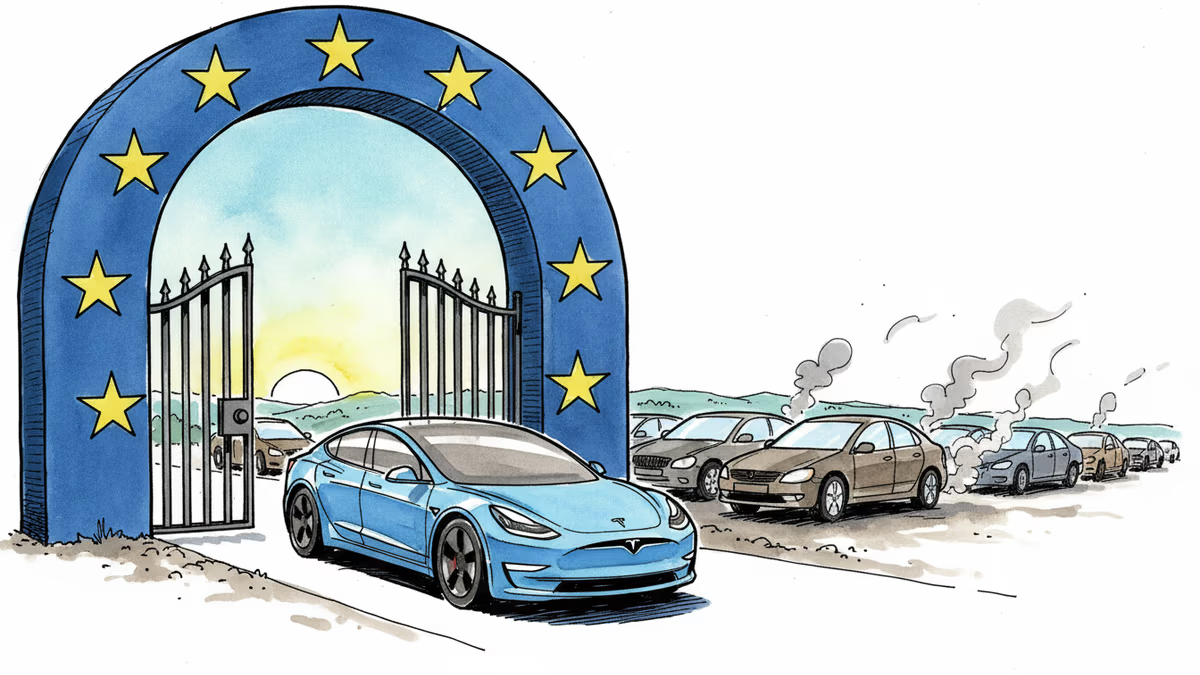
The Netherlands became the first European country to officially approve Tesla's FSD Supervised. With EU's type-approval framework, this could ripple across 27 member states fast.
Waymo's new Ojai robotaxi isn't just a vehicle upgrade. It's the company's most serious attempt yet at cracking the cost problem that has kept autonomous vehicles from scaling. Here's what's really at stake.
Elon Musk confirmed on Tesla's Q1 2026 earnings call that Hardware 3 vehicles will never receive unsupervised Full Self-Driving — locking out millions who paid for the feature.
Tesla expanded its driverless robotaxi to Dallas and Houston, even after reporting 14 crashes in Austin. What does this tell us about how autonomous vehicles actually get built?
The Netherlands became the first European country to officially approve Tesla's FSD Supervised. With EU's type-approval framework, this could ripple across 27 member states fast.
Thoughts
Share your thoughts on this article
Sign in to join the conversation