
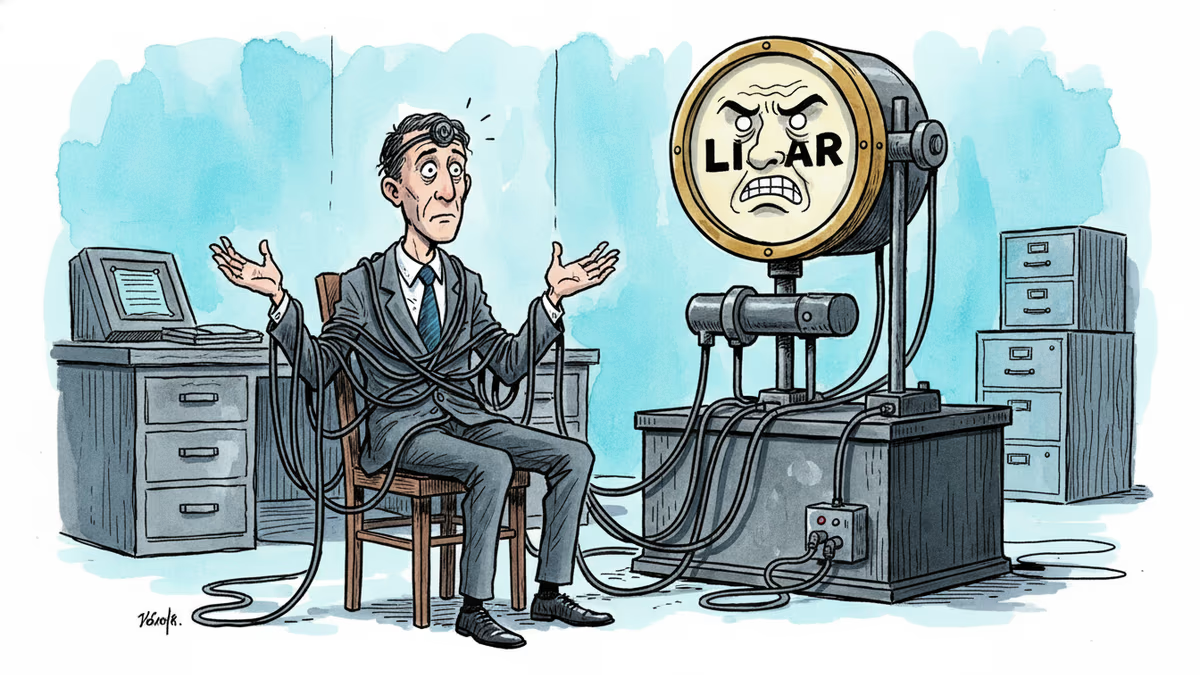
The Machine Said He Was Lying. He Wasn't.
George Maschke passed 11 years of military security clearance, then failed an FBI polygraph. Decades later, the science still doesn't support the test—so why do agencies keep using it?
He'd Held a Security Clearance for 11 Years. A Machine Ended His FBI Career in an Afternoon.
When George W. Maschke walked into an FBI polygraph examination room in the spring of 1995, he had already cleared one of the most rigorous trust filters the U.S. government runs: 11 consecutive years of military security clearance. The Army had decided, repeatedly, that he was someone worth trusting with secrets.
The polygraph examiner reached a different conclusion. According to Maschke's account, the machine—measuring his heart rate, breathing, blood pressure, and skin conductivity—flagged him as deceptive on two counts: whether he would protect classified information, and whether he had undisclosed contacts with foreign intelligence agencies. He says he told the truth. The machine said otherwise. His FBI application was rejected.
Maschke went on to become one of the most prominent critics of polygraph testing in the United States, running a website dedicated to exposing what he calls the test's fundamental scientific failures. His story is a useful entry point into a debate that has never really been resolved—and is becoming newly relevant as governments and corporations reach for ever more sophisticated tools to judge human honesty.
What the Machine Actually Measures
The polygraph doesn't detect lies. That's not a fringe position—it's the conclusion of the National Academy of Sciences, which reviewed the evidence in 2003 and found the scientific basis for polygraph accuracy to be insufficient for high-stakes security screening.
What the machine actually measures is physiological arousal: the body's stress response. The assumption baked into every polygraph examination is that lying produces a distinctive and detectable physical signature. But anxiety, fear, and the sheer stress of being interrogated produce the same signature. A nervous innocent person and a calm, practiced deceiver can produce results that the machine interprets in exactly the wrong direction.
The error rates matter enormously here. Studies suggest false positive rates—flagging truthful people as deceptive—can run anywhere from 10% to 40% depending on methodology and examiner. For an agency screening thousands of applicants, that's not a rounding error. That's a systematic filter that may be removing some of the most conscientious, anxiety-prone candidates while waving through those with the psychological profile to lie without flinching.

So Why Does It Survive?
The FBI, CIA, NSA, and dozens of other federal agencies still require polygraph examinations for sensitive positions. Courts won't admit the results as evidence—the legal system made that call long ago. But polygraphs remain gatekeepers for employment and security clearances, affecting the careers of tens of thousands of people each year.
The agencies aren't unaware of the science. They have a different argument: the polygraph works not because it's accurate, but because it's psychologically coercive. The mere existence of the test, they argue, deters applicants with things to hide and sometimes prompts pre- or post-test confessions. In this framing, the machine is less a truth detector than an interrogation prop—a way of signaling that the government is watching and that lies carry consequences.
This is a more defensible position than claiming the polygraph is scientifically valid. But it also reveals the test's deepest problem. If the machine's value lies in the fear it generates, then it punishes fear itself. And fear is not guilt.
The Broader Stakes: Who Gets to Judge Honesty?
Maschke's story is 30 years old, but the question it raises has never been more current. The polygraph is, in a sense, the original algorithmic judge—a machine given authority to render verdicts on human character, with limited transparency, limited accountability, and limited recourse for those it gets wrong.
Today, that template has been replicated across hiring, lending, law enforcement, and border control. AI-powered interview analysis tools claim to detect deception through micro-expressions and vocal patterns. Predictive policing algorithms flag individuals as high-risk based on behavioral proxies. Credit scoring systems make consequential judgments about people's futures based on statistical correlations they can't fully interrogate or contest.
The polygraph debate is, at its core, a debate about what happens when we outsource judgment to machines—and whether the humans whose lives are affected retain any meaningful ability to challenge the verdict. In Maschke's case, the answer was effectively no. He could assert his innocence, but he couldn't cross-examine the machine.
For civil liberties advocates, the concern is structural: once an institution adopts a technology as a screening tool, the burden of proof shifts onto the individual to disprove what the machine concluded. That inversion—guilty until the algorithm is satisfied—is worth examining carefully as newer, more opaque systems take the polygraph's place.
Authors
Related Articles
FBI surveillance systems breached, North Korea steals $280M in crypto, Claude Code leaks malware, and a 22-year-old student helps take down a record botnet. This week in cybersecurity.
FBI Director Kash Patel confirmed the agency purchases Americans' location data from commercial brokers without a warrant. The admission raises urgent questions about the future of the Fourth Amendment.
Court filings reveal an FBI informant co-operated the Incognito dark web marketplace for nearly two years, approving fentanyl sales that led to multiple overdose deaths including a 27-year-old tennis player.
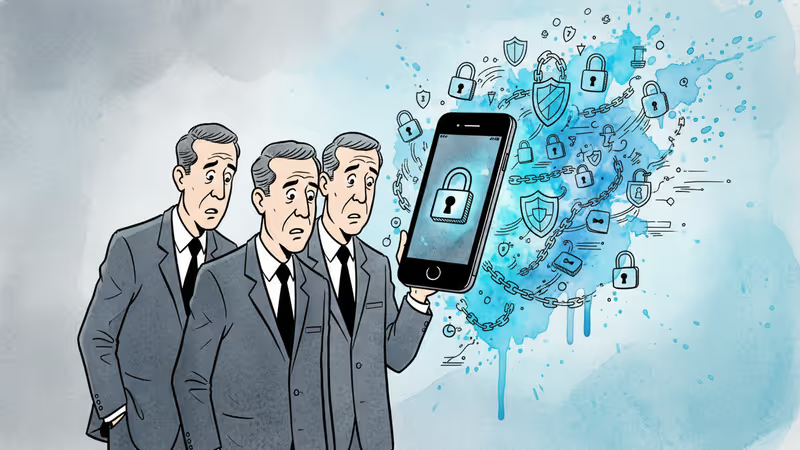
FBI agents couldn't access a Washington Post reporter's iPhone due to Apple's Lockdown Mode during a classified leak investigation, highlighting the growing tension between privacy and law enforcement.
FBI surveillance systems breached, North Korea steals $280M in crypto, Claude Code leaks malware, and a 22-year-old student helps take down a record botnet. This week in cybersecurity.
FBI Director Kash Patel confirmed the agency purchases Americans' location data from commercial brokers without a warrant. The admission raises urgent questions about the future of the Fourth Amendment.
Court filings reveal an FBI informant co-operated the Incognito dark web marketplace for nearly two years, approving fentanyl sales that led to multiple overdose deaths including a 27-year-old tennis player.
FBI agents couldn't access a Washington Post reporter's iPhone due to Apple's Lockdown Mode during a classified leak investigation, highlighting the growing tension between privacy and law enforcement.
Thoughts
Share your thoughts on this article
Sign in to join the conversation