
Why the Plaud Note Pro AI recorder 2025 is Outpacing the Wearable Competition
Plaud Note Pro AI recorder 2025 has shipped over 1 million units. Discover how this ultra-thin, $179 device is succeeding where other AI wearables have failed.
The graveyard of AI wearables is filling up fast, but one device is carving out a massive niche for itself. While gadgets like Omi and Friend struggle to find a purpose, the Plaud Note Pro has quietly become a productivity powerhouse for professionals. It's not trying to replace your phone—it's just making your meetings easier to manage.
Plaud Note Pro AI recorder 2025: Utility Over Hype
According to Reuters, Plaud has already shipped over 1 million units. What's even more impressive is that over 50% of its users have converted to paid pro subscriptions. At $179, the device offers a specific value proposition that general-purpose AI pins have failed to deliver.
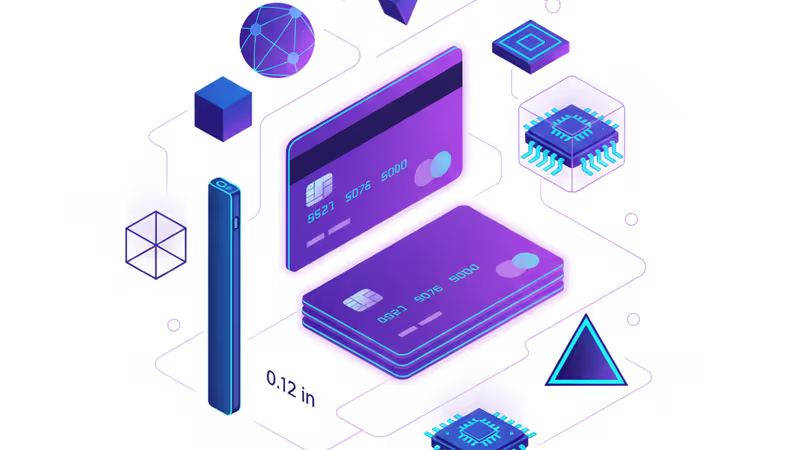
At just 0.12 inches thick—roughly the width of three stacked credit cards—the Note Pro is the thinnest AI recorder on the market. It weighs only 30 grams, making it effortless to carry in a wallet or magnetically attach to an iPhone via MagSafe.

Designed for the Professional Workflow
Unlike many competitors, the Note Pro doesn't rely on a constant phone connection. With 64GB of onboard memory, it records and stores audio locally. Its array of 4 MEMS microphones provides a range of 16.4 feet, coupled with a dedicated voice processing unit for noise isolation and echo cancellation.
Battery life is equally outstanding. A single charge delivers 30 hours of continuous recording and 60 days of standby. For a typical user, this means the device can last weeks without needing a plug.
Authors
Related Articles
Two ex-Apple engineers built an AI puck that only listens when you press it. At $179, Button is a deliberate bet that dedicated AI hardware beats the Swiss Army knife approach of smartphones.

A South Korean startup called Absolics is betting that glass substrates can cut AI chip energy consumption. Here's why that matters beyond the data center.

A material humans have shaped for thousands of years is about to become the backbone of next-gen AI chips. Here's why the semiconductor industry is betting on glass—and what's at stake.

Apple's new MacBook Pro prices jump up to $400 amid RAM shortages. What this means for the tech industry's AI ambitions and consumer wallets.
Two ex-Apple engineers built an AI puck that only listens when you press it. At $179, Button is a deliberate bet that dedicated AI hardware beats the Swiss Army knife approach of smartphones.
A South Korean startup called Absolics is betting that glass substrates can cut AI chip energy consumption. Here's why that matters beyond the data center.
A material humans have shaped for thousands of years is about to become the backbone of next-gen AI chips. Here's why the semiconductor industry is betting on glass—and what's at stake.
Apple's new MacBook Pro prices jump up to $400 amid RAM shortages. What this means for the tech industry's AI ambitions and consumer wallets.
Thoughts
Share your thoughts on this article
Sign in to join the conversation