
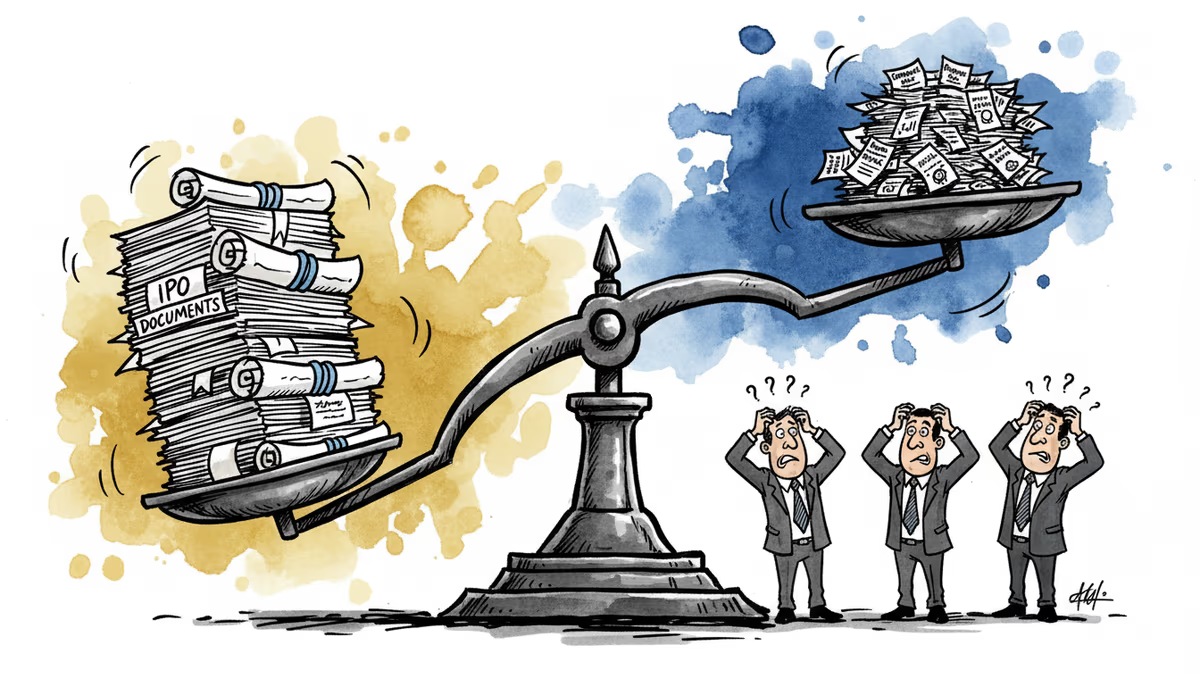
Plaid's $8B Valuation Masks a Deeper Silicon Valley Shift
Plaid's employee share sale at $8B valuation reflects a new trend where private companies avoid IPO pressure through secondary markets, but questions remain about sustainability.
$8 Billion Sounds Great, Until You Do the Math
Plaid just allowed employees to cash out shares at an $8 billion valuation—a 31% jump from last year's $6.1 billion. The fintech darling, which connects apps to bank accounts, confirmed the secondary sale Thursday. But here's what the headline doesn't tell you: Plaid is still worth 40% less than its $13.4 billion peak in 2021.
Welcome to the post-ZIRP reality. When interest rates were near zero, fintech valuations soared on dreams and potential. Now? Reality bites.
The New Retention Playbook
This marks Plaid's second employee liquidity program in under a year. Last April, the 13-year-old company raised $575 million partly for the same purpose: letting employees sell shares and cover tax bills from expiring restricted stock units (RSUs).
It's not just Plaid. Stripe this week enabled employee sales at a staggering $159 billion valuation. Clay, ElevenLabs, and Linear have similar programs running. The pattern is clear: secondary sales have become Silicon Valley's new retention tool.
"Companies can't afford to lose talent over illiquid equity," explains a venture capital partner who requested anonymity. "When RSUs vest and employees face massive tax bills with no way to sell, they walk."
IPO Pressure? What IPO Pressure?

Plaid has been around for 13 years and explicitly stated it won't go public in 2025. That would've been unthinkable a decade ago, when IPO was the only exit strategy that mattered.
Now? Companies are discovering they can have their cake and eat it too. Avoid public market scrutiny while providing liquidity to stakeholders. No quarterly earnings calls, no activist investors, no regulatory headaches.
But there's a catch.
The Sustainability Question
Secondary markets work when there's demand from institutional investors betting on future growth. But what happens when that demand dries up? Or when employees realize their equity is perpetually illiquid compared to public company stock?
Stripe's$159 billion valuation, for instance, makes it worth more than Goldman Sachs and Morgan Stanley combined. Can private markets really support such valuations indefinitely?
Some warn we're creating a two-tier system: public companies with transparent pricing and private "unicorns" with valuations that exist mainly on paper.
The Broader Fintech Reality Check
Plaid's story mirrors the entire fintech sector's journey from euphoria to pragmatism. The company processes financial data for millions of Americans through apps like Venmo and Robinhood. It's real revenue, real customers, real utility.
Yet its valuation rollercoaster reflects how dramatically investor sentiment has shifted. In 2021, fintech was the future. In 2026, it's just another business that needs to prove profitability.
Authors
Related Articles
Despite fierce competition, the CEOs of Polymarket and Kalshi have co-invested in 5(c) Capital, a $35M VC fund targeting prediction market infrastructure. What this signals for the industry.
A class action lawsuit accuses Kalshi of changing payout rules after Iran's Supreme Leader Khamenei was killed. The case cuts to the heart of prediction market credibility.

A massive dispute over Iran's supreme leader prediction market exposes the dark side of betting on world events. How Kalshi's rule interpretation sparked trader revolt.
Iran bombing predictions drew $529M in bets, raising insider trading concerns. Exploring the ethical dilemmas of prediction markets in conflict zones.
Despite fierce competition, the CEOs of Polymarket and Kalshi have co-invested in 5(c) Capital, a $35M VC fund targeting prediction market infrastructure. What this signals for the industry.
A class action lawsuit accuses Kalshi of changing payout rules after Iran's Supreme Leader Khamenei was killed. The case cuts to the heart of prediction market credibility.
A massive dispute over Iran's supreme leader prediction market exposes the dark side of betting on world events. How Kalshi's rule interpretation sparked trader revolt.
Iran bombing predictions drew $529M in bets, raising insider trading concerns. Exploring the ethical dilemmas of prediction markets in conflict zones.
Thoughts
Share your thoughts on this article
Sign in to join the conversation