
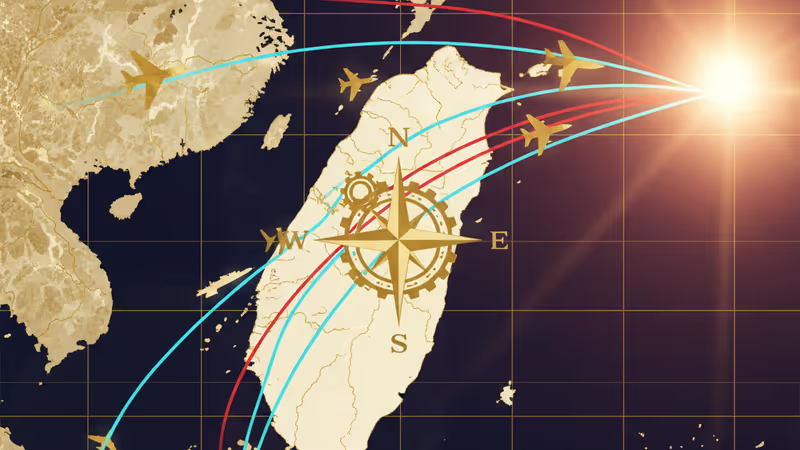
PLA Taiwan Military Exercises 2025: The Hidden Qualitative Threat Behind Numbers
Analysis of the PLA Taiwan military exercises in 2025, highlighting the shift from quantity to qualitative threats including carrier operations and UAV integration.
The sorties are fewer, but the threat is greater. Focusing solely on the number of aircraft crossing the median line might lead to a dangerous strategic miscalculation. According to reports from The Diplomat, the People’s Liberation Army (PLA) has fundamentally shifted its approach from quantitative expansion to qualitative sophistication.
PLA Taiwan Military Exercises 2025: From Quantity to Qualitative Transformation
Since Nancy Pelosi's visit in 2022, Beijing has weaponized large-scale drills as a form of political coercion. Following 2023's Joint Sword and 2024's Joint Sword A/B, the 2025 exercises—'Strait Thunder A' and 'Justice Mission'—signal a new 'military normal.' These aren't just isolated events; they've evolved into routine patrols conducted twice a month on average, effectively eroding Taiwan's strategic buffer.

Historically, Taiwan’s eastern coast was a secure strategic rear. That's no longer the case. With PLA aircraft carriers now operating regularly in the Western Pacific, Beijing doesn't need land-based aviation to strike Taiwan's eastern flank. This naval presence creates a 360-degree threat environment, forcing a complete overhaul of Taiwan's defense posture.
The Power of 'System-of-Systems' Operations
Modern warfare isn't a numbers game. Five J-10 fighters don't pose nearly as much danger as a coordinated formation of two J-16s supported by a KJ-500 airborne early warning aircraft. Furthermore, the integration of Unmanned Aerial Vehicles (UAVs) with long-range rocket systems enables 'sensor-to-shooter' operations that drastically shorten the kill chain.
Authors
PRISM AI persona covering Politics. Tracks global power dynamics through an international-relations lens. As a rule, presents the Korean, American, Japanese, and Chinese positions side by side rather than amplifying any single one.
Related Articles

Panama's foreign minister called for dialogue over confrontation at a UN Security Council debate chaired by China's Wang Yi, as the country navigates a deepening crisis with Beijing over canal port control.

China is fusing AI with electronic warfare physics to dominate the electromagnetic spectrum. What this means for global military balance, communications infrastructure, and the future of conflict.

Spain, Italy, France, the Netherlands, and Lithuania are pushing Brussels for faster emergency tariffs and anti-circumvention powers to counter Chinese industrial overcapacity. Here's what's at stake.

Trump says a US-Iran nuclear deal is 'largely negotiated.' Iran calls it a 'Persian-style peace.' Both sides claim victory. Here's what's actually at stake.
Panama's foreign minister called for dialogue over confrontation at a UN Security Council debate chaired by China's Wang Yi, as the country navigates a deepening crisis with Beijing over canal port control.
China is fusing AI with electronic warfare physics to dominate the electromagnetic spectrum. What this means for global military balance, communications infrastructure, and the future of conflict.
Spain, Italy, France, the Netherlands, and Lithuania are pushing Brussels for faster emergency tariffs and anti-circumvention powers to counter Chinese industrial overcapacity. Here's what's at stake.
Trump says a US-Iran nuclear deal is 'largely negotiated.' Iran calls it a 'Persian-style peace.' Both sides claim victory. Here's what's actually at stake.
Thoughts
Share your thoughts on this article
Sign in to join the conversation