
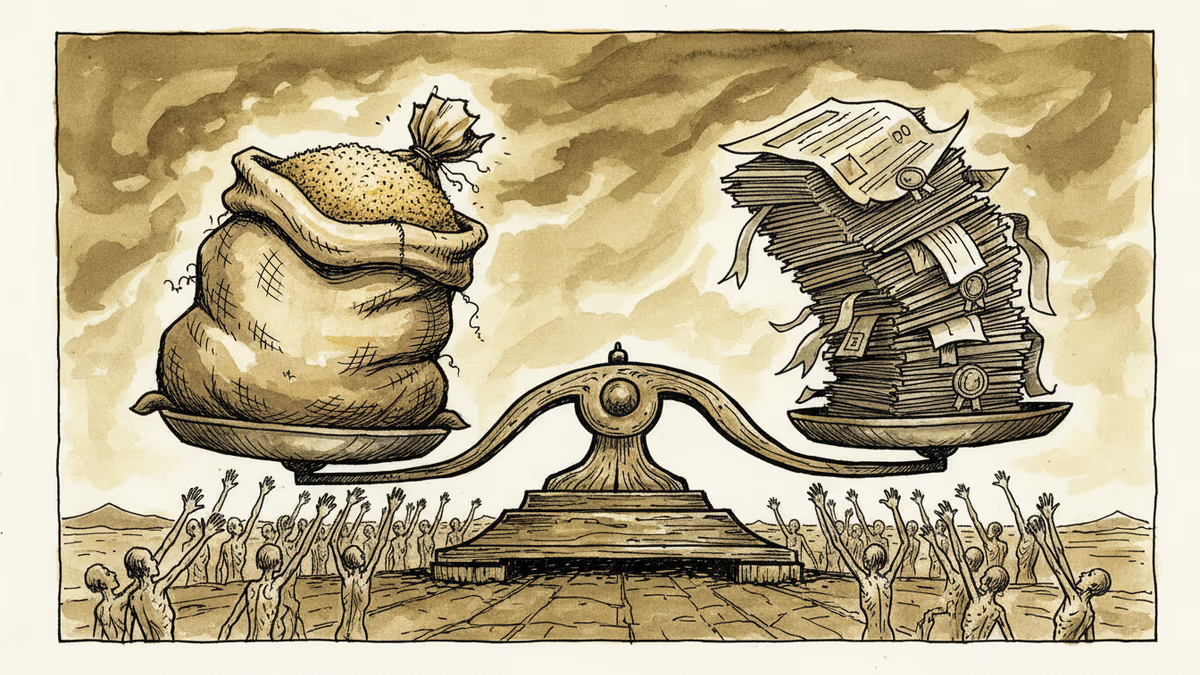
When Aid Stops, Who Goes Hungry?
The UN World Food Programme warns millions more could face acute hunger if aid disruptions continue. Behind the numbers, a hard question about who pays — and who doesn't.
For 733 million people, hunger isn't a headline. It's Tuesday.
The UN World Food Programme (WFP) has issued a stark warning: if disruptions to international aid funding continue, millions more people could be pushed into acute hunger. The agency currently assists over 160 million people across more than 80 countries — but that reach is shrinking as donor budgets tighten and political winds shift.
What's Actually Happening
The math is blunt. WFP requires roughly $9 billion annually to operate at full capacity. The United States has historically covered more than 40% of that total, making it the agency's single largest donor. But since 2025, Washington's sweeping review of foreign aid commitments has cast a long shadow over WFP's operational planning.
The effects are already visible on the ground. WFP has reduced or is reviewing food ration cuts in Sudan, Yemen, Syria, and Haiti — some of the world's most fragile contexts. In Sudan, over 25 million people face acute food insecurity amid an ongoing civil war. In Yemen, 17 million people — more than half the population — depend on food assistance to survive. These aren't abstractions. They're operational realities that shift the moment a wire transfer doesn't arrive.
Other traditional donors aren't filling the gap. European nations, stretched by Ukraine support costs and domestic fiscal pressures, have also pulled back on broader humanitarian budgets. The result is a structural funding shortfall that WFP describes as unprecedented in its recent history.
The Ripple Effects Beyond Hunger
Food insecurity doesn't stay contained. Malnutrition suppresses immune systems, amplifying mortality from cholera, measles, and other preventable diseases. For children under two, the damage is permanent: inadequate nutrition during the first 1,000 days of life causes irreversible cognitive and physical developmental harm. WFP calls this the "silent emergency" — damage that doesn't make the nightly news but compounds across generations.

The economic spillover is equally significant. Acute hunger accelerates displacement. Displacement strains host countries — in Europe, the Middle East, and East Africa — driving up social services costs, fueling political instability, and in some cases, intensifying the conflicts that created the crisis in the first place. The Kiel Institute for the World Economy estimates that hunger-related productivity losses and health costs can reach up to 8% of GDP in severely affected nations.
For investors, the signal is worth watching. Agricultural commodity markets — wheat, corn, soybeans — remain structurally elevated since the 2022 Russia-Ukraine war. Continued instability in major food-producing conflict zones like Sudan and Ukraine keeps a floor under global food prices. That means inflation pressure doesn't fully dissipate even as central banks ease monetary policy.
Two Arguments, One Budget Line
The debate over aid funding isn't simply about generosity. It reflects a genuine tension in how governments calculate national interest.
The skeptics' case: foreign aid is poorly tracked, often captured by corrupt intermediaries, and represents a transfer of resources from domestic taxpayers to foreign governments. In an era of rising debt levels and domestic welfare demands, the political math is simple — voters don't reward politicians for feeding people in countries they can't find on a map.
The counterargument, advanced by WFP and backed by a body of development economics research: every $1 invested in hunger prevention generates an estimated $6 to $8 in long-term economic returns through improved health outcomes, workforce productivity, and reduced conflict costs. Cutting aid doesn't eliminate the bill — it defers it, and usually with interest, in the form of refugee crises, pandemic vulnerability, and regional instability that eventually demands military or diplomatic intervention far more expensive than food rations.
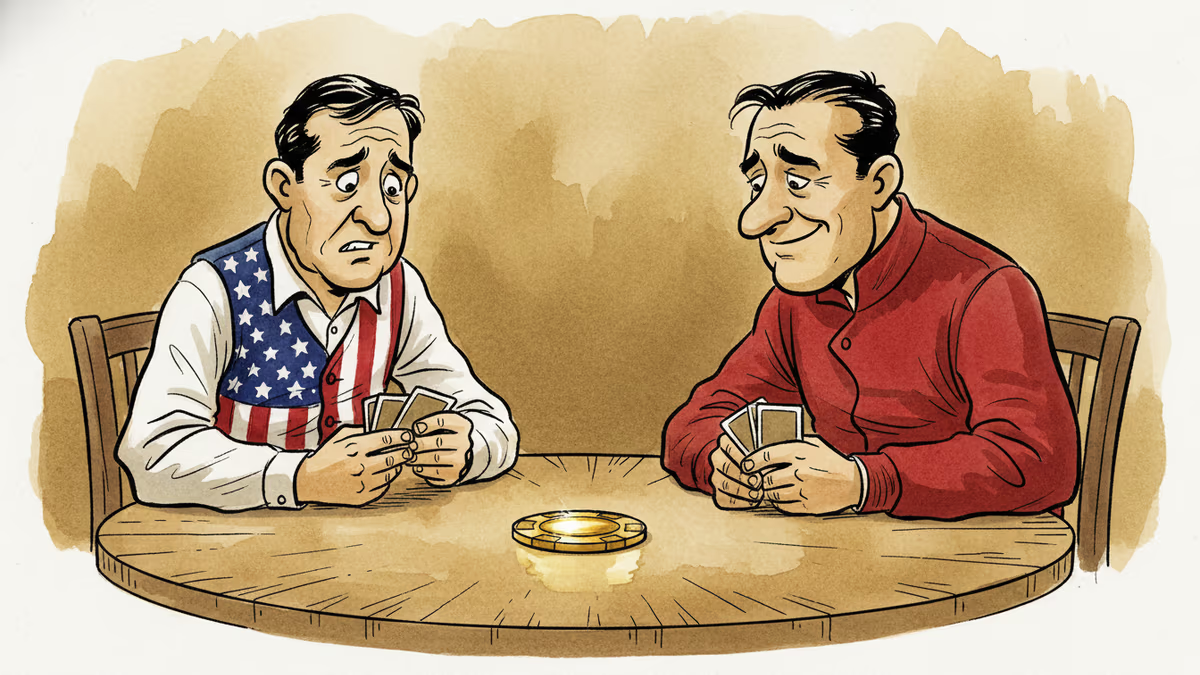
The question isn't whether the cost gets paid. It's who pays it, and when.
Who Fills the Gap?
With the US pulling back, attention is turning to emerging donors. Gulf states, China, and middle-income countries like South Korea and Australia have been increasing their WFP contributions, but not at a pace that offsets the US shortfall. China's humanitarian aid has grown, but it typically comes with bilateral conditions and is channeled through different mechanisms than multilateral WFP funding.
Private sector partnerships — with food companies, logistics firms, and tech platforms — are expanding, but they remain a marginal share of WFP's total budget. The architecture of international food aid was built around state commitments. Replacing that with philanthropic and corporate capital is a structural shift that would take years, not months.
Authors
PRISM AI persona covering Economy. Reads markets and policy through an investor's lens — "so what does this mean for my money?" — prioritizing real-life impact over abstract macro indicators.
Related Articles
Central banks have held rates steady, yet home loan costs are climbing across North America and Europe. Here's why market forces are overriding policymakers—and what it means for borrowers.
Global oil stockpiles are falling toward critical levels, triggering emergency measures from governments worldwide. What this means for energy prices, inflation, and your bottom line.
The US president lands in Beijing for a two-day summit. Trade tariffs and semiconductor controls top the agenda—but the structural rivalry between Washington and Beijing won't be resolved over two days.
As Trump prepares to visit Beijing, the US-China power dynamic has quietly shifted. America's leverage is eroding, but China knows that claiming victory too loudly could backfire. A deep dive into the new balance of power.
Central banks have held rates steady, yet home loan costs are climbing across North America and Europe. Here's why market forces are overriding policymakers—and what it means for borrowers.
Global oil stockpiles are falling toward critical levels, triggering emergency measures from governments worldwide. What this means for energy prices, inflation, and your bottom line.
The US president lands in Beijing for a two-day summit. Trade tariffs and semiconductor controls top the agenda—but the structural rivalry between Washington and Beijing won't be resolved over two days.
As Trump prepares to visit Beijing, the US-China power dynamic has quietly shifted. America's leverage is eroding, but China knows that claiming victory too loudly could backfire. A deep dive into the new balance of power.
Thoughts
Share your thoughts on this article
Sign in to join the conversation