

Why London's Youth Are Paying $17 to Give Up Their Phones
The Offline Club has spread to 19 European cities, offering a new approach to digital detox. What happens when you surrender your smartphone for two hours?
Pay $17, hand over your smartphone to a stranger, then spend two hours in silence coloring with pencils. Sound absurd? It's become London's hottest ticket.
The Offline Club started in February 2024 in the Netherlands and has since expanded to 19 European cities. The format is simple: participants surrender their phones at the door, spend one hour in complete silence doing analog activities like reading or puzzles, followed by an hour of phone-free conversation with strangers.
In London's trendy Dalston district, these sessions have been selling out regularly since last summer.
When Meta Employees Seek Digital Detox
The irony runs deep. Among the attendees was Sangeet Narayan, a Meta employee who codes the notification systems for Facebook, Instagram, and WhatsApp. "I feel I am addicted to my phone," he admitted. "I feel the urge to see my phone—to open it, just for no reason."
This captures a broader contradiction: the very people building our digital infrastructure are seeking refuge from it. Laura Wilson, co-host of London's branch, calls it "a gentle rebellion." The message is clear—any moment not on your phone is "claiming back for yourself."
The demographic is telling: professionals aged 25-40, the generation that grew up with social media but still remembers life before smartphones. They're not digital natives seeking novelty, but digital immigrants yearning for what they've lost.

The Attention Economy's Casualties
The Offline Club emerged from a 2000-person gathering on London's Primrose Hill, where participants watched the sunset without the usual sea of glowing screens. That unofficial "world record" attempt highlighted something profound: we've forgotten how to simply be present.
The format taps into what urban life has stripped away—unstructured time, face-to-face interaction, and the ability to sit with our own thoughts. Wilson describes it as "a free pocket of time where you kind of have no responsibilities for a while."
One attendee, raised in Cornwall's Quaker tradition, sought to recreate the collective silent contemplation she remembered from meetings. Another analog enthusiast uses smartphones "only begrudgingly" for work and has never had social media accounts.
The Paradox of Offline Marketing
Here's the kicker: most participants discovered the Offline Club through Instagram. This contradiction—using the very platforms they're trying to escape to find escape—reveals our complex relationship with technology.
We know doomscrolling steals our leisure time, notifications shatter our peace, and algorithms pollute our discourse. Yet we're simultaneously unwilling to forfeit these digital conveniences. The Offline Club doesn't resolve this tension; it simply provides temporary relief.
Participants report unexpected benefits. "I left the event weirdly feeling more energized," said Eleanor, a management consultant. Others found comfort in awkward conversational pauses—a skill that's atrophying in our swipe-right culture.
Authors
Related Articles

Samsung Electronics' union branch revealed that 84% of survey respondents oppose the government's roughly $290 billion (₩400 trillion) semiconductor megaproject in Gwangju. Government, management, the union and shareholders are all reading the same national project in sharply different ways.
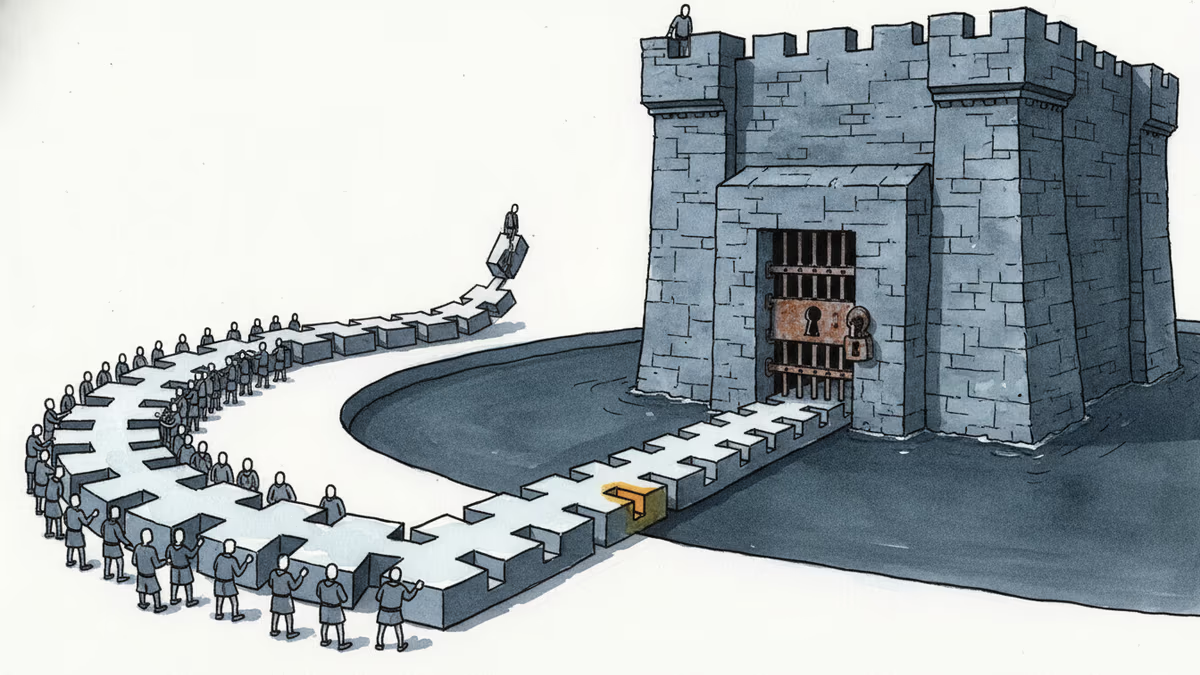
Nvidia shipped roughly a billion RISC-V cores in 2024, then announced it would run CUDA on the open standard. We break down how royalty-free instruction sets and open software stacks are trying to route around CUDA's lock-in. Part 2 of the Semiconductor Sovereignty series.
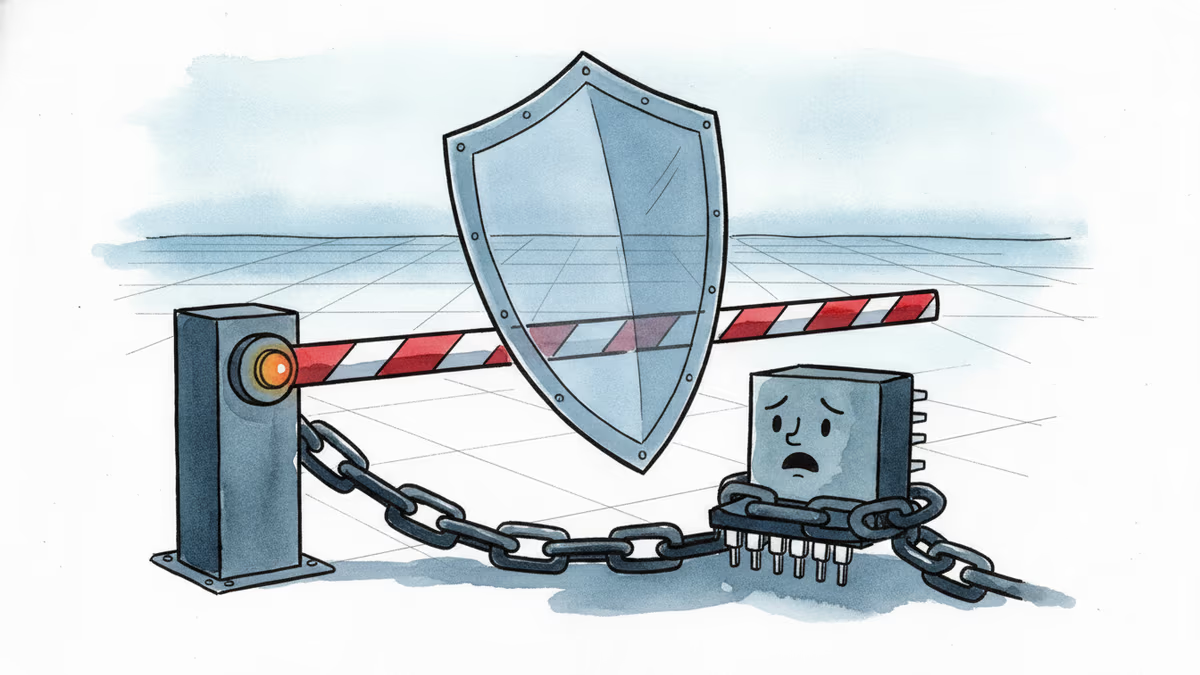
US AI-chip export controls split into three layers in the first half of 2026 — January easing, a May crackdown on circumvention, and a pending bill. Nvidia erased China from its guidance and still posted a record $81.6 billion quarter. A look at the export policy that both shields and cages it.

AMD's MI325X matches or beats Nvidia on memory and bandwidth — yet Nvidia's 86-92% share holds. The real moat is CUDA, 20 years in the making. Part 1 of 4.
Samsung Electronics' union branch revealed that 84% of survey respondents oppose the government's roughly $290 billion (₩400 trillion) semiconductor megaproject in Gwangju. Government, management, the union and shareholders are all reading the same national project in sharply different ways.
Nvidia shipped roughly a billion RISC-V cores in 2024, then announced it would run CUDA on the open standard. We break down how royalty-free instruction sets and open software stacks are trying to route around CUDA's lock-in. Part 2 of the Semiconductor Sovereignty series.
US AI-chip export controls split into three layers in the first half of 2026 — January easing, a May crackdown on circumvention, and a pending bill. Nvidia erased China from its guidance and still posted a record $81.6 billion quarter. A look at the export policy that both shields and cages it.
AMD's MI325X matches or beats Nvidia on memory and bandwidth — yet Nvidia's 86-92% share holds. The real moat is CUDA, 20 years in the making. Part 1 of 4.
Thoughts
Share your thoughts on this article
Sign in to join the conversation