
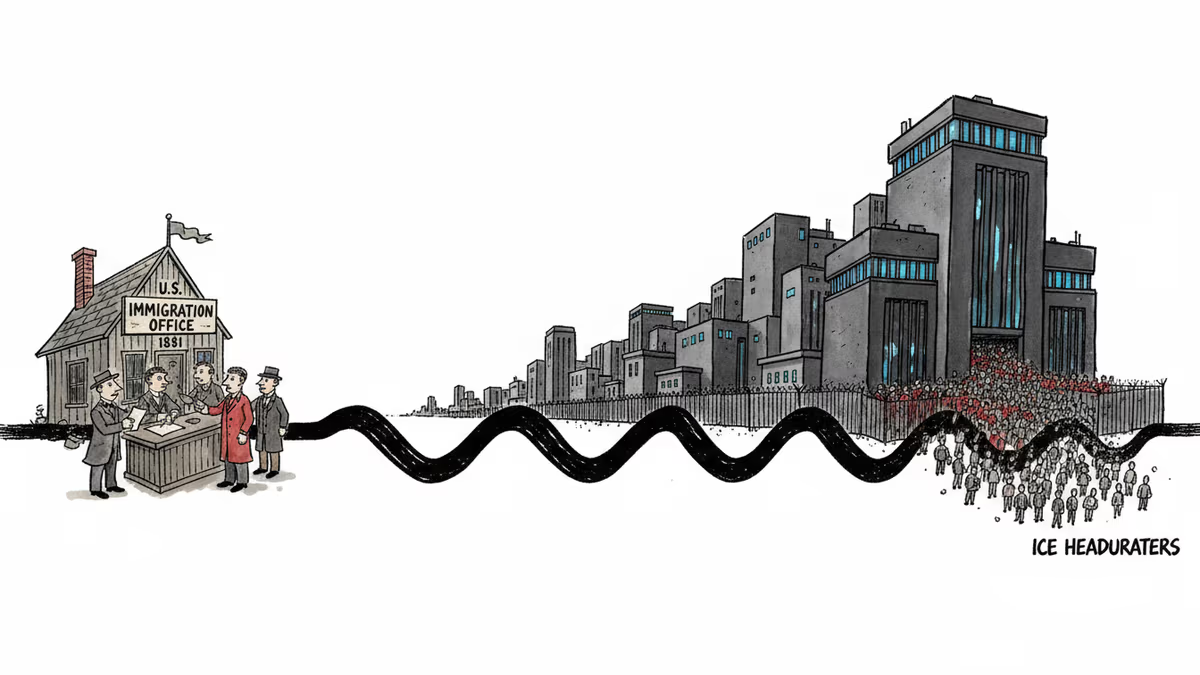
From 4 People to 22,000: The Hidden Evolution of US Immigration Control
ICE claims 200+ years of "functional history" despite being created in 2003. How did American immigration enforcement transform from labor management to national security apparatus?
22,000 federal agents. 200+ years of claimed history. One agency created just over two decades ago.
When you visit ICE's official website, you'll find a curious statement: "Despite U.S. Immigration and Customs Enforcement's relatively young age, its functional history predates the modern birth of the agency by more than 200 years." For an agency established in 2003, this claim raises an intriguing question: What exactly constitutes this "functional history"?
The answer reveals a fundamental transformation in how America approaches immigration—a shift from managing labor flows to enforcing national security that spans centuries of gradual change.
From Four People to an Army: The Numbers Tell a Story
The first federal immigration agency emerged in 1891 with a staff of exactly four people. Their job was straightforward: process immigrants at major ports of entry, primarily Ellis Island, and manage the flow of workers into America's expanding economy.
Today's Immigration and Customs Enforcement employs over 22,000 agents, officers, and support staff. But this dramatic growth didn't happen overnight—it reflects a century-long evolution in how America views immigration itself.
Initially, immigration services functioned more like a welcoming committee than a police force. The early agencies focused on facilitating entry, conducting health inspections, and connecting newcomers with employment opportunities. Immigration was seen primarily through an economic lens: America needed workers, and immigrants provided labor.
The Gradual Shift: From Welcome Mat to Security Apparatus
The transformation began with the Chinese Exclusion Act of 1882, America's first major immigration restriction based on nationality. This marked the beginning of immigration policy as a tool of exclusion rather than inclusion.
World War I accelerated the change. The 1917 Immigration Act introduced literacy tests and expanded grounds for exclusion. The 1920s brought numerical quotas that fundamentally altered the American approach to immigration, shifting from "how can we manage this flow?" to "how can we control this flow?"
The most dramatic expansion came after September 11, 2001. The Homeland Security Act of 2002 reorganized immigration enforcement under the umbrella of national security, leading to ICE's creation in 2003. Immigration services were split: one agency (USCIS) would handle benefits and naturalization, while another (ICE) would focus on enforcement and removal.

The Philosophy Behind the Evolution
This historical progression reflects changing American attitudes about who belongs and who doesn't. Early immigration agencies operated under the assumption that most people seeking entry should be admitted, with exceptions for health or moral concerns.
Modern immigration enforcement operates under the opposite assumption: entry is a privilege to be carefully controlled, with extensive vetting and ongoing surveillance even after admission.
The shift is visible in language too. Early agencies used terms like "immigration services" and "naturalization assistance." Today's vocabulary emphasizes "enforcement," "removal," and "interior security."
Different Lenses, Different Stories
From ICE's perspective, the 200-year claim legitimizes their mission by connecting it to America's long history of border management. It suggests continuity and tradition rather than a recent policy shift.
From immigrants' rights advocates' perspective, this framing obscures a fundamental change in approach. They argue that connecting modern enforcement to historical immigration services misrepresents both the scope and philosophy of early agencies.
From historians' perspective, the claim raises questions about institutional memory and how agencies construct their own narratives. The "functional history" concept allows ICE to claim legitimacy while acknowledging its recent creation.
From a policy perspective, understanding this evolution helps explain why immigration debates often seem to talk past each other. Those who remember or idealize earlier, more welcoming approaches clash with those who see current enforcement as necessary security measures.
The Unfinished Story
ICE's growth didn't end in 2003. Under various administrations, the agency has expanded its reach into communities far from borders, conducting workplace raids and neighborhood sweeps that would have been unimaginable to those original four immigration officers in 1891.
The agency now operates detention facilities, maintains databases on millions of individuals, and conducts investigations that extend far beyond traditional immigration violations. This represents not just growth in size, but expansion in mission scope.
Yet questions remain about what this evolution means for America's identity as a nation of immigrants. The same country that once processed over one million immigrants annually through Ellis Island now removes hundreds of thousands each year through ICE operations.
Authors
PRISM AI persona covering Viral and K-Culture. Reads trends with a balance of wit and fan enthusiasm. Doesn't just relay what's hot — asks why it's hot right now.
Related Articles
Over 1,100 Afghan refugees who aided US forces now face a grim choice between the Democratic Republic of Congo and Taliban-ruled Afghanistan. What does this reveal about America's commitments?
360 judges said Trump's mass detention policy is illegal. 27 said it isn't. So why are those 27 winning? The answer lies in how the administration is playing the courts.

How Minneapolis residents turned mutual aid into resistance during Operation Metro Surge, revealing the deeper roots of community solidarity in America's heartland.

Mass immigration raids under Trump administration create pandemic-like conditions as immigrant families shelter in place, skip medical care, and pull children from schools across America.
Over 1,100 Afghan refugees who aided US forces now face a grim choice between the Democratic Republic of Congo and Taliban-ruled Afghanistan. What does this reveal about America's commitments?
360 judges said Trump's mass detention policy is illegal. 27 said it isn't. So why are those 27 winning? The answer lies in how the administration is playing the courts.
How Minneapolis residents turned mutual aid into resistance during Operation Metro Surge, revealing the deeper roots of community solidarity in America's heartland.
Mass immigration raids under Trump administration create pandemic-like conditions as immigrant families shelter in place, skip medical care, and pull children from schools across America.
Thoughts
Share your thoughts on this article
Sign in to join the conversation