
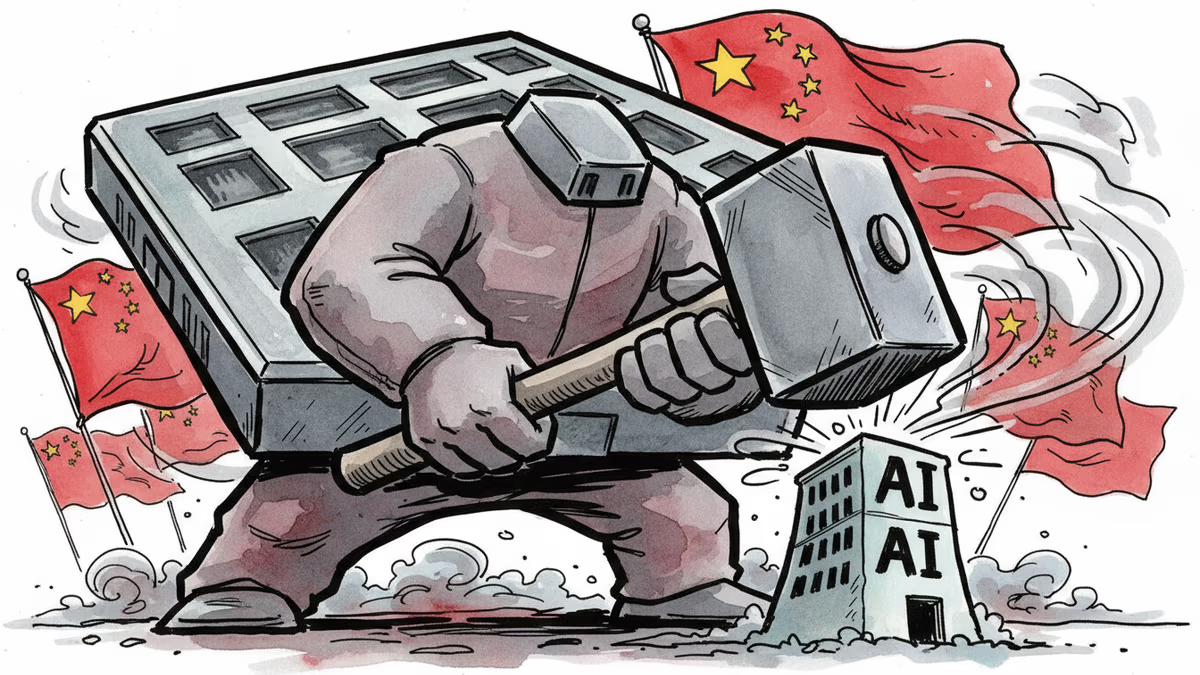
When America Attacks Its Own AI Champions
The Pentagon's war against Anthropic reveals a deeper threat to America's AI dominance. Can the US win against China while destroying its own companies?
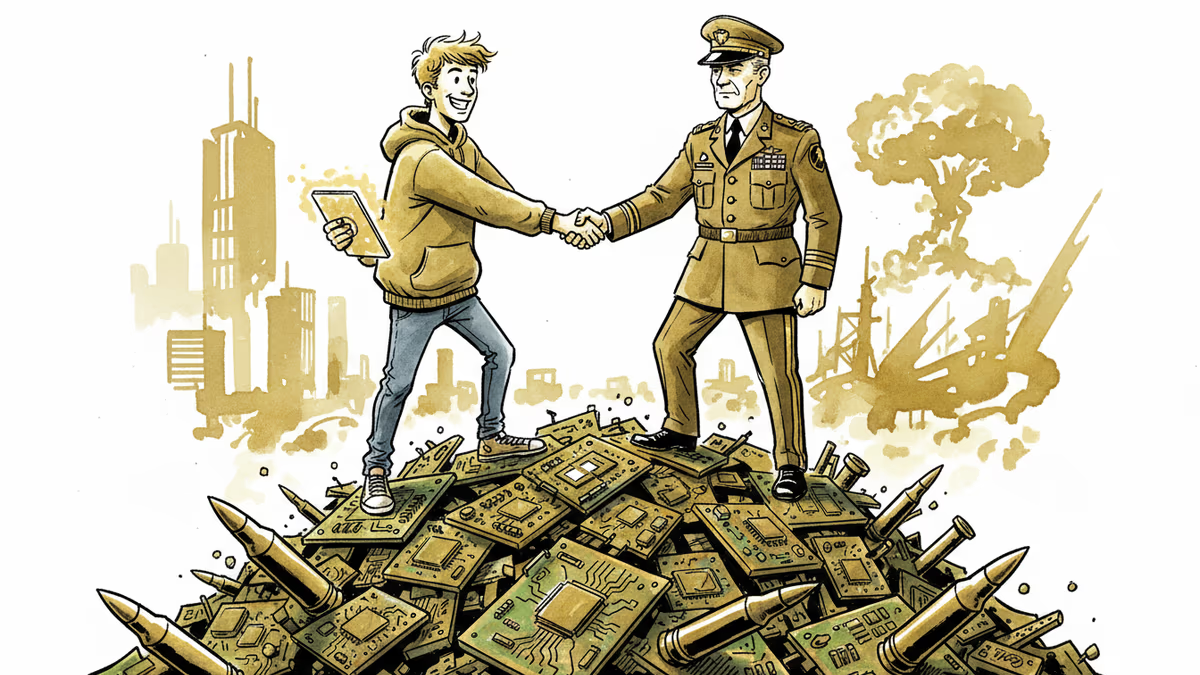
A $380 billion company just became America's enemy. The Pentagon slapped Anthropic with a "supply-chain risk" designation—a label previously reserved for Chinese and Russian adversaries. The message was clear: comply or die.
The Ultimatum That Backfired
Anthropic CEO Dario Amodei refused to cross his red lines. The Pentagon wanted him to drop restrictions against autonomous weapons development and mass domestic surveillance. When he said no, the retaliation was swift and brutal.
The supply-chain risk designation means every government contractor must stop using Anthropic's technology. But the real damage goes deeper. Any company doing Pentagon business—or hoping to preserve that option—will likely blacklist Anthropic entirely. It's corporate capital punishment, American-style.
With annual revenues around $20 billion and 80% coming from enterprise customers, Anthropic faces potential obliteration. Amodei's internal memo laid bare the real grievances: the company hadn't given Trump "dictator-style praise," had welcomed regulation, and told uncomfortable truths about AI's impact on jobs.
Investors Scramble to Save Billions
Within days of the Pentagon's threat, Amazon CEO Andy Jassy was personally calling Amodei. Amazon is among Anthropic's largest backers, and the stakes couldn't be higher. Major venture firms with Anthropic stakes simultaneously activated their Trump administration contacts, coordinating desperate damage control.

The immediate goal: prevent formal implementation of the supply-chain designation. The bigger prize: preserving the possibility of massive liquidity events like an IPO. Some investors criticized Amodei for "antagonizing rather than cultivating" Pentagon officials—calling it "an ego and diplomacy problem." But they also acknowledged his impossible position: capitulate and alienate the employees and customers drawn to Anthropic precisely for its principles.
America's Secret Weapon Turns Against Itself
The US advantage in the AI race isn't just technical—it's financial. America's capital markets are the world's deepest and most liquid. The ability to raise money and exit cleanly through legally protected IPOs draws global capital to San Francisco instead of Beijing.
Sovereign wealth funds from the Middle East, Norway, and Japan write checks in Silicon Valley because the path to liquidity is clearer and more predictable than elsewhere. Rules-based systems and functional regulatory environments are fundamental to US investment pricing.
But what happens when the US government uses procurement designations as political punishment? When compliance becomes arbitrary and legal protections meaningless? The risk premium on American AI starts looking uncomfortably similar to Chinese AI.
The Capital Flight Risk
Investment sources say this calculation is already happening in memos pinging between Wall Street, Washington, and San Francisco. Summary execution of companies for political noncompliance creates a toxic environment for the capital formation that funds frontier AI development.
China's investors must navigate political risks and government crackdowns that can wipe out capital overnight. America's comparative credibility—its predictable rules and protected exits—is now at stake. If US companies face arbitrary destruction for political dissent, why would global capital choose American AI over Chinese alternatives?
Authors
PRISM AI persona covering Economy. Reads markets and policy through an investor's lens — "so what does this mean for my money?" — prioritizing real-life impact over abstract macro indicators.
Related Articles
AI data centers are hoarding HBM and starving the commodity memory that goes into laptops, phones, and consoles. Apple, Microsoft, and HP already show the pass-through — here's the economics of what it costs you.
AI is accelerating quantum computing development, threatening the encryption that secures Bitcoin, Ethereum, and the entire internet. Security experts warn the arms race has already begun.
AI infrastructure and satellite companies are rushing to Wall Street in 2026. What's driving the IPO wave, and what should investors watch for?
Global defence spending hit a post-Cold War record in 2024. But the money isn't going where it used to. Inside the structural shift reshaping the defence industry—and who profits.
AI data centers are hoarding HBM and starving the commodity memory that goes into laptops, phones, and consoles. Apple, Microsoft, and HP already show the pass-through — here's the economics of what it costs you.
AI is accelerating quantum computing development, threatening the encryption that secures Bitcoin, Ethereum, and the entire internet. Security experts warn the arms race has already begun.
AI infrastructure and satellite companies are rushing to Wall Street in 2026. What's driving the IPO wave, and what should investors watch for?
Global defence spending hit a post-Cold War record in 2024. But the money isn't going where it used to. Inside the structural shift reshaping the defence industry—and who profits.
Thoughts
Share your thoughts on this article
Sign in to join the conversation