
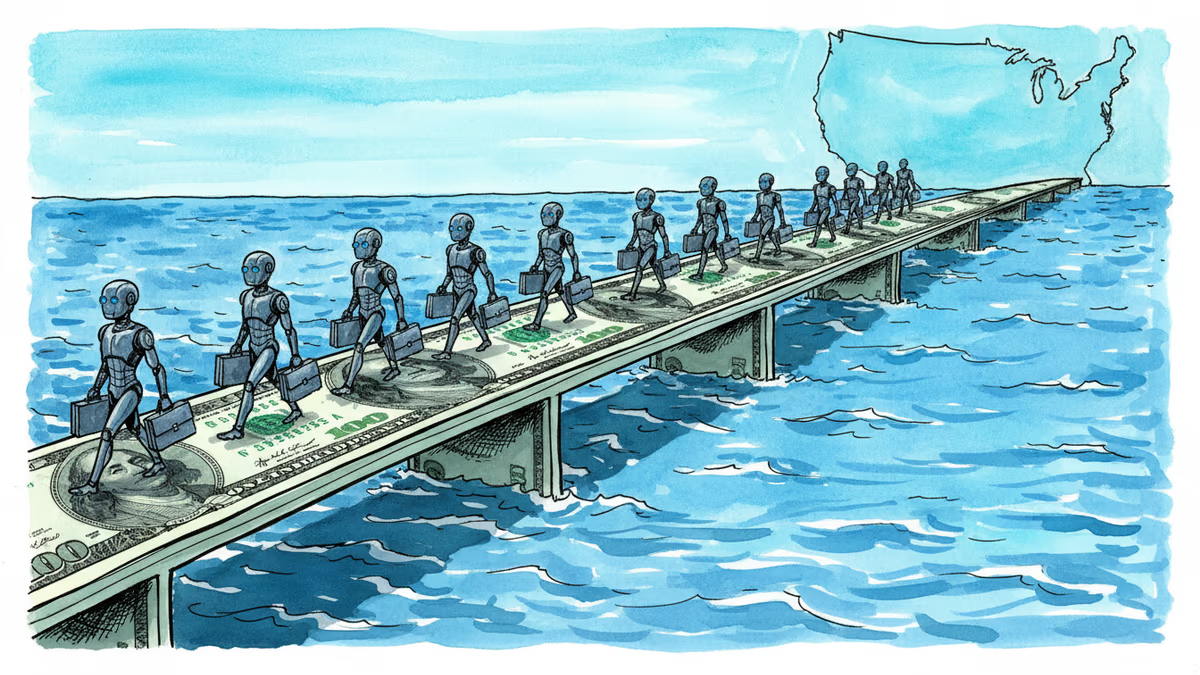
Why a $10B Fund Is Betting Big on AI Border-Crossing
Peak XV raises $1.3B for AI and cross-border investments as competition intensifies. What this signals for the future of venture capital strategy.
$1.3 Billion Says Everything About Where Smart Money's Going
Peak XV just raised $1.3 billion across new India and Asia-focused funds, pushing its total assets under management past $10 billion. But here's what's really interesting: they're not trying to match rivals dollar-for-dollar. Instead, they're doubling down on artificial intelligence and cross-border bets while everyone else is throwing money at whatever's hot.
The timing isn't coincidental. As New Delhi hosts the AI Impact Summit this week, with OpenAI, Anthropic, and Google in attendance, General Catalyst announced plans to invest $5 billion in India over the next five years. The message is clear: India isn't just a market anymore—it's becoming a global AI hub.
The Anti-Megafund Strategy
"We are not trying to match rivals dollar-for-dollar," Managing Director Shailendra Singh told TechCrunch. "Our priority is generating strong returns rather than maximizing assets under management."
This philosophy runs counter to the megafund trend that's dominated venture capital. Peak XV actually reduced their previous fund from $2.85 billion to $2.4 billion in what Singh calls a "disciplined approach to capital."
The numbers back up their restraint. Peak XV has returned more than $7 billion in cash to investors since inception, with 35 portfolio companies going public. In 2024 alone, they distributed about $1.2 billion—a return rate that megafunds struggle to match.

What This Means for Global Tech Investing
Peak XV's strategy reveals three critical shifts happening in venture capital right now.
First, AI specialization is becoming table stakes. The firm has made more than 80 investments in AI startups, but they're not just throwing money at anything with "AI" in the pitch deck. They're focusing on practical applications in fintech, consumer internet, and deep tech.
Second, cross-border thinking is replacing regional silos. "U.S.-India ties are becoming increasingly important as more founders in the region build for global markets," Singh noted. This isn't about American companies expanding to India—it's about Indian startups building global products from day one.
Third, selective competition over market domination. "In the U.S. market, we are an underdog—and that's great," Singh said. Rather than competing everywhere, Peak XV focuses on software, developer tools, and fintech where their experience gives them an edge.
The Underdog Advantage
Peak XV's approach challenges the conventional wisdom that bigger funds automatically win better deals. With more than 450 portfolio companies spanning seed to growth stages, they're proving that focused capital can outperform scattered megafunds.
The firm's recent leadership changes—including departures of senior partner Ashish Agrawal and investors Ishaan Mittal and Tejeshwi Sharma—might have raised eyebrows. But Singh emphasizes continuity: five of seven managing partners have been with Peak XV for more than a decade.
This stability matters when you're making two-to-three-year deployment commitments in volatile markets. Peak XV expects to deploy the new capital primarily into AI, fintech, and consumer startups while exploring emerging opportunities in deep tech.
Authors
Related Articles

Lucra Sports CEO Dylan Robbins landed Cathie Wood's ARK Invest as a Series B lead without building AI. The story behind his unconventional fundraising playbook.

SolarSquare is raising $55-60M at a $450-500M valuation, more than doubling its worth in 18 months. Here's what's driving investor conviction in India's residential solar market.

Indian venture capital has quietly displaced Silicon Valley in its own backyard. Only one American VC made India's top 10 investor list last year. Here's why that matters beyond India.

Cerebras Systems IPO yields a $5.3 billion return for Benchmark. Explore the 8.5-year journey from a reluctant first meeting to challenging Nvidia's AI dominance.
Lucra Sports CEO Dylan Robbins landed Cathie Wood's ARK Invest as a Series B lead without building AI. The story behind his unconventional fundraising playbook.
SolarSquare is raising $55-60M at a $450-500M valuation, more than doubling its worth in 18 months. Here's what's driving investor conviction in India's residential solar market.
Indian venture capital has quietly displaced Silicon Valley in its own backyard. Only one American VC made India's top 10 investor list last year. Here's why that matters beyond India.
Cerebras Systems IPO yields a $5.3 billion return for Benchmark. Explore the 8.5-year journey from a reluctant first meeting to challenging Nvidia's AI dominance.
Thoughts
Share your thoughts on this article
Sign in to join the conversation