
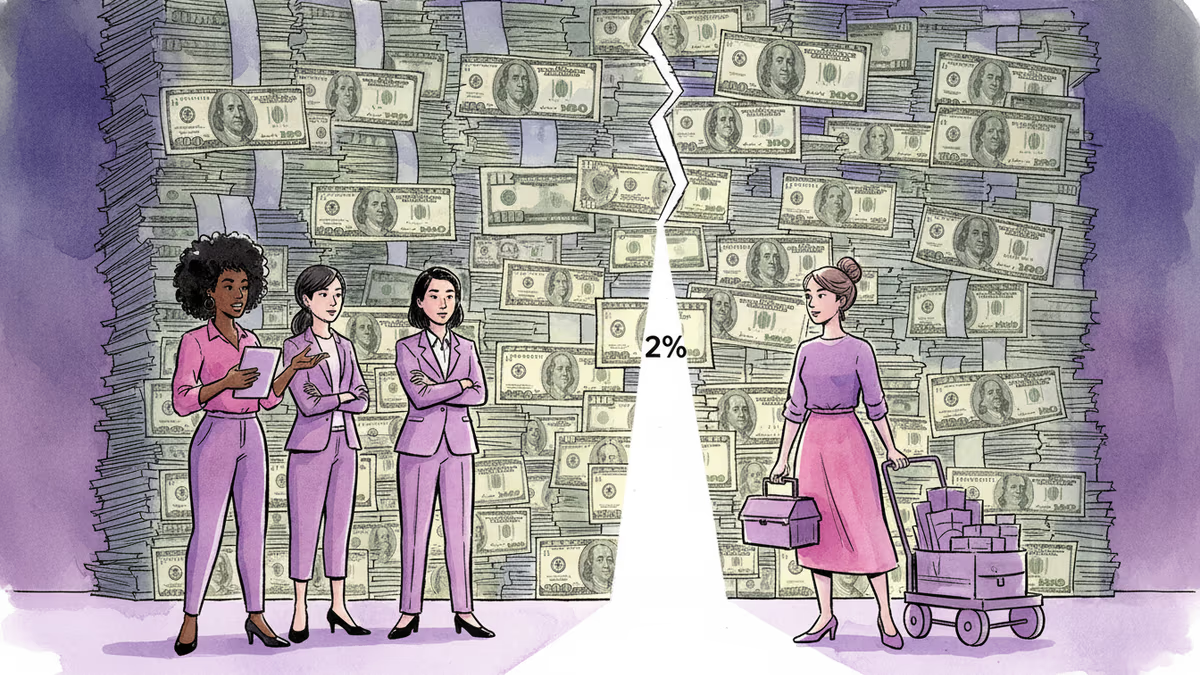
The 2% Glass Ceiling: Why Female Founders Can't Break Through
Female founders receive only 2% of US venture capital funding, with immigrant women facing compounded bias in the AI boom. A new California law might change the game.
$211 Billion Flowed Into AI. Women Got Crumbs.
That's how much venture capital poured into artificial intelligence companies in 2025 — half of all global VC funding. Yet female founders captured just 2% of total venture funding in the US, a figure that hasn't budged in years. For immigrant women founders, the numbers are even grimmer, though no one bothers to track them separately.
Sri Ramaswamy thought she was ready. Pitching her AI-powered insurance claims product Charlee.AI to Bay Area investors, she expected technical questions, growth projections, market analysis. Instead, she got: "Who else is on your team?" One funder was brutally direct: "If you had a white male CEO, you would get a check."
This isn't just about one founder's experience. It's about a $211 billion market being shaped by the same biases that have kept women on the sidelines for decades.
The Question Gap: What Men vs. Women Actually Hear
The disparity starts with the questions investors ask. Research by the Female Founder Collective reveals a stark pattern: men get asked about opportunities ("If we give you $5 million, where can you take this?"), while women get grilled about risks ("What if you fail?").
The numbers are damning:
- Women are interrupted 5x more during pitch meetings
- They receive 2x more questions about personal commitments and family
- They're routinely described as "cautious," "inexperienced," and "emotional"
Angela Lee, Columbia Business School professor and founder of 37 Angels, calls it "compounding bias." Immigrant women navigate sexism and racism simultaneously, layered with cultural gaps, accent bias, and limited access to elite US networks.

"For immigrant women, that bias shows up earlier and more often: in pitch meetings, partner discussions, and even informal feedback loops that determine who gets a second meeting," Lee explains.
The Network Effect: Who You Know Still Trumps What You Know
The venture capital industry runs on networks — specifically, Ivy League and elite tech school alumni networks. Indian men in the US tap into Indian Institute of Technology (IIT) connections; Vinod Khosla of Khosla Ventures is an IIT alum. Chinese male founders leverage similar pathways.
But these networks have historically excluded women. The stereotype that benefits Indian and Chinese men in tech — being "naturally skilled" in technology and finance — doesn't extend to women from the same countries.
Assel Seitova, founder of Sisters (a network for female founders from Central Asia), puts it bluntly: "Many founders need to first educate investors about where they come from before talking about what they are building."
Yet success stories are emerging. Kazakhstan's Zhanel Nugmanova co-founded biotech company Valinor, raising a $13 million seed round. Legal AI tool Alma, founded by women from Kazakhstan and Kyrgyzstan, secured $8 million last year.
California's Transparency Gambit
Starting April 2026, a new California law requires VC firms to disclose demographic data of their portfolio companies. Since over a third of US VC firms operate from California, this could force systemic change.
Erika Bahr, founder of AI data platform Daxe, sees promise: "Historically, investors have liked to invest in people that look like them. The challenge is getting more women funding women, and shifting the mindset around risk."
At Rittenhouse Ventures, about a third of investments go to women-led startups — well above industry average. But most VC firms still lack female partners, perpetuating the cycle.
Authors
Related Articles

Lucra Sports CEO Dylan Robbins landed Cathie Wood's ARK Invest as a Series B lead without building AI. The story behind his unconventional fundraising playbook.

SolarSquare is raising $55-60M at a $450-500M valuation, more than doubling its worth in 18 months. Here's what's driving investor conviction in India's residential solar market.
Two commencement speakers learned the hard way that AI enthusiasm doesn't land well with today's graduates. The backlash reveals a widening gap between tech optimism and Gen Z's economic reality.
Indian venture capital has quietly displaced Silicon Valley in its own backyard. Only one American VC made India's top 10 investor list last year. Here's why that matters beyond India.
Lucra Sports CEO Dylan Robbins landed Cathie Wood's ARK Invest as a Series B lead without building AI. The story behind his unconventional fundraising playbook.
SolarSquare is raising $55-60M at a $450-500M valuation, more than doubling its worth in 18 months. Here's what's driving investor conviction in India's residential solar market.
Two commencement speakers learned the hard way that AI enthusiasm doesn't land well with today's graduates. The backlash reveals a widening gap between tech optimism and Gen Z's economic reality.
Indian venture capital has quietly displaced Silicon Valley in its own backyard. Only one American VC made India's top 10 investor list last year. Here's why that matters beyond India.
Thoughts
Share your thoughts on this article
Sign in to join the conversation