
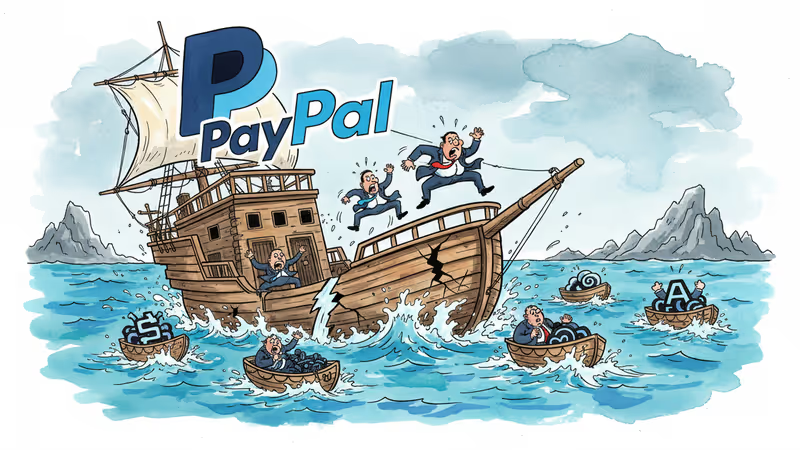
PayPal's CEO Shuffle Signals Deeper Fintech Struggles
PayPal replaces CEO Alex Chriss with HP's Enrique Lores as shares plunge 18% on disappointing earnings. What this means for the digital payments giant's future.
18 months. That's how long Alex Chriss lasted as PayPal's CEO before the board decided he wasn't moving fast enough. His replacement? HP's Enrique Lores, who'll inherit a company whose stock just plunged 17.9% in premarket trading.
Third CEO in Two Years
PayPal's board didn't mince words. The company's "pace of change and execution was not in line with the Board's expectations," they said Tuesday. Chriss, who joined from Intuit in September 2023, becomes the third CEO to leave PayPal in just two years, following Dan Schulman's departure.
Lores brings over six years of experience leading HP and has been PayPal's board chair since July 2024. But he's walking into a company that just delivered earnings results that spooked Wall Street. The timing suggests this wasn't a planned transition—it was a response to mounting pressure.
When Reality Meets Expectations
The numbers tell the story. PayPal's fourth-quarter revenue and profit both missed analyst expectations, hurt by consumers tightening their belts amid rising living costs and a softening job market. But the real shock came from the company's full-year profit forecast—PayPal expects earnings to decline when Wall Street was betting on growth.
This disconnect between corporate guidance and market expectations reflects a broader challenge facing established fintech companies. While PayPal processes billions in transactions, growth has stagnated as competition intensifies and consumer behavior shifts.

The AI Arms Race in Payments
Lores acknowledged the reality in his statement: "The payments industry is changing faster than ever, driven by new technologies, evolving regulations, an increasingly competitive landscape, and the rapid acceleration of AI that is reshaping commerce daily."
That's not corporate speak—it's recognition that PayPal is fighting battles on multiple fronts. Apple Pay and Google Pay dominate mobile payments. Stripe and Square have captured merchant services. Meanwhile, AI-powered fraud detection, personalized financial services, and cryptocurrency integration have become table stakes.
PayPal sits at the center of this transformation, but being in the middle doesn't guarantee victory. The company needs to prove it can innovate faster than it's been disrupted.
Beyond the Executive Suite
CEO changes often signal deeper structural issues. PayPal's challenge isn't just leadership—it's positioning. The company built its reputation on being the safe, trusted option for online payments. But "safe and trusted" doesn't drive growth when consumers want seamless, invisible, and intelligent payment experiences.
The question isn't whether Lores can stabilize PayPal's operations—his HP track record suggests he can. The question is whether any CEO can navigate the company through a market where being a payments processor isn't enough anymore.
Authors
Related Articles
Venmo's biggest redesign since 2021 adds social features, personalized offers, and a revamped feed. But the timing — amid PayPal's restructuring and Stripe's reported interest — raises a harder question about who this update is really for.
Despite fierce competition, the CEOs of Polymarket and Kalshi have co-invested in 5(c) Capital, a $35M VC fund targeting prediction market infrastructure. What this signals for the industry.
A class action lawsuit accuses Kalshi of changing payout rules after Iran's Supreme Leader Khamenei was killed. The case cuts to the heart of prediction market credibility.
A massive dispute over Iran's supreme leader prediction market exposes the dark side of betting on world events. How Kalshi's rule interpretation sparked trader revolt.
Venmo's biggest redesign since 2021 adds social features, personalized offers, and a revamped feed. But the timing — amid PayPal's restructuring and Stripe's reported interest — raises a harder question about who this update is really for.
Despite fierce competition, the CEOs of Polymarket and Kalshi have co-invested in 5(c) Capital, a $35M VC fund targeting prediction market infrastructure. What this signals for the industry.
A class action lawsuit accuses Kalshi of changing payout rules after Iran's Supreme Leader Khamenei was killed. The case cuts to the heart of prediction market credibility.
A massive dispute over Iran's supreme leader prediction market exposes the dark side of betting on world events. How Kalshi's rule interpretation sparked trader revolt.
Thoughts
Share your thoughts on this article
Sign in to join the conversation