
Why India Is Embracing Chinese Fintech After Banning 250 Apps
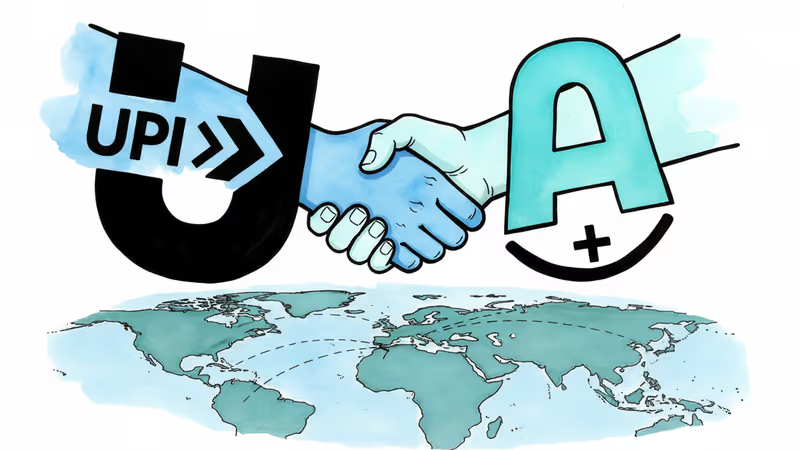
India banned over 250 Chinese apps for security reasons, but now it's negotiating with Alipay+ to integrate with UPI. Trump's tariff pressure may be reshaping geopolitical calculations.
250. That's how many Chinese apps India banned between 2020 and the end of that year, citing threats to the country's "sovereignty and integrity." Six years later, India is in talks with Ant International—a subsidiary of Chinese fintech giant Ant Group—to integrate Alipay+ with India's unified payments interface.
If the deal goes through, Indian tourists could use UPI at over 150 million Alipay+ merchants across 100+ markets. It's a dramatic shift for a country that once saw Chinese tech as a national security threat.
India's Digital Payment Ambitions Go Global
UPI isn't just a payment system—it's India's digital pride. Launched in 2016, this state-backed platform enables real-time money transfers using smartphones, eliminating the need for digital wallets. Users can transact up to 100,000 rupees ($1,106) daily using just mobile numbers or QR codes.
The numbers are staggering: 504 million users, 65 million merchants, and over 20 billion transactions monthly. UPI accounts for 84% of India's digital retail payments. A top Indian central bank official recently suggested the user base could reach 1 billion.
India has been pushing UPI internationally for years. It's currently available in seven countries including the UAE, Singapore, Bhutan, Nepal, Sri Lanka, France, and Mauritius. At the 2023 G20 Summit, Prime Minister Narendra Modi declared India would be "happy to share our experience with the world."
Partnering with Alipay+ could accelerate this ambition without the need to build infrastructure country by country.
Trump's Tariffs Change the Calculation

But why now? The timing isn't coincidental. On February 2, India reached a tariff truce with the U.S. after months of intense negotiations with President Donald Trump's administration. Experts suggest Trump's economic pressure prompted India to diversify its international partnerships.
"Trump's tariff measures created economic pressure, prompting India to diversify its international partnerships and reduce overreliance on the U.S. market," said Salman Waris, founding partner at tech law firm TechLegis. "The present initiative actually coincides with a strategic thaw in India-China relations."
This shift is already visible. India has become more flexible in allowing local electronics manufacturers to partner with Chinese firms and has eased business visa restrictions for mainland Chinese workers. Even long-term U.S. allies like Canada have felt the heat of Trump's tariff moves.
Security Concerns Remain
The deal won't happen without scrutiny. "The final decision is pending," Waris noted, highlighting persistent concerns about "geopolitical sensitivities" due to Alipay+'s Chinese origins and "security and data privacy concerns, particularly around the flow of Indian users' financial data across borders."
Data localization clauses and kill-switch provisions will likely be key negotiation points. India's regulatory bodies remain cautious about any arrangement that could compromise user data or national security.
Yet if successful, the integration offers significant benefits beyond convenience for Indian travelers. "The deal will benefit UPI and its customers in multiple ways, including lower transaction costs and reduced reliance on card networks and foreign exchange," Waris explained. "Most importantly, it would be a strategic boost to India's digital payment ecosystem, aligning with its goal to make UPI a global standard."
Beyond Payments: A New Financial Order?
This potential partnership represents more than technical integration. It could signal the emergence of a non-Western approach to cross-border financial infrastructure. As Sudhir Shyam, economic adviser at India's Department of Financial Services, noted last year, "This expansion will further bolster remittance flows, improve financial inclusion, and elevate India's stature in the global financial landscape."
Authors
Related Articles
Despite fierce competition, the CEOs of Polymarket and Kalshi have co-invested in 5(c) Capital, a $35M VC fund targeting prediction market infrastructure. What this signals for the industry.
A class action lawsuit accuses Kalshi of changing payout rules after Iran's Supreme Leader Khamenei was killed. The case cuts to the heart of prediction market credibility.
Cyber operations played a pivotal role in the U.S.-Israeli strikes against Iran, disrupting communications and hijacking broadcasts. A new era of warfare where code is as powerful as bombs.
A massive dispute over Iran's supreme leader prediction market exposes the dark side of betting on world events. How Kalshi's rule interpretation sparked trader revolt.
Despite fierce competition, the CEOs of Polymarket and Kalshi have co-invested in 5(c) Capital, a $35M VC fund targeting prediction market infrastructure. What this signals for the industry.
A class action lawsuit accuses Kalshi of changing payout rules after Iran's Supreme Leader Khamenei was killed. The case cuts to the heart of prediction market credibility.
Cyber operations played a pivotal role in the U.S.-Israeli strikes against Iran, disrupting communications and hijacking broadcasts. A new era of warfare where code is as powerful as bombs.
A massive dispute over Iran's supreme leader prediction market exposes the dark side of betting on world events. How Kalshi's rule interpretation sparked trader revolt.
Thoughts
Share your thoughts on this article
Sign in to join the conversation