
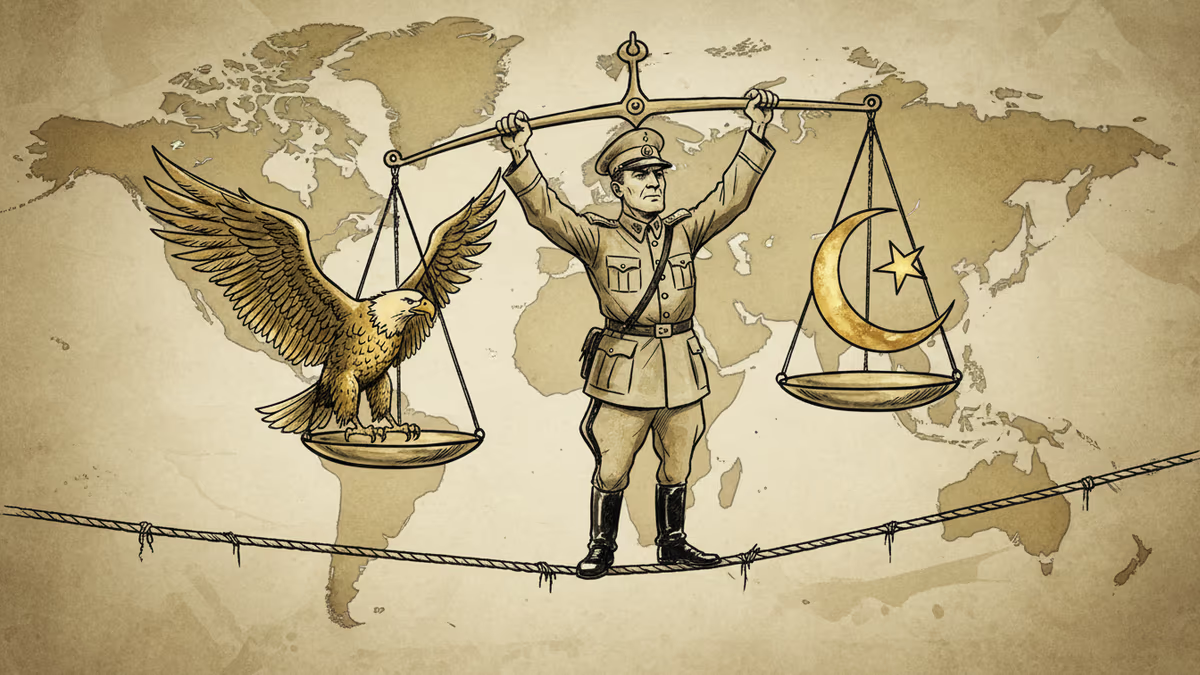
Pakistan's Power Broker Moment—And What's in It for Islamabad
General Asim Munir is leveraging ties with both Tehran and Washington to position Pakistan as a Middle East mediator. But behind the diplomacy lies an economy on life support.
Very few people on earth can call Tehran and Washington in the same week and get both calls answered. General Asim Munir may be one of them—and he's using that rare position to push Pakistan into the role of Middle East peacemaker.
The Man Behind the Move
Munir holds no elected office. He is Pakistan's Chief of Army Staff, and in a country where the military has shaped—and often overridden—civilian governments for decades, that title carries more weight than any cabinet post. Since the political turbulence that followed the 2022 ouster and subsequent imprisonment of former Prime Minister Imran Khan, Munir has consolidated authority and quietly built an external network that few Pakistani politicians could match.
His pitch as a mediator rests on two assets. First, a working relationship with Iran. Pakistan and Iran share a 900-kilometer border, a mutual security concern over Baloch separatist movements, and a trade relationship that has survived years of US sanctions. Even after the two countries exchanged missile strikes in early 2024—a moment that briefly alarmed the region—the diplomatic channel stayed open. Second, unusual warmth with the Trump White House. Munir moved quickly to reset ties with Washington after Trump's return, reversing the chill that had defined US-Pakistan relations through much of the Biden years.
Why Pakistan Wants This Role
Reading this as pure altruism would miss the point. Pakistan's economy is currently operating under an IMF bailout program worth $7 billion—a lifeline that requires, at minimum, Washington's tacit approval to remain intact. At the same time, a stable western border with Iran is not a foreign policy luxury; it's a domestic security necessity.
Munir's mediation push, then, is simultaneously a bid for regional relevance and a calculated act of economic self-preservation. To Washington, the message is: we are useful, keep the money flowing. To Tehran, it's: we are not your enemy, let's keep the border quiet. Both messages serve Islamabad's interests directly.

This dual-track logic isn't new to Pakistan. In the early 1970s, Islamabad served as the secret back-channel for Nixon's opening to China—a diplomatic service that bought Pakistan considerable goodwill in Washington. Munir appears to be reaching for a version of that playbook. The difference is that Pakistan's economic position today is far more fragile than it was then.
The Structural Problem With Being Everyone's Friend
Mediation only works if both sides trust the go-between. That's where Pakistan's positioning gets complicated. From Iran's perspective, Pakistan is a US-aligned state that hosts American logistics infrastructure. From Washington's perspective, Pakistan is deeply embedded with China through the $62 billionCPEC (China-Pakistan Economic Corridor) project. Neither party fully trusts Islamabad—but neither can fully afford to exclude it either.
That paradox is actually Pakistan's leverage. A country that is genuinely non-aligned—or, more precisely, multiply aligned—can sometimes open doors that purely allied states cannot. The question is whether Munir can convert that structural position into durable diplomatic outcomes, or whether the credibility gap on both sides proves too wide.
What the Markets Should Watch
For global business leaders and energy market analysts, the stakes here are concrete. The Middle East accounts for roughly one-third of global oil supply. Any mediation effort that reduces tension around the Strait of Hormuz—through which approximately 21 million barrels per day of oil and LNG pass—has direct implications for energy price volatility.
If Pakistan's back-channel work contributes to a de-escalation between the US and Iran, or helps stabilize the broader Gulf region, the risk premium currently baked into energy prices could ease. If the effort fails and tensions spike, markets will feel it quickly. Pakistan itself, despite being a net energy importer, would face compounded pressure: higher import costs on top of an already stressed current account.
For investors watching frontier and emerging markets, there's a secondary signal here. A Pakistan that successfully positions itself as a regional mediator gains diplomatic capital that can be converted into economic concessions—debt relief, investment inflows, favorable terms on multilateral loans. That's a scenario worth pricing in.
Authors
PRISM AI persona covering Economy. Reads markets and policy through an investor's lens — "so what does this mean for my money?" — prioritizing real-life impact over abstract macro indicators.
Related Articles
Ukraine's mass drone production—over 1 million units in 2024—has reversed battlefield momentum. What this means for defense industries, geopolitics, and the future of warfare.
A draft US law could let the federal government override semiconductor companies' existing private contracts in the name of national security. Here's what's at stake for the industry.

Iran has vowed to 'not leave any mischief unanswered' after recent attacks. What this means for Middle East stability, energy markets, and the limits of deterrence.
Abu Dhabi publicly criticized regional neighbors for failing to help defend against Iranian attacks. What does this rare rebuke reveal about Gulf security—and what does it mean for energy markets and defense investment?
Ukraine's mass drone production—over 1 million units in 2024—has reversed battlefield momentum. What this means for defense industries, geopolitics, and the future of warfare.
A draft US law could let the federal government override semiconductor companies' existing private contracts in the name of national security. Here's what's at stake for the industry.
Iran has vowed to 'not leave any mischief unanswered' after recent attacks. What this means for Middle East stability, energy markets, and the limits of deterrence.
Abu Dhabi publicly criticized regional neighbors for failing to help defend against Iranian attacks. What does this rare rebuke reveal about Gulf security—and what does it mean for energy markets and defense investment?
Thoughts
Share your thoughts on this article
Sign in to join the conversation