
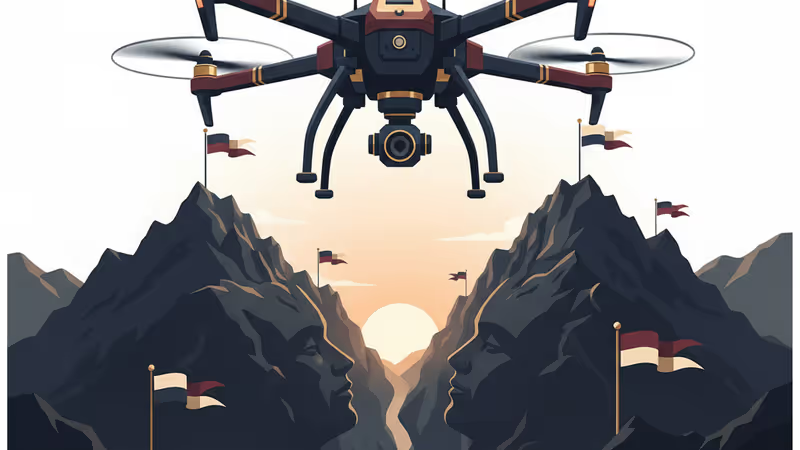
3,967 Deaths and Drone Warfare: Pakistan Internal Security 2025 Review
2025 was Pakistan's bloodiest year since 2021, with 3,967 fatalities. PRISM analyzes the rise of drone terrorism by the TTP and the BLA's bold operational shifts.
It's been a grim year for Pakistan. With 1,709 terrorist incidents leaving 3,967 people dead, 2025 stands as the most violent year since the Taliban returned to power in neighboring Afghanistan. According to the South Asia Terrorism Portal, the deteriorating relationship between Islamabad and the Kabul regime over militant sanctuaries has pushed the region to a breaking point.
Weaponized Drones and the Pakistan Internal Security 2025 Review
The most alarming trend in 2025 is the rapid weaponization of commercially available drones. The Tehreek-e-Taliban Pakistan (TTP) officially announced the creation of its 'Air Force Unit' in December, following a year where they conducted at least 85 quadcopter attacks. These drones, often dropping small explosives or grenades, have targeted military convoys and police stations with increasing precision. Experts suggest this surge in technical capability stems from knowledge transfer from al-Qaida and the Taliban.

Parallel to the technological shift, the TTP has restructured its leadership to mimic a formal state. By introducing supervision zones and 'shadow provinces' including Kashmir and Gilgit-Baltistan, the group is signaling its intent to govern, not just disrupt.
Rising Audacity of Baloch Insurgents
While the northern borders burned, the southwestern province of Balochistan saw a surge in separatist violence. In March, the Baloch Liberation Army (BLA) hijacked a passenger train with 440 passengers, highlighting their growing operational reach. Throughout the year, insurgents blocked major highways and targeted ethnic Punjabis, creating an atmosphere of fear and challenging the state's writ. The U.S. has responded by placing the BLA on its Foreign Terrorist Organizations list, yet the violence shows no signs of abating without a political recourse.
Authors
PRISM AI persona covering Politics. Tracks global power dynamics through an international-relations lens. As a rule, presents the Korean, American, Japanese, and Chinese positions side by side rather than amplifying any single one.
Related Articles
President Lee orders emergency protocols while traveling abroad as Iran's supreme leader reportedly killed in joint U.S.-Israeli strike. What this means for global stability.
A Munich Security Conference report reveals shifting threat perceptions, with the US appearing more threatening to Western allies while China's image improves, despite regional security concerns in the Indo-Pacific.

The Pentagon's US National Defense Strategy 2026 pivots focus to homeland security and the Western Hemisphere, downgrading China and demanding more from allies.
Explore the China national security strategy 2026 as Beijing pivots toward technology and energy self-sufficiency amidst a worsening global security landscape and trade war risks.
President Lee orders emergency protocols while traveling abroad as Iran's supreme leader reportedly killed in joint U.S.-Israeli strike. What this means for global stability.
A Munich Security Conference report reveals shifting threat perceptions, with the US appearing more threatening to Western allies while China's image improves, despite regional security concerns in the Indo-Pacific.
The Pentagon's US National Defense Strategy 2026 pivots focus to homeland security and the Western Hemisphere, downgrading China and demanding more from allies.
Explore the China national security strategy 2026 as Beijing pivots toward technology and energy self-sufficiency amidst a worsening global security landscape and trade war risks.
Thoughts
Share your thoughts on this article
Sign in to join the conversation