
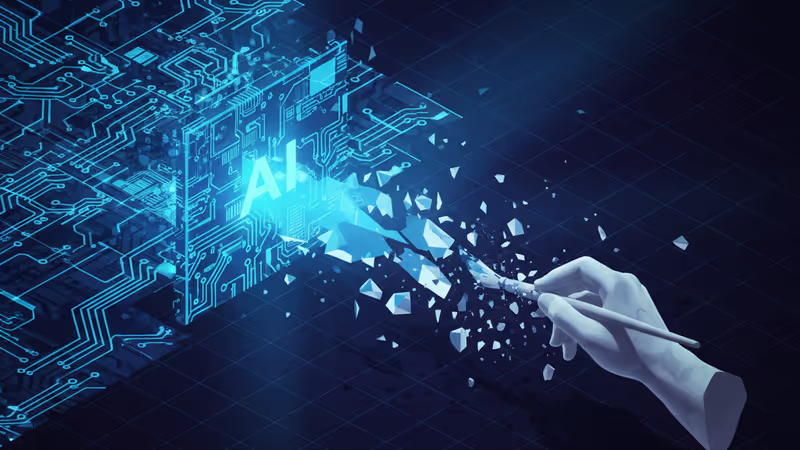
OpenAI's New Image Model Isn't Just Faster—It's a Strategic Assault on the Creative Enterprise
OpenAI's new GPT-Image-1.5 model is more than a speed upgrade. It's a strategic move to dominate the enterprise AI space. Our analysis explains why.
The Lede: Speed as a Weapon
OpenAI just announced a significant upgrade to its image generation model within ChatGPT, now available as GPT-Image-1.5 in its API. While the headlines will focus on the 4x speed boost and enhanced precision, the real story isn't about better pictures. It's a calculated strategic move to shift AI imagery from a novelty art tool into an indispensable, high-velocity utility for developers and businesses. OpenAI is sacrificing the esoteric artistry of rivals like Midjourney for something far more valuable in the long run: scalable, integrated, enterprise-grade infrastructure.
Why It Matters
This update is more than a simple feature bump; it's a tremor that redefines the competitive landscape. The AI image generation market is bifurcating, and this move clarifies OpenAI's position.
- The Battle for Workflow, Not Walls: While Midjourney continues to dominate the high-end, artistic generation space (think digital art for display), its closed ecosystem and lack of an API are significant weaknesses. OpenAI is exploiting this by building a horizontal platform. GPT-Image-1.5 is designed to be embedded everywhere, from marketing automation platforms to design software, making it the 'good enough' engine that's always at hand.
- The Economics of Scale: A 4x speed increase isn't just a user convenience; it's a fundamental change in unit economics. Faster generation means lower computational cost (inference cost), making it commercially viable to generate images at a massive scale. This unlocks applications previously too expensive to consider, like real-time personalized ad creatives or dynamic e-commerce product shots.
- Lowering the Skill Floor: The emphasis on "more precise edits" and "consistent details" signals a move away from the arcane art of 'prompt engineering.' The goal is to make professional-quality image creation accessible to marketers, product managers, and developers without them needing to become AI whisperers. This drastically expands the total addressable market.
The Analysis: From Magic Trick to Power Tool

To understand the gravity of this release, we must look at the evolution of the market and the competitive dynamics at play.
Historical Context: The End of the 'Wow' Era
The first wave of AI image generation, led by DALL-E and early Midjourney, was about producing surreal, shocking, and beautiful images that demonstrated the technology's potential. It was a magic show. We've now entered the second act: the era of utility. The market is maturing from asking "Can it do this?" to "How can I reliably integrate this into my product and business?" Consistency, speed, and API access are the new battlegrounds, and OpenAI is planting its flag firmly on this territory.
Competitive Dynamics: A Differentiated War
OpenAI isn't trying to out-Midjourney Midjourney. It's playing a different game entirely.
- vs. Midjourney: Midjourney is the boutique art studio, producing stunning, bespoke pieces. OpenAI's GPT-Image-1.5 is the high-volume manufacturing plant. By making its model available via API, OpenAI empowers a thousand other companies to build creative tools, while Midjourney remains a destination tool.
- vs. Stable Diffusion: Stable Diffusion's power lies in its open-source flexibility and fine-tuning capabilities, attracting a deeply technical user base. OpenAI is competing on simplicity and integration. It's betting that the majority of the market wants a powerful, turnkey solution integrated into a platform they already use (ChatGPT) and can easily build upon (the API).
PRISM's Take
OpenAI's GPT-Image-1.5 is a trojan horse. While the public sees a faster image generator inside ChatGPT, the strategic objective is the domination of the B2B and developer AI market. By prioritizing industrial-grade speed, reliability, and API-first integration over niche artistic perfection, OpenAI is betting that the future of generative media isn't in a standalone app, but as a foundational, invisible layer powering a million other applications. This isn't just an update; it's a declaration that the war for AI platform supremacy is heating up.
Authors
Related Articles
Google's Gmail Live lets you ask your inbox questions out loud. Announced at I/O 2026, it's AI's pitch to skeptics — and a reminder of how much Google already knows about you.

OpenAI has reorganized for the second time in a month, merging ChatGPT and Codex into a single agentic platform under president Greg Brockman's unified product leadership.

After two weeks of witnesses calling him a liar, OpenAI CEO Sam Altman testified in his own defense, claiming Elon Musk tried to kill the company twice.
Sam Nelson, 19, died after following ChatGPT's advice to mix Kratom and Xanax. His parents are suing OpenAI for wrongful death, raising urgent questions about AI trust, liability, and design.
Google's Gmail Live lets you ask your inbox questions out loud. Announced at I/O 2026, it's AI's pitch to skeptics — and a reminder of how much Google already knows about you.
OpenAI has reorganized for the second time in a month, merging ChatGPT and Codex into a single agentic platform under president Greg Brockman's unified product leadership.
After two weeks of witnesses calling him a liar, OpenAI CEO Sam Altman testified in his own defense, claiming Elon Musk tried to kill the company twice.
Sam Nelson, 19, died after following ChatGPT's advice to mix Kratom and Xanax. His parents are suing OpenAI for wrongful death, raising urgent questions about AI trust, liability, and design.
Thoughts
Share your thoughts on this article
Sign in to join the conversation