

OpenAI's 28-Day Android App: The Dawn of the AI-Native Development Stack
OpenAI built the Sora Android app in just 28 days using AI. This isn't just faster coding—it's a new paradigm for software development. Here's what it means.
The 28-Day Challenge: A New Benchmark for Tech
OpenAI didn't just ship an Android app for its groundbreaking video model, Sora. They did it in 28 days. For any CTO or engineering lead, that timeline is a siren call. This wasn't achieved through brute force or a massive team; it was accomplished by a small, nimble group using AI—specifically Codex—not just as a coding assistant, but as a core part of the development workflow. This isn't an incremental improvement; it's a paradigm shift that signals the dawn of the AI-Native Development Stack, fundamentally altering the economics of software creation.
Why This Matters: Speed Becomes the Ultimate Moat
In the tech industry, speed is the ultimate competitive advantage. OpenAI's feat compresses product cycles from quarters into a single month. This has profound implications that go far beyond one app launch:
- The Economics of Talent: A small, AI-augmented team can now achieve the output of a much larger, traditional engineering organization. This forces a complete re-evaluation of hiring strategies, team structures, and R&D budgets.
- Strategic Agility: The ability to conceptualize, build, and ship a cross-platform application in weeks instead of months allows companies to react to market changes with unprecedented speed. Your roadmap is no longer a static yearly plan; it's a dynamic, responsive system.
- Second-Order Effects: When the barrier to creating high-quality software plummets, the market will see an explosion of new applications. The new bottleneck won't be development, but rather product discovery, marketing, and maintaining a high signal-to-noise ratio.

The Analysis: From Co-Pilot to Project Architect
For years, AI in coding has been about assistance. Tools like GitHub Copilot write functions and boilerplate code, acting as a super-powered pair programmer. OpenAI's approach represents a leap in abstraction. The AI is no longer just a co-pilot; it's becoming the architect and project manager.
Deconstructing the AI-Native Stack
The success of the Sora for Android project hinges on three core pillars, which represent a new model for software engineering:
- AI-Assisted Planning: This moves beyond simple task generation. It implies the AI can take a high-level product requirement, break it down into a detailed technical specification, define API contracts, and structure the entire project architecture before a human writes a single line of high-level code.
- AI-Assisted Translation: This is the death of the painful, manual 'porting' project. Translating a codebase from one language or platform to another (e.g., Swift for iOS to Kotlin for Android) has historically been a resource-intensive and error-prone process. AI models like Codex can now automate the vast majority of this work, freeing up human engineers to focus on platform-specific optimizations and UX.
- Parallel Coding Workflows: This is perhaps the most revolutionary concept. An AI system can manage and execute multiple coding tasks in parallel, ensuring that different components integrate seamlessly. It's like having a team of junior developers, managed by a senior AI architect, working 24/7 without communication overhead.
PRISM's Take
This is the starting gun for a new arms race in enterprise software development. The 28-day Sora app is proof that AI-managed development is no longer theoretical. The competitive moat for tech companies is rapidly shifting from the size of their engineering department to the sophistication of their internal AI development tools and workflows. Companies that fail to adapt, treating AI as a mere productivity add-on rather than a foundational layer of their engineering stack, will be outmaneuvered and out-built by leaner, faster, AI-native competitors.
This content is AI-generated based on source articles. While we strive for accuracy, errors may occur. We recommend verifying with the original source.
Related Articles

Cerebras Systems has refiled for an IPO targeting mid-May, backed by a $23B valuation, a reported $10B OpenAI deal, and an AWS partnership. What does this mean for Nvidia's dominance and the AI chip landscape?
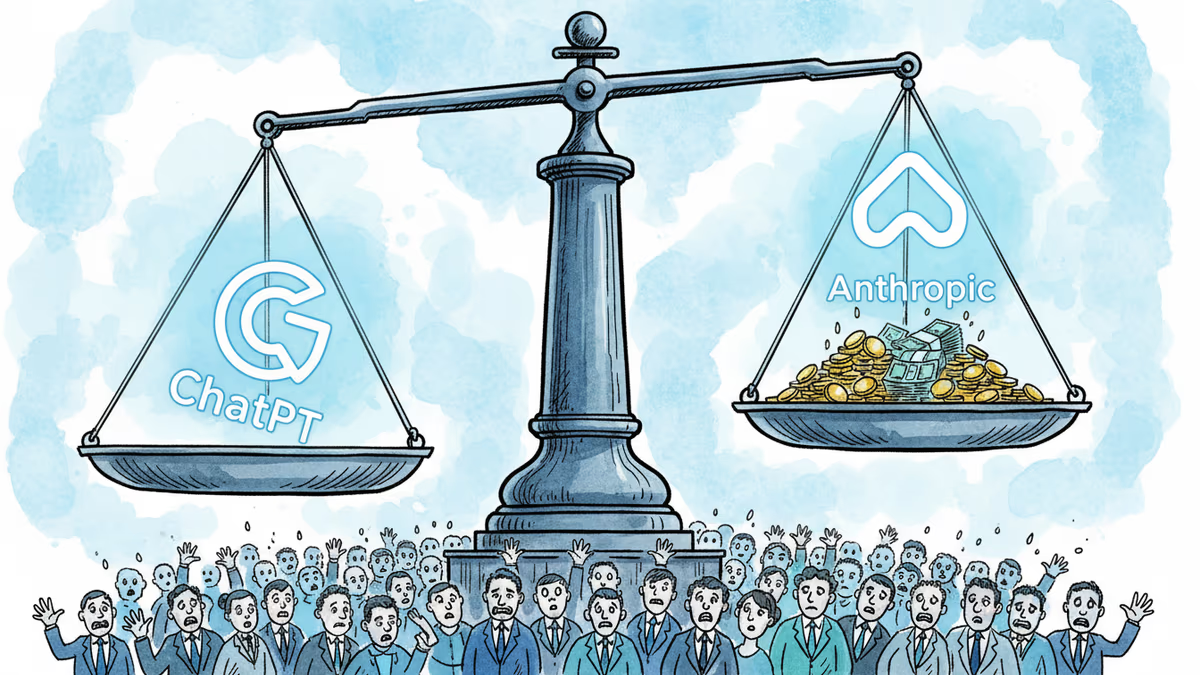
OpenAI's $852B valuation is drawing skepticism from its own backers as Anthropic's ARR tripled in three months. The secondary market is already voting with its feet.
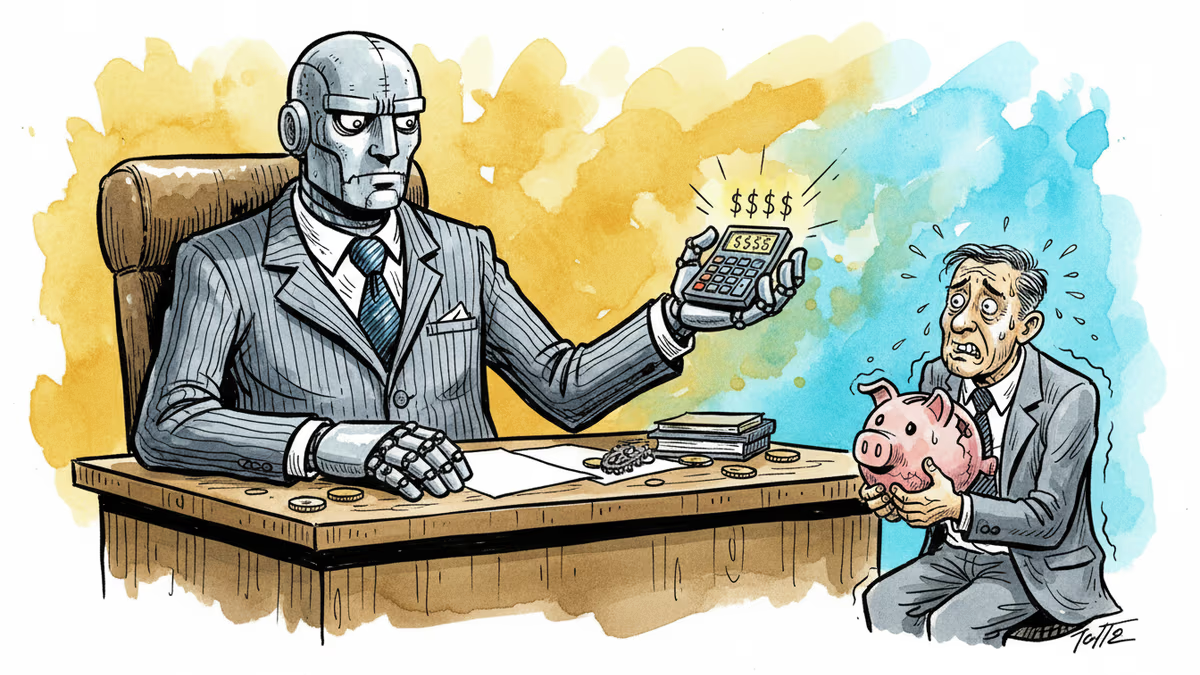
OpenAI acquired Hiro Finance, an AI-powered personal finance startup. Is this just a talent grab, or is the ChatGPT maker quietly building a financial services empire?

OpenAI CEO Sam Altman's San Francisco residence was attacked twice in three days — first a Molotov cocktail, then a shooting. What does this say about tech power, public anger, and the real-world risks facing AI leaders?
Cerebras Systems has refiled for an IPO targeting mid-May, backed by a $23B valuation, a reported $10B OpenAI deal, and an AWS partnership. What does this mean for Nvidia's dominance and the AI chip landscape?
OpenAI's $852B valuation is drawing skepticism from its own backers as Anthropic's ARR tripled in three months. The secondary market is already voting with its feet.
OpenAI acquired Hiro Finance, an AI-powered personal finance startup. Is this just a talent grab, or is the ChatGPT maker quietly building a financial services empire?
OpenAI CEO Sam Altman's San Francisco residence was attacked twice in three days — first a Molotov cocktail, then a shooting. What does this say about tech power, public anger, and the real-world risks facing AI leaders?
Thoughts
Share your thoughts on this article
Sign in to join the conversation