
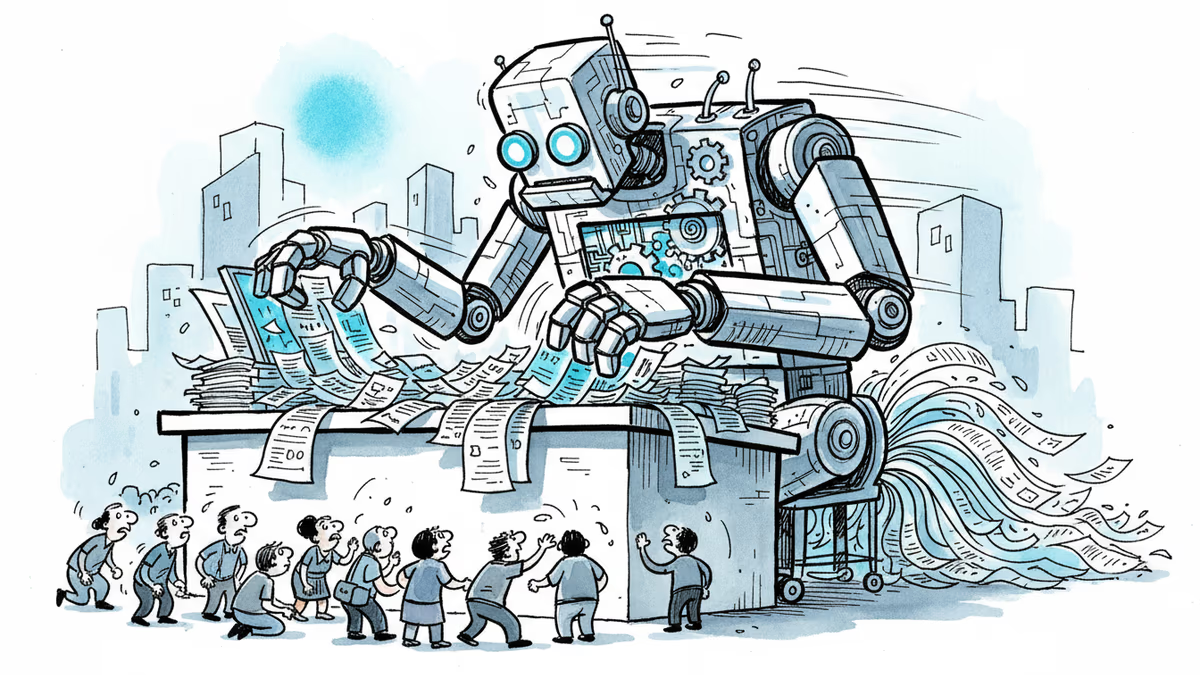
Why OpenAI Just Dove Into India's Payment Wars
OpenAI partners with Pine Labs to embed AI into payment infrastructure, moving beyond ChatGPT into regulated financial workflows. What this means for fintech globally.
$126 Billion in Transactions, Now AI-Powered
What happens when the company behind ChatGPT decides to rewire how money moves? OpenAI just announced a partnership with Indian fintech giant Pine Labs to embed AI directly into payment infrastructure—not just customer service chatbots, but the actual plumbing of commerce.
The numbers tell the story: Pine Labs processes payments for over 980,000 merchants across 20 countries, handling 6 billion transactions worth over ₹11.4 trillion ($126 billion). Now, OpenAI's APIs will automate settlement, reconciliation, and invoicing workflows that currently require armies of human operators.
Pine Labs CEO B Amrish Rau says they've already cut daily settlement processing from hours to minutes using AI internally. What used to require dozens of employees manually checking funds from multiple banks before markets opened is now largely handled by AI-driven systems.
Beyond ChatGPT: The Infrastructure Play
This partnership signals OpenAI's ambitious pivot from consumer AI darling to enterprise infrastructure provider. India represents one of OpenAI's fastest-growing markets, and this week alone, the company also partnered with leading Indian engineering and medical institutions to bring AI tools into higher education.
"People talk about retail AI, but the bigger impact is really efficiency improvement, especially in B2B," Rau told TechCrunch. "If you look at invoicing and settlement, those are workflows where agents can actually drive the process end to end."

The rollout strategy reveals regulatory realities: while Pine Labs is already prototyping agent-driven payments in the Middle East and Southeast Asia, Indian regulations require tighter controls. The company expects gradual adoption focused on AI-assisted rather than fully autonomous payments.
The Revenue Model That Changes Everything
Here's where it gets interesting: there's no revenue sharing between the companies. "We've kept it completely independent—anything related to payment services, we get the benefit, and anything related to OpenAI revenues goes to them," Rau explained. It's similar to OpenAI's partnership with Stripe in the US, and notably non-exclusive.
This structure suggests OpenAI is prioritizing market penetration over immediate monetization. By making integration financially painless for partners, they're essentially subsidizing their way into regulated financial infrastructure—a notoriously difficult market to crack.
For Pine Labs, the bet is on merchant stickiness. By offering AI-powered efficiency gains, they're positioning themselves as more than a payment processor—they want to become the comprehensive commerce platform that merchants can't afford to leave.
The Bigger Game
This announcement comes as India hosts its AI Impact Summit in New Delhi, where global AI companies including Anthropic and Google are showcasing capabilities alongside Indian startups. The timing isn't coincidental—it's a statement about where the real AI adoption will happen: not in flashy consumer apps, but in the boring, profitable world of B2B workflows.
Rau noted that Pine Labs is building additional security and compliance layers around AI-driven workflows, acknowledging that moving fast in financial services means moving carefully. The focus remains on ensuring transactions stay secure and compliant even as more processes become automated.
Authors
Related Articles
SpaceX's IPO filing puts AI at the center, claiming a $26.5 trillion market opportunity. But can Grok compete with OpenAI and Anthropic for enterprise customers?

OpenAI has reorganized for the second time in a month, merging ChatGPT and Codex into a single agentic platform under president Greg Brockman's unified product leadership.
After two weeks of witnesses calling him a liar, OpenAI CEO Sam Altman testified in his own defense, claiming Elon Musk tried to kill the company twice.
Sam Nelson, 19, died after following ChatGPT's advice to mix Kratom and Xanax. His parents are suing OpenAI for wrongful death, raising urgent questions about AI trust, liability, and design.
SpaceX's IPO filing puts AI at the center, claiming a $26.5 trillion market opportunity. But can Grok compete with OpenAI and Anthropic for enterprise customers?
OpenAI has reorganized for the second time in a month, merging ChatGPT and Codex into a single agentic platform under president Greg Brockman's unified product leadership.
After two weeks of witnesses calling him a liar, OpenAI CEO Sam Altman testified in his own defense, claiming Elon Musk tried to kill the company twice.
Sam Nelson, 19, died after following ChatGPT's advice to mix Kratom and Xanax. His parents are suing OpenAI for wrongful death, raising urgent questions about AI trust, liability, and design.
Thoughts
Share your thoughts on this article
Sign in to join the conversation