
Why Big Tech Needs Big Consulting to Sell AI
OpenAI partners with McKinsey, BCG, Accenture, and Capgemini to crack the enterprise market. Why direct sales aren't working and what this means for AI adoption.
The $200 Billion Consulting Industry Just Became AI's Sales Force
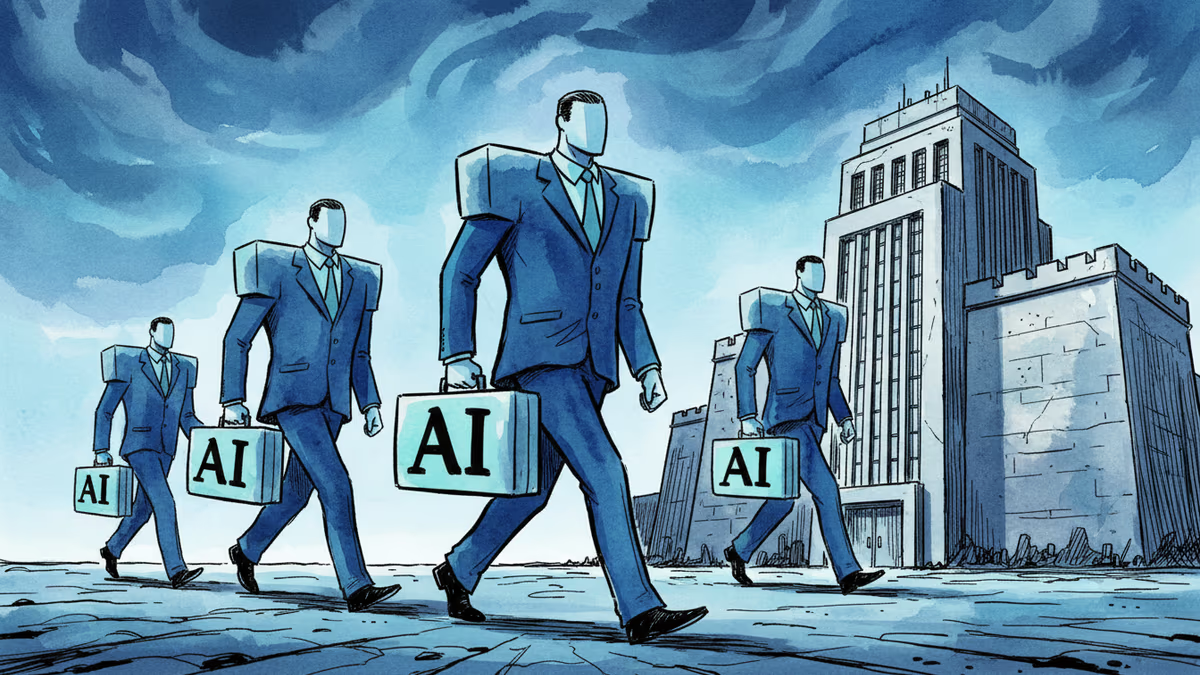
OpenAI's "Frontier Alliance" announcement on Monday isn't just another partnership. It's an admission: selling AI directly to enterprises isn't working. So the company that created ChatGPT is outsourcing its enterprise sales to the world's biggest consulting firms—McKinsey, BCG, Accenture, and Capgemini.
The move signals a fundamental shift in how AI companies approach the enterprise market. Instead of pitching technology, they're now selling transformation.
Why Enterprises Are Still AI-Skeptical
Despite the AI hype, enterprise adoption remains sluggish. The reason isn't technical—it's practical. Companies struggle to find meaningful ROI from their AI investments. They're drowning in proof-of-concept projects that never scale.
BCG CEO Christoph Schweizer nailed the problem: "AI alone does not drive transformation. It must be linked to strategy, built into redesigned processes, and adopted at scale with aligned incentives and culture."
This is exactly why OpenAI needs consulting giants. They don't just implement technology—they redesign entire business operations around it.
The Consulting Playbook for AI

The alliance focuses on OpenAI's new Frontier platform, a no-code tool for building AI agents. But the real product isn't software—it's organizational change management.
Consulting firms excel at this. They can walk into a Fortune 500 company and say: "We're not here to install AI. We're here to reimagine how you work." That's a $500,000 engagement versus a $50,000 software license.
Anthropic is following the same playbook with Deloitte and Accenture partnerships. The entire AI industry is pivoting from direct sales to consulting-mediated transformation.
What This Means for IT Leaders
For enterprise IT leaders, this shift changes everything. AI procurement is no longer a technology decision—it's a strategy consultation. Expect longer sales cycles, higher budgets, and more C-suite involvement.
The upside? Better implementation success rates. Consulting-led AI projects typically have 3x higher adoption rates than DIY approaches, according to industry data.
The downside? Vendor lock-in through process dependency. Once a consulting firm redesigns your workflows around specific AI tools, switching becomes exponentially harder.
The New AI Value Chain
We're witnessing the emergence of a new value chain: AI companies create the technology, consulting firms package it into business solutions, and enterprises buy transformation rather than tools.
This model benefits everyone—except perhaps the enterprises paying premium prices for what used to be direct software purchases.
Authors
Related Articles

OpenAI has reorganized for the second time in a month, merging ChatGPT and Codex into a single agentic platform under president Greg Brockman's unified product leadership.
After two weeks of witnesses calling him a liar, OpenAI CEO Sam Altman testified in his own defense, claiming Elon Musk tried to kill the company twice.

Sam Nelson, 19, died after following ChatGPT's advice to mix Kratom and Xanax. His parents are suing OpenAI for wrongful death, raising urgent questions about AI trust, liability, and design.

OpenAI's new Daybreak initiative uses the Codex AI agent to find and patch security vulnerabilities before attackers do—putting it in direct competition with Anthropic's secretive Claude Mythos.
OpenAI has reorganized for the second time in a month, merging ChatGPT and Codex into a single agentic platform under president Greg Brockman's unified product leadership.
After two weeks of witnesses calling him a liar, OpenAI CEO Sam Altman testified in his own defense, claiming Elon Musk tried to kill the company twice.
Sam Nelson, 19, died after following ChatGPT's advice to mix Kratom and Xanax. His parents are suing OpenAI for wrongful death, raising urgent questions about AI trust, liability, and design.
OpenAI's new Daybreak initiative uses the Codex AI agent to find and patch security vulnerabilities before attackers do—putting it in direct competition with Anthropic's secretive Claude Mythos.
Thoughts
Share your thoughts on this article
Sign in to join the conversation