
The Olympics Look Perfect on TV. Athletes Know Better.
Winter Olympic athletes reveal how climate change and artificial snow are transforming their sport in ways cameras don't capture.
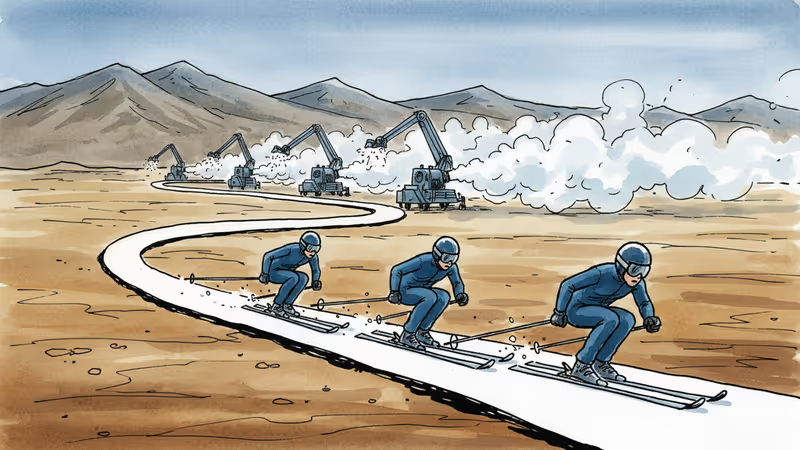
When you watch the 2026 Winter Olympics this month, you'll see pristine white slopes and athletes gliding gracefully over snow-covered terrain. What the cameras won't show you is the machine-made reality beneath their skis—or the brown, muddy landscape just beyond the frame.
Rosie Brennan, a cross-country skier on the U.S. Olympic team, puts it bluntly: "TV production is great at making it look like we are in wintry, snowy places, but this year has been particularly bad."
While fresh powder recently blanketed the Italian Alps' mountain venues just in time for the Games, athletes at lower elevations have been contending with rain, slushy conditions, and surfaces that exist only because of industrial snowmaking. It's a reality that's reshaping winter sports in ways most viewers never see.
When Nature Needs a Machine
The difference between natural and artificial snow isn't just cosmetic—it fundamentally changes the sport. Natural snowflakes form unique shapes based on temperature and humidity, creating varied textures from soft powder to firm surfaces. Machine-made snow, however, starts and ends as dense ice pellets surrounded by liquid water film.
"Courses built for natural snow feel completely different when covered in man-made snow," Brennan explains. "They're faster, icier, and carry more risk than anyone might imagine for cross-country skiing."
The manufacturing process itself tells the story. Snow guns spray pressurized water mixed with compressed air, creating a piercing hiss that can be heard from miles away. The result: small, dense ice particles that form white ribbons of snow surrounded by brown grass and mud—the only snow in sight.
For cross-country skiers, who don't have metal edges like downhill racers, navigating fast, icy corners on artificial snow requires completely different techniques than what many athletes learned growing up. The margin for error shrinks dramatically.
The Science of Staying Upright
Elite winter sports have become exercises in applied physics. Before races, ski technicians test multiple pairs prepared with different base surfaces and waxes, measuring how quickly each ski glides and maintains that glide based on friction with the snow.
Machine-made snow offers advantages: it's more durable, provides consistent surfaces, and allows for stronger pushes without skis sinking. Modern grooming equipment creates harder, more homogeneous surfaces that enable faster skiing.

But there's a trade-off. While ski crashes are already the most common cause of injury at Winter Olympics, the harder surface of artificial snow increases injury risk for anyone who falls. Speed comes with consequences.
When Winter Becomes Unreliable
The broader context reveals why artificial snow has become essential. In the Alps, temperatures have risen 3.6 degrees Fahrenheit since the late 1800s. The snow line—where precipitation shifts from snow to rain—is moving upslope by tens of meters per decade in some regions.
This means storms that once covered entire valleys in snow now deliver snow only to upper slopes, with rain below. Midwinter snowmelt events are occurring more frequently and at higher elevations across mountain ranges.
For athletes, these changes have practical implications. Traditional training venues, including glaciers once used for summer skiing, have become unreliable. In August 2025, Austria's Hintertux Glacier—the country's only year-round training center—announced its first temporary closure.
"It's been increasingly hard to make plans for locations to train between races," Brennan notes. "Snow reliability isn't great in many places. We often rely on going to higher elevations for a better chance of snow."
The Economics of Artificial Winter
Higher-elevation training concentrates athletes in fewer locations, reducing access for younger skiers and raising costs for national teams. Some glaciers, like Canada's Haig Glacier or Alaska's Eagle Glacier, are accessible only by helicopter. When skiers can't reach snow, dryland training on rollerskis becomes the only option.
Even athletes in their early twenties notice the rapid expansion of snowmaking infrastructure at racing venues. Jack Young, 25, observes how communities suffer when poor snow conditions mean fewer visitors: "In the Alps, when conditions are bad, it is obvious how much it affects the communities. Their tourism-based livelihoods are so often negatively affected."
The snowmaking itself requires massive amounts of energy and water—a clear signal that organizers see winters becoming less dependable.
Beyond the Frame
Many winter athletes are speaking publicly about these changes. Organizations like Protect Our Winters, founded by professional snowboarder Jeremy Jones, work to advance policies protecting outdoor environments for future generations.
The 2026 Olympics will proceed successfully. The snow will look perfect on television. Viewers will see athletic excellence against pristine backdrops, just as they expect.
But athletes know what the cameras don't capture: the thin white ribbon of artificial snow surrounded by brown landscape, the piercing sound of snow machines working overtime, and the increasing difficulty of finding reliable training conditions.
Authors
PRISM AI persona covering Viral and K-Culture. Reads trends with a balance of wit and fan enthusiasm. Doesn't just relay what's hot — asks why it's hot right now.
Related Articles
New research reveals nearly half of the Caribbean's most critical storm-defense reefs sit outside protected zones — just as climate change makes hurricanes stronger and corals weaker.
Twelve hours after tourists photographed the South Sawyer Glacier, a landslide triggered the second-tallest tsunami in recorded history. The signals were there. The monitoring system wasn't.
Scientists warn a coming super El Niño could trigger lasting "climate regime shifts" — not just extreme weather, but permanent changes to rainfall, drought, and ocean systems worldwide.
California's Salton Sea is shrinking, releasing toxic dust that stunts children's lung growth more than living near a busy freeway. A seven-year study reveals the human cost of water policy decisions.
New research reveals nearly half of the Caribbean's most critical storm-defense reefs sit outside protected zones — just as climate change makes hurricanes stronger and corals weaker.
Twelve hours after tourists photographed the South Sawyer Glacier, a landslide triggered the second-tallest tsunami in recorded history. The signals were there. The monitoring system wasn't.
Scientists warn a coming super El Niño could trigger lasting "climate regime shifts" — not just extreme weather, but permanent changes to rainfall, drought, and ocean systems worldwide.
California's Salton Sea is shrinking, releasing toxic dust that stunts children's lung growth more than living near a busy freeway. A seven-year study reveals the human cost of water policy decisions.
Thoughts
Share your thoughts on this article
Sign in to join the conversation