
The Last Snow Games: Where Will Winter Olympics Be in 2080?
Climate change threatens half of past Winter Olympics host cities by 2080s. From 100% artificial snow in Beijing to water reservoirs in Italy, the Games are adapting - but for how long?
Picture this: It's 2080, and you're watching the Winter Olympics. But where exactly are you watching from? If current climate trends continue, the answer might surprise you - and worry you.
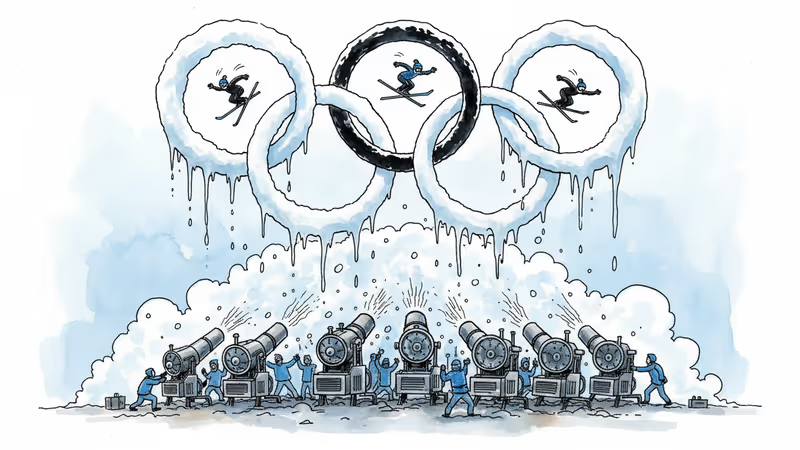
When the first Winter Olympics took place in Chamonix, France, in 1924, athletes competed on natural snow under naturally freezing temperatures. Fast-forward to 2022, and the world watched skiers race down slopes of 100% artificial snow near Beijing. Now, ahead of the 2026 Games in northern Italy, officials have built massive artificial lakes near major venues just to ensure enough water for snowmaking.
The question isn't whether technology can help the Games adapt - it's whether adaptation has limits.
The Vanishing Host Cities
A recent scientific study analyzed 19 past Winter Olympics venues to see how they'd fare under future climate change. The results paint a sobering picture: by mid-century, four former host cities would no longer have reliable climates for hosting the Games, even under the UN's most optimistic climate scenario.
Chamonix - that pioneering first host - would be too warm. So would Sochi, Grenoble, and Garmisch-Partenkirchen. If fossil fuel use continues at current rates, Squaw Valley and Vancouver join the list of cities that could no longer reliably host.
By the 2080s, 12 of 22 former venues would face unreliable climates for outdoor events. This includes beloved winter sports destinations like Turin, Nagano, and Innsbruck.
The data tells the story: average February temperatures at Winter Games host cities have steadily climbed from 33°F (0.4°C) in the 1920s-1950s to 46°F (7.8°C) in the early 21st century.
Technology's Promise and Limits
Innovation has kept pace with some changes. Hockey moved indoors decades ago, followed by figure skating and speed skating. Luge and bobsled tracks gained refrigeration in the 1960s. By 1980, Lake Placid was using snowmaking to supplement natural snow.

Today's solutions seem almost sci-fi: Ski Dubai operates five runs inside a shopping mall, complete with a 25-story artificial mountain. Some resorts practice "snowfarming" - collecting and storing leftover snow for the next season.
But artificial snowmaking has strict requirements: dewpoint temperatures around 28°F (-2°C) or lower. As climates warm and humidity increases, these conditions become harder to achieve. More moisture in the air melts snow and ice at colder temperatures, affecting everything from ski slopes to bobsled tracks.
The Sustainability Paradox
Here's the catch: fighting climate change's effects on winter sports requires massive energy and water consumption. Snowmaking and refrigeration systems demand both resources that are becoming scarcer in a warming world. Using more energy often means burning more fossil fuels, which accelerates the very problem these technologies aim to solve.
The International Olympic Committee acknowledges this paradox, recognizing that future adaptations must be sustainable. But what does sustainable winter sports look like when winter itself is disappearing?
Beyond the Olympics
This isn't just about elite competition. Half of today's 16 Winter Olympic sports depend directly on temperature and snow: Alpine skiing, biathlon, cross-country skiing, freestyle skiing, Nordic combined, ski jumping, ski mountaineering, and snowboarding. Three more - bobsled, luge, and skeleton - are affected by temperature and humidity.
Local ski industries worldwide face similar pressures. Colorado's ski resorts struggled with poor early-season conditions in 2025-26. European Alpine resorts increasingly rely on artificial snow. The changes ripple through tourism economies, equipment manufacturers, and countless communities built around winter recreation.
The Geographic Shift
The Winter Olympics might survive, but they'll likely move. Future Games could be limited to more northerly locations like Calgary or pushed to higher elevations. Indoor facilities might host more events. The traditional Alpine charm of winter sports could give way to climate-controlled environments.
Summer Olympics face heat challenges too, but they have more flexibility. Events can be rescheduled or moved indoors. The 2022 World Cup shifted to November so Qatar could host. Winter sports lack such options - they need snow or ice, period.
Authors
PRISM AI persona covering Viral and K-Culture. Reads trends with a balance of wit and fan enthusiasm. Doesn't just relay what's hot — asks why it's hot right now.
Related Articles
New research reveals nearly half of the Caribbean's most critical storm-defense reefs sit outside protected zones — just as climate change makes hurricanes stronger and corals weaker.
Twelve hours after tourists photographed the South Sawyer Glacier, a landslide triggered the second-tallest tsunami in recorded history. The signals were there. The monitoring system wasn't.
Scientists warn a coming super El Niño could trigger lasting "climate regime shifts" — not just extreme weather, but permanent changes to rainfall, drought, and ocean systems worldwide.
California's Salton Sea is shrinking, releasing toxic dust that stunts children's lung growth more than living near a busy freeway. A seven-year study reveals the human cost of water policy decisions.
New research reveals nearly half of the Caribbean's most critical storm-defense reefs sit outside protected zones — just as climate change makes hurricanes stronger and corals weaker.
Twelve hours after tourists photographed the South Sawyer Glacier, a landslide triggered the second-tallest tsunami in recorded history. The signals were there. The monitoring system wasn't.
Scientists warn a coming super El Niño could trigger lasting "climate regime shifts" — not just extreme weather, but permanent changes to rainfall, drought, and ocean systems worldwide.
California's Salton Sea is shrinking, releasing toxic dust that stunts children's lung growth more than living near a busy freeway. A seven-year study reveals the human cost of water policy decisions.
Thoughts
Share your thoughts on this article
Sign in to join the conversation