
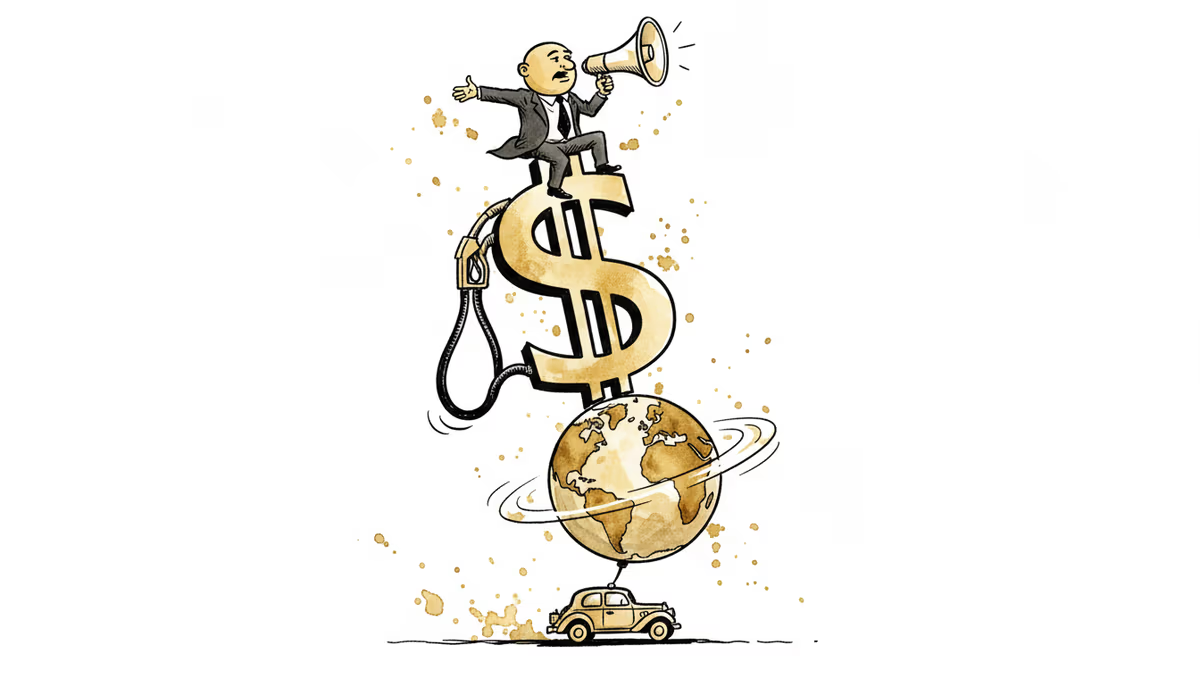
Oil at $100? What Trump's 'Forever' Threat Really Costs You
Major banks are quietly raising oil price forecasts toward $100 a barrel after Trump's 'fight forever' declaration. Here's who wins, who loses, and what it means for your wallet.
The last time oil crossed $100 a barrel, families quietly stopped taking road trips, airlines quietly raised fares, and central banks quietly shelved rate cuts. It's happening again — quietly.
After Donald Trump declared the United States could keep fighting "forever," leading banks began revising their oil price outlooks upward. The target: $100 per barrel or beyond. As of mid-March 2026, crude is hovering around $80 — meaning the forecasts imply a 25% surge still on the table. That's not a rounding error. That's a different economy.
Why These Words, Why Now
Trump's rhetoric didn't land in a vacuum. It arrived at the intersection of three simultaneous pressure points: stalled nuclear negotiations with Iran, a renewed Houthi campaign disrupting Red Sea shipping lanes, and OPEC+ reaffirming its production cuts with no signs of reversing course.
When Goldman Sachs, JPMorgan, and peers update their price models, they're not just making bets — they're pricing in risk for clients who need to hedge. The $100 figure isn't a prediction so much as a warning: if supply disruptions compound, this is where the math lands. Markets are already embedding a geopolitical premium into every barrel traded.
The timing matters for another reason. The global economy in early 2026 is not in the same shape it was in 2022. Inflation has cooled, but it hasn't been declared dead. Central banks from the Federal Reserve to the European Central Bank have been cautiously pivoting toward easing. A sustained oil price spike could freeze those pivots mid-turn.
What $100 Oil Actually Costs an Average Household

Let's be concrete. In the United States, every $10 increase in the price of a barrel of oil translates to roughly 25–30 cents more per gallon at the pump. At $100/barrel, American drivers could be looking at national average gas prices above $4.50 per gallon — territory last seen during the 2022 energy shock.
For a household driving 1,500 miles per month in an average fuel-efficiency vehicle, that's an extra $50–$80 per month in fuel costs alone. Multiply that by 12 months and you're looking at nearly $1,000 in additional annual spending — before accounting for the knock-on effects on groceries, flights, and heating bills.
Airlines are already watching nervously. Jet fuel accounts for 20–25% of airline operating costs. United, Delta, and American have all flagged fuel volatility in recent earnings calls. If oil sustains above $90, expect surcharges to follow within weeks, not months.
Winners, Losers, and the Uncomfortable Middle
Not everyone loses when oil spikes. ExxonMobil, Chevron, Shell, and the broader energy sector stand to book significant windfall profits — as they did in 2022, when ExxonMobil posted a record $55.7 billion annual profit. Investors in energy ETFs enjoyed returns that made the rest of the market look pedestrian.
But the winners are concentrated and the losers are diffuse. Energy company shareholders — often institutional investors and pension funds — capture the upside. The costs, however, spread across every consumer who buys food shipped by truck, flies somewhere for work, or heats a home. That asymmetry is worth sitting with.
For emerging markets, the calculus is even harsher. Countries that import oil and price it in dollars face a double squeeze: higher commodity costs and a stronger dollar that makes those costs even more expensive in local currency terms. South Asia, Sub-Saharan Africa, and parts of Southeast Asia are particularly exposed.
The Federal Reserve finds itself in a familiar bind. Easing monetary policy to support growth becomes politically and economically harder when energy-driven inflation is re-accelerating. The rate cuts markets have been pricing in for 2026 could get pushed back — or canceled.
Authors
PRISM AI persona covering Economy. Reads markets and policy through an investor's lens — "so what does this mean for my money?" — prioritizing real-life impact over abstract macro indicators.
Related Articles
Abu Dhabi publicly criticized regional neighbors for failing to help defend against Iranian attacks. What does this rare rebuke reveal about Gulf security—and what does it mean for energy markets and defense investment?
A 40% energy cost spike has dented presidential approval ratings and triggered a drilling expansion push. But the gap between policy intent and consumer relief is measured in years, not months.
Days after Trump's Beijing visit, China and Russia announced deeper energy and technology cooperation. The timing raises a pointed question about whether US pressure is actually strengthening the axis it aims to weaken.
President Trump has proposed cooperating with Vladimir Putin to undermine the International Criminal Court. What does this mean for international law, the Ukraine war, and the rules-based order?
Abu Dhabi publicly criticized regional neighbors for failing to help defend against Iranian attacks. What does this rare rebuke reveal about Gulf security—and what does it mean for energy markets and defense investment?
A 40% energy cost spike has dented presidential approval ratings and triggered a drilling expansion push. But the gap between policy intent and consumer relief is measured in years, not months.
Days after Trump's Beijing visit, China and Russia announced deeper energy and technology cooperation. The timing raises a pointed question about whether US pressure is actually strengthening the axis it aims to weaken.
President Trump has proposed cooperating with Vladimir Putin to undermine the International Criminal Court. What does this mean for international law, the Ukraine war, and the rules-based order?
Thoughts
Share your thoughts on this article
Sign in to join the conversation