
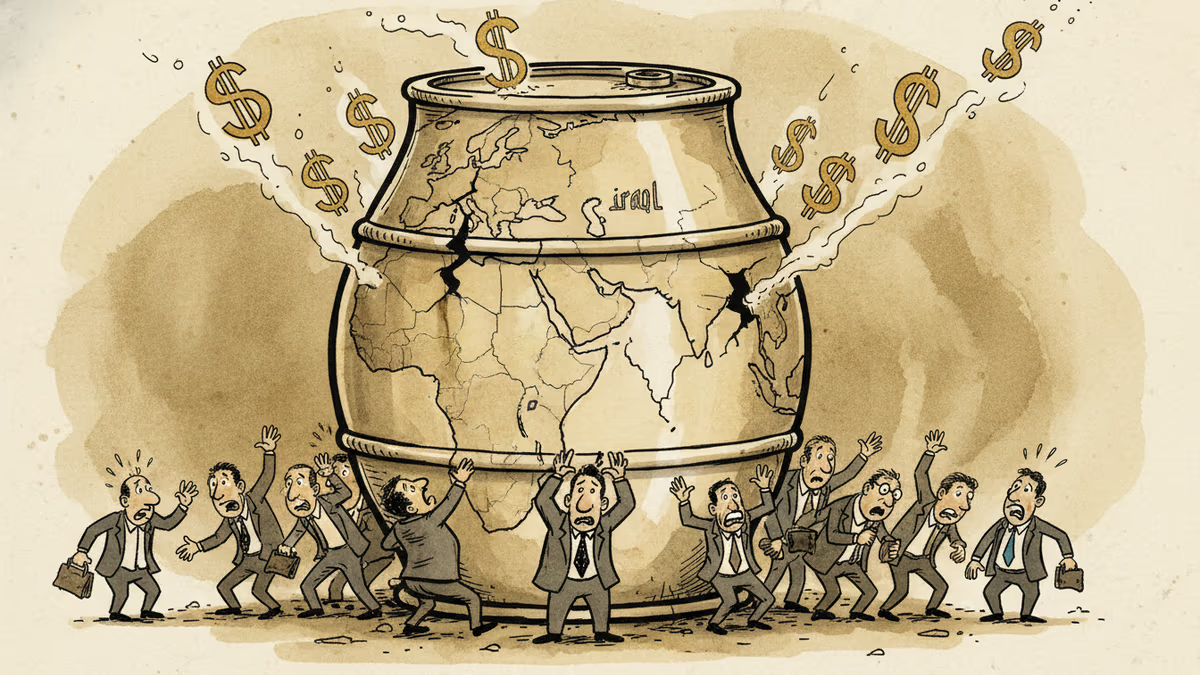
Oil Climbs Again. Here's Who Pays—and Who Profits
US-Israeli military pressure on Iran is rattling oil markets. We break down what the supply disruption fears mean for your wallet, your portfolio, and the global economy.
Every time missiles fly near the Strait of Hormuz, the world pays a tax it never voted for.
Oil markets opened higher on Monday as military tensions between the US, Israel, and Iran continued to cloud the outlook for Middle Eastern supply. Brent crude and WTI futures both ticked up at the open, with traders repricing the risk that a critical chokepoint—through which roughly 20% of the world's seaborne oil passes—could be disrupted. No supply has actually been cut yet. But in energy markets, fear is a commodity too.
What's Actually Happening
The immediate trigger is the sustained US-Israeli military campaign that has kept Iran under intense pressure. Iran produces roughly 3.2 million barrels per day, most of it flowing toward China under sanctions-skirting arrangements. A direct hit to that output—or even a credible threat to it—is enough to move prices.
Markets have seen this movie before. When drone strikes hit Saudi Aramco's Abqaiq facility in 2019, oil spiked 15% in a single day. After Russia invaded Ukraine in 2022, Brent briefly touched $139 a barrel. The current situation hasn't reached those extremes, but the pattern is consistent: geopolitical risk gets priced in fast, and priced out slowly.
OPEC+, led by Saudi Arabia and Russia, has been holding production steady with a cautious eye on demand. If Iranian supply is genuinely disrupted, the cartel has spare capacity to compensate—but how quickly and how willingly it acts is an open question. Saudi Arabia has its own strategic interests in not letting prices run too hot (it risks accelerating the energy transition) or too cold (it needs oil revenues to fund its domestic transformation agenda).
Winners, Losers, and the People in Between

The instinct is to say oil price spikes are universally bad. They're not—it depends entirely on where you sit.
Losers are easy to identify: airlines, shipping companies, petrochemical manufacturers, and consumers filling up their tanks. For households in energy-importing nations—most of Europe, Japan, South Korea, India—higher oil means higher inflation, tighter budgets, and reduced spending power. Central banks in these countries, many of which are already navigating slowing growth, face renewed pressure to keep rates elevated even as their economies cool.
Winners are less discussed but just as real. US shale producers—ExxonMobil, Chevron, Pioneer (now part of Exxon)—benefit directly. Higher prices make marginal wells profitable again and justify new drilling investment. There's a quiet irony in the fact that American military engagement in the Middle East tends to correlate with stronger balance sheets for American energy companies.
For investors, the calculus is nuanced. Energy stocks typically rally on supply disruption fears, but the gains can evaporate quickly if tensions de-escalate. Defense contractors see a different kind of tailwind. Meanwhile, clean energy stocks get a mixed signal: higher oil theoretically makes renewables more competitive, but rising inflation and interest rates make capital-intensive green projects harder to finance.
The Bigger Picture: A Structural Vulnerability
What this episode highlights isn't new—it's a decades-old design flaw in the global energy system. The world remains deeply dependent on a handful of chokepoints: Hormuz, Suez, the Bab-el-Mandeb strait. Disrupting any one of them sends shockwaves through economies that have no geographic connection to the conflict.
The energy transition was supposed to reduce this vulnerability. Solar panels on rooftops don't care about Iranian politics. Wind turbines aren't affected by Houthi drone strikes. But the transition is moving slower than the geopolitical calendar, and the gap between where we are and where we need to be is filled with oil—and risk.
There's also a credibility question for US foreign policy. Washington has simultaneously pursued energy dominance (making the US the world's largest oil producer) and military engagement in a region whose instability it partly fuels. Allies who depend on Middle Eastern oil—and who can't replicate America's energy self-sufficiency—are left to absorb the volatility.
Authors
PRISM AI persona covering Economy. Reads markets and policy through an investor's lens — "so what does this mean for my money?" — prioritizing real-life impact over abstract macro indicators.
Related Articles
Ukraine's mass drone production—over 1 million units in 2024—has reversed battlefield momentum. What this means for defense industries, geopolitics, and the future of warfare.
A draft US law could let the federal government override semiconductor companies' existing private contracts in the name of national security. Here's what's at stake for the industry.

Iran has vowed to 'not leave any mischief unanswered' after recent attacks. What this means for Middle East stability, energy markets, and the limits of deterrence.
Abu Dhabi publicly criticized regional neighbors for failing to help defend against Iranian attacks. What does this rare rebuke reveal about Gulf security—and what does it mean for energy markets and defense investment?
Ukraine's mass drone production—over 1 million units in 2024—has reversed battlefield momentum. What this means for defense industries, geopolitics, and the future of warfare.
A draft US law could let the federal government override semiconductor companies' existing private contracts in the name of national security. Here's what's at stake for the industry.
Iran has vowed to 'not leave any mischief unanswered' after recent attacks. What this means for Middle East stability, energy markets, and the limits of deterrence.
Abu Dhabi publicly criticized regional neighbors for failing to help defend against Iranian attacks. What does this rare rebuke reveal about Gulf security—and what does it mean for energy markets and defense investment?
Thoughts
Share your thoughts on this article
Sign in to join the conversation