

Nvidia Licenses Groq's LPU Tech in a Deal Reportedly Worth $20 Billion
Nvidia has struck a licensing deal with AI chip rival Groq, hiring its founder. CNBC reports a $20 billion asset acquisition, which Nvidia denies.
The AI chip titan just embraced its rival. But this isn't a friendly handshake; it's a strategic power play that could reshape the market. Nvidia has struck a non-exclusive licensing agreement with its AI chip competitor Groq, and will hire its founder and other key employees in a stunning move.
A $20 Billion Handshake?
As part of the deal, Groq founder Jonathan Ross, president Sunny Madra, and other staff will join Nvidia. While Nvidia told TechCrunch this is not an acquisition of the company, CNBC reported that Nvidia is acquiring assets from Groq for a staggering $20 billion. If those numbers are accurate, this would be Nvidia's largest purchase ever.

The Power of the LPU
So, why Groq? The startup has been making waves with a different kind of chip called an LPU (Language Processing Unit). Groq has claimed its LPU can run Large Language Models (LLMs) 10 times faster while using just one-tenth the energy of conventional hardware. Its CEO, Jonathan Ross, is a giant in the field, known for helping invent Google's TPU (Tensor Processing Unit).
Groq's growth has been explosive. The company raised $750 million at a $6.9 billion valuation back in September. It also said its technology now powers the AI apps of more than 2 million developers, a huge jump from about 356,000 last year.
Authors
Related Articles

Nvidia shipped roughly a billion RISC-V cores in 2024, then announced it would run CUDA on the open standard. We break down how royalty-free instruction sets and open software stacks are trying to route around CUDA's lock-in. Part 2 of the Semiconductor Sovereignty series.

US AI-chip export controls split into three layers in the first half of 2026 — January easing, a May crackdown on circumvention, and a pending bill. Nvidia erased China from its guidance and still posted a record $81.6 billion quarter. A look at the export policy that both shields and cages it.
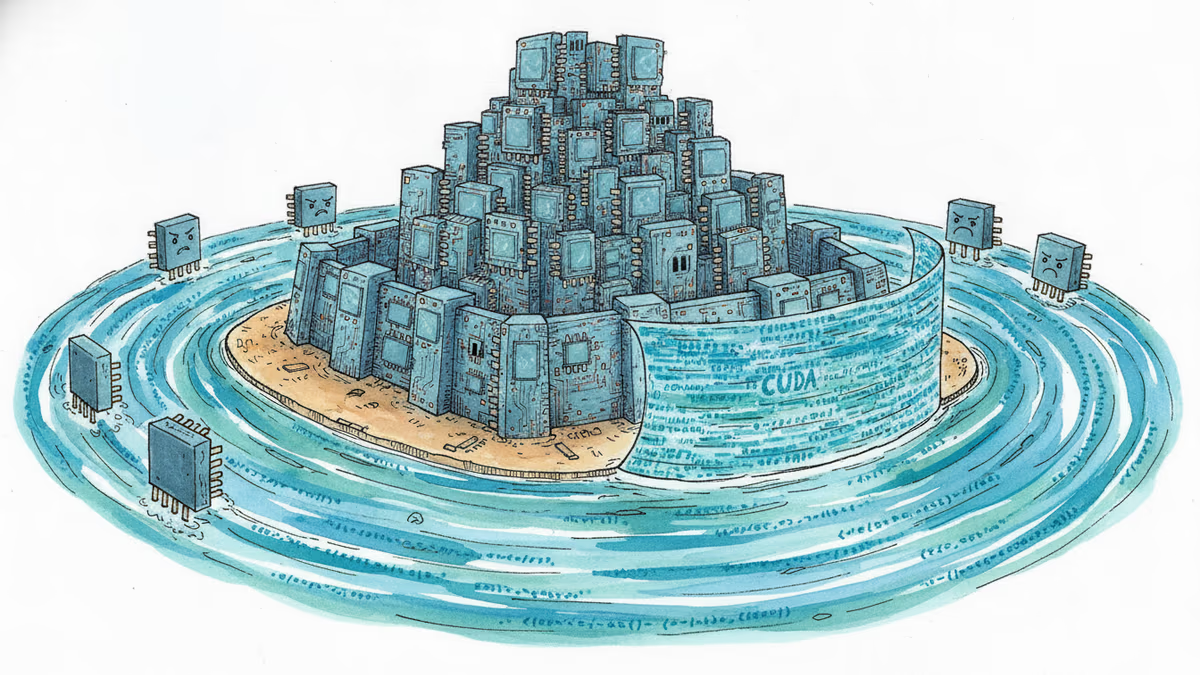
AMD's MI325X matches or beats Nvidia on memory and bandwidth — yet Nvidia's 86-92% share holds. The real moat is CUDA, 20 years in the making. Part 1 of 4.

Snowflake's new $6 billion AWS contract is about more than cloud spending. It signals a shift in AI infrastructure—away from Nvidia GPUs and toward cheaper, homegrown chips for the agent era.
Nvidia shipped roughly a billion RISC-V cores in 2024, then announced it would run CUDA on the open standard. We break down how royalty-free instruction sets and open software stacks are trying to route around CUDA's lock-in. Part 2 of the Semiconductor Sovereignty series.
US AI-chip export controls split into three layers in the first half of 2026 — January easing, a May crackdown on circumvention, and a pending bill. Nvidia erased China from its guidance and still posted a record $81.6 billion quarter. A look at the export policy that both shields and cages it.
AMD's MI325X matches or beats Nvidia on memory and bandwidth — yet Nvidia's 86-92% share holds. The real moat is CUDA, 20 years in the making. Part 1 of 4.
Snowflake's new $6 billion AWS contract is about more than cloud spending. It signals a shift in AI infrastructure—away from Nvidia GPUs and toward cheaper, homegrown chips for the agent era.
Thoughts
Share your thoughts on this article
Sign in to join the conversation