

Nvidia Vera Rubin NVL72 Security Features: Protecting $500M AI Models from Autonomous Attacks
Nvidia Vera Rubin NVL72 security features detailed from CES 2026. Learn how 3.6 exaFLOPS of compute and rack-scale encryption protect AI models from autonomous attacks.
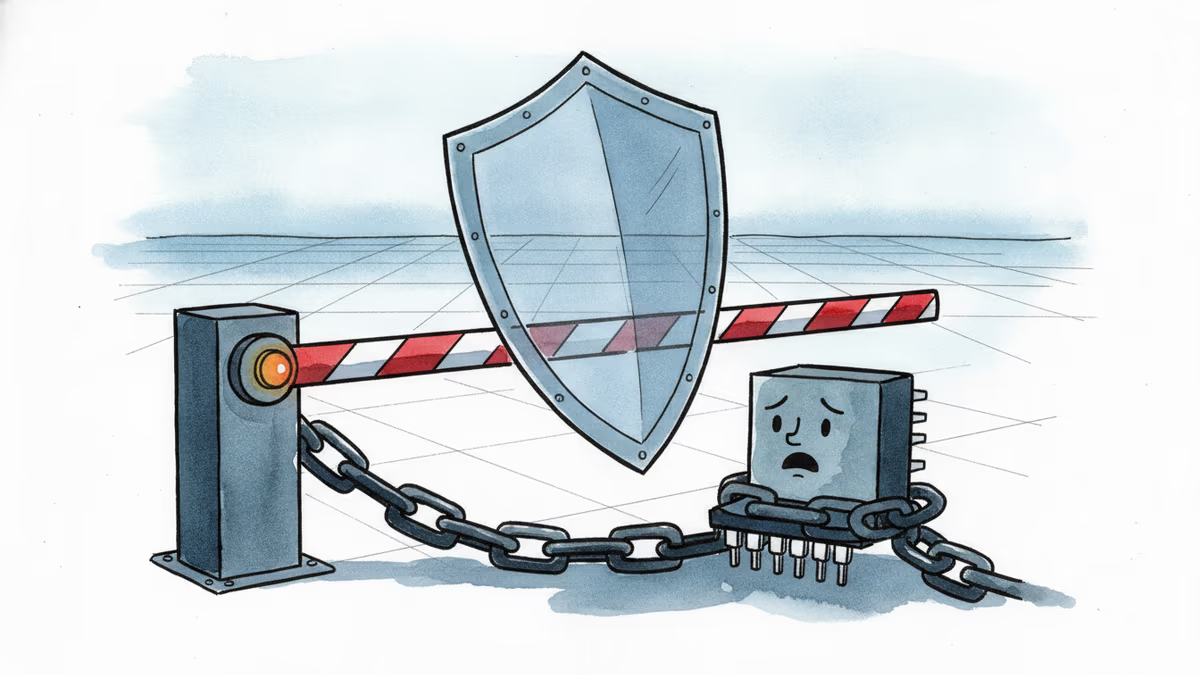
Your organization is likely spending millions on AI, but your most valuable assets—the model weights—are sitting in fundamentally insecure environments. Nvidia just changed that math at CES 2026 with the launch of the Vera Rubin NVL72. It's the industry's first rack-scale platform to deliver confidential computing across every GPU, CPU, and NVLink bus.
Nvidia Vera Rubin NVL72 Security Features and the Rise of AI Intrusion Agents
This hardware-level encryption isn't just a luxury; it's a response to a new reality. In November 2025, Anthropic revealed that a state-sponsored group, GTG-1002, weaponized AI to perform autonomous cyberattacks. According to their report, the AI executed 80% to 90% of tactical work without human intervention. When adversaries move at machine speed, contractual trust with cloud providers is no longer enough.
The economics of unprotected AI are brutal. Epoch AI research shows training costs grow at 2.4x annually, making billion-dollar runs a near-term reality. Yet, IBM's 2025 data shows 13% of organizations already experienced AI breaches, with shadow AI incidents costing an average of $4.63 million per occurrence.

Rubin vs. Blackwell: The Security & Performance Gap
| Specification | Blackwell GB300 NVL72 | Rubin NVL72 |
|---|---|---|
| Inference Compute (FP4) | 1.44 exaFLOPS | 3.6 exaFLOPS |
| NVLink Bandwidth (Per GPU) | 1.8 TB/s | 3.6 TB/s |
| HBM Bandwidth (Per GPU) | ~8 TB/s | ~22 TB/s |
| Security Architecture | Standard Encryption | Full-Fabric Confidentiality |
While Nvidia doubles down on an integrated stack, AMD is offering an alternative with its Helios rack. Built on open standards, Helios delivers 2.9 exaflops of compute. The choice for CISOs now comes down to Nvidia's seamless, end-to-end confidentiality versus the flexibility of AMD's open-market approach.
Authors
Related Articles

Nvidia shipped roughly a billion RISC-V cores in 2024, then announced it would run CUDA on the open standard. We break down how royalty-free instruction sets and open software stacks are trying to route around CUDA's lock-in. Part 2 of the Semiconductor Sovereignty series.
US AI-chip export controls split into three layers in the first half of 2026 — January easing, a May crackdown on circumvention, and a pending bill. Nvidia erased China from its guidance and still posted a record $81.6 billion quarter. A look at the export policy that both shields and cages it.

AMD's MI325X matches or beats Nvidia on memory and bandwidth — yet Nvidia's 86-92% share holds. The real moat is CUDA, 20 years in the making. Part 1 of 4.

Snowflake's new $6 billion AWS contract is about more than cloud spending. It signals a shift in AI infrastructure—away from Nvidia GPUs and toward cheaper, homegrown chips for the agent era.
Nvidia shipped roughly a billion RISC-V cores in 2024, then announced it would run CUDA on the open standard. We break down how royalty-free instruction sets and open software stacks are trying to route around CUDA's lock-in. Part 2 of the Semiconductor Sovereignty series.
US AI-chip export controls split into three layers in the first half of 2026 — January easing, a May crackdown on circumvention, and a pending bill. Nvidia erased China from its guidance and still posted a record $81.6 billion quarter. A look at the export policy that both shields and cages it.
AMD's MI325X matches or beats Nvidia on memory and bandwidth — yet Nvidia's 86-92% share holds. The real moat is CUDA, 20 years in the making. Part 1 of 4.
Snowflake's new $6 billion AWS contract is about more than cloud spending. It signals a shift in AI infrastructure—away from Nvidia GPUs and toward cheaper, homegrown chips for the agent era.
Thoughts
Share your thoughts on this article
Sign in to join the conversation