

Nvidia's China Victory Lap Signals Major US Policy Reversal
Jensen Huang's casual China tour coincides with approval of 400,000+ H200 chip sales to Chinese companies. A stunning reversal of Biden-era export controls raises questions about US tech strategy.
Jensen Huang wasn't just playing tourist when he casually biked through Shanghai and slurped hot pot in Shenzhen this week. The Nvidia CEO's leisurely China tour coincided with something far more significant: Beijing's approval to sell over 400,000 powerful H200 AI chips to Chinese tech giants.
According to Reuters, China greenlit conditional licenses allowing ByteDance, Alibaba, and Tencent to purchase hundreds of thousands of these advanced chips during Huang's visit. More approvals are expected in coming weeks—a stunning validation of Huang's year-long lobbying campaign in Washington.
From Biden's Ban to Trump's Bargain
This represents a complete 180-degree reversal of US policy toward China. Under Biden, America sharply tightened export controls on high-end AI chips, barring models like the H200 from Chinese customers due to national security concerns. The goal was clear: prevent Beijing from developing powerful AI systems with military applications.
But Trump's team embraced a different logic, championed by Huang and White House AI czar David Sacks. Their argument? Allowing China limited access to American AI chips beats ceding such a massive market entirely to Chinese chipmakers. It's supposedly better economically and theoretically keeps Chinese firms dependent on US technology.
White House officials have privately justified the H200 sales by pointing to continued chip smuggling into China—arguing that US restrictions have proven ineffective anyway. Better to allow limited, regulated sales than an opaque gray market, they contend.
China's Calculated Win-Win

Beijing isn't just taking what it can get—it's executing a sophisticated dual strategy. Samuel Bresnick, a research fellow at Georgetown's Center for Security and Emerging Technology, sees this as China achieving two strategic goals simultaneously.
First, Chinese tech champions now get the compute power they desperately need to train cutting-edge AI models rivaling OpenAI and other American labs. Second, by tightly controlling who gets Nvidia hardware, Beijing ensures demand for Huawei chips remains high while maintaining strong incentives for companies to build out China's domestic semiconductor ecosystem.
"This is excellent evidence that this David Sacks idea of keeping China hooked on American technology is just not how this is going to go," Bresnick argues. "I see this as proof that China is totally uncomfortable with the idea of letting its own burgeoning chip industry be swamped by Nvidia."
The Whiplash Problem
The real damage may come from Washington's policy whiplash. For years, US policymakers have sent mixed signals about what they want to accomplish with chip controls, and China has been watching closely.
"The worst possible thing we can do is just go back and forth," warns Bresnick. "We have already given China the imperative to get their own chips going while also giving them access at the same time."
This creates the nightmare scenario US strategists wanted to avoid: spurring Chinese self-reliance while simultaneously providing access to advanced technology. America risks losing both long-term technological advantage and short-term economic benefits.
The policy reversal also signals to other nations that US export controls may be temporary political tools rather than durable strategic commitments. That uncertainty could accelerate the very technological decoupling America claims to want to manage.
Authors
Related Articles
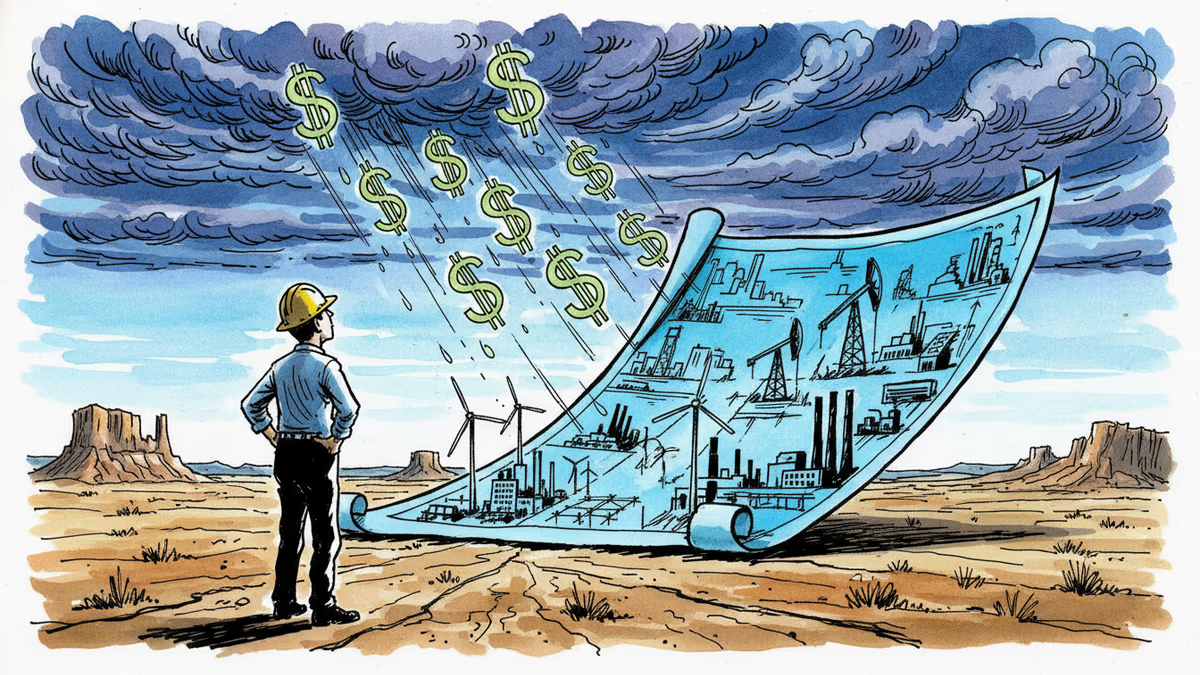
SpaceX plans to invest at least $55 billion in a Texas AI chip factory called Terafab, with total costs potentially reaching $119 billion. We break down what's real, what's at stake, and who wins or loses.
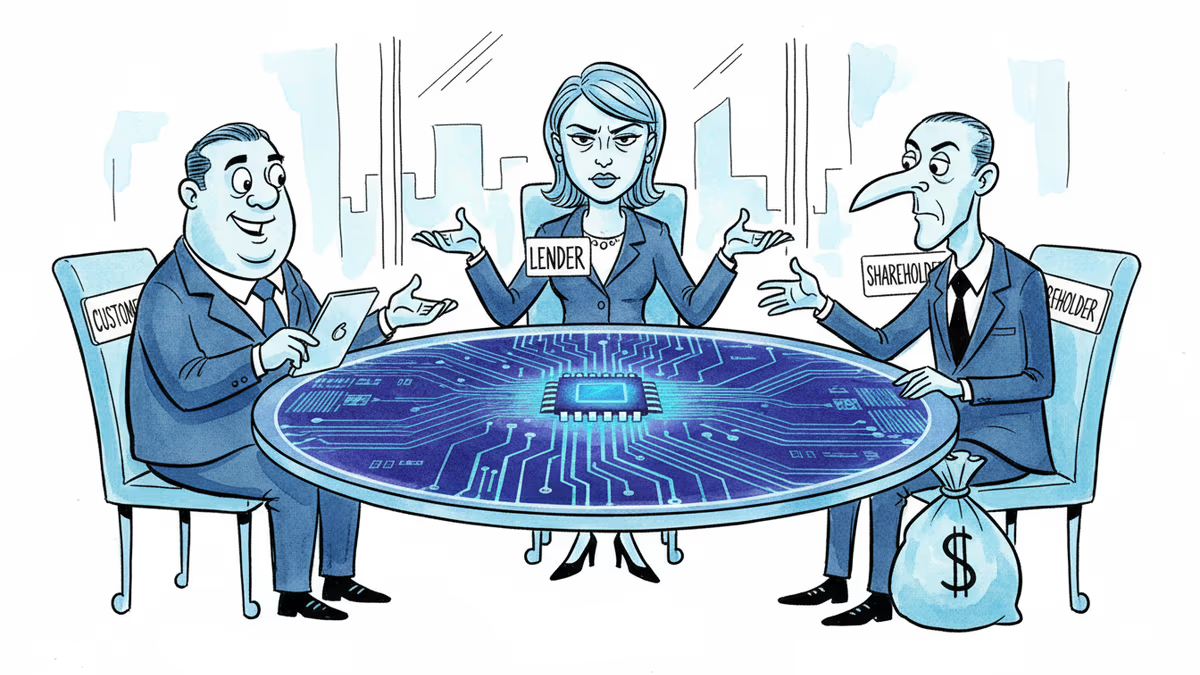
Cerebras Systems is targeting a $26.6B valuation in what could be 2026's largest tech IPO. But the real story is how deeply OpenAI is embedded in its capital structure—as customer, lender, and potential shareholder.
Cerebras Systems has refiled for an IPO targeting mid-May, backed by a $23B valuation, a reported $10B OpenAI deal, and an AWS partnership. What does this mean for Nvidia's dominance and the AI chip landscape?
At GTC 2026, Nvidia CEO Jensen Huang doubled his chip demand forecast to $1 trillion through 2027. Here's what that number actually means — and what it doesn't.
SpaceX plans to invest at least $55 billion in a Texas AI chip factory called Terafab, with total costs potentially reaching $119 billion. We break down what's real, what's at stake, and who wins or loses.
Cerebras Systems is targeting a $26.6B valuation in what could be 2026's largest tech IPO. But the real story is how deeply OpenAI is embedded in its capital structure—as customer, lender, and potential shareholder.
Cerebras Systems has refiled for an IPO targeting mid-May, backed by a $23B valuation, a reported $10B OpenAI deal, and an AWS partnership. What does this mean for Nvidia's dominance and the AI chip landscape?
At GTC 2026, Nvidia CEO Jensen Huang doubled his chip demand forecast to $1 trillion through 2027. Here's what that number actually means — and what it doesn't.
Thoughts
Share your thoughts on this article
Sign in to join the conversation