

The Box That Can Never Be Truly Empty
Quantum mechanics reveals that even perfect vacuum contains infinite energy. Scientists grapple with zero-point energy's mind-bending implications for our universe.
Infinite Energy Lurks in Every Empty Space
Imagine you want to empty a box. Completely. You remove everything visible, pump out gases, and—using some sci-fi tech—evacuate even dark matter. What's left?
Here's where quantum mechanics delivers its signature curveball: The box is still brimming with energy. Worse yet, your heroic emptying efforts have barely scratched the surface. This unavoidable residue is zero-point energy, and it's everywhere.
Max Planck introduced the concept in 1911, but it was Einstein who first took it seriously, according to Peter Milonni from the University of Rochester. The implications were immediate and profound—explaining why molecules vibrate even in their lowest energy states and why liquid helium refuses to freeze solid at ordinary pressure, no matter how cold you make it.
When 'Nothing' Contains Everything
Zero-point energy comes in two flavors. First, there's field-associated energy—think electromagnetic fields that can't be completely silenced. Second, there's energy in discrete objects like atoms and molecules that retain motion even near absolute zero.
The culprit? Heisenberg's uncertainty principle. You can't simultaneously pin down both position and velocity with perfect precision. It's like a ball settled at the bottom of a valley—it looks still, but quantum mechanics says it's always jiggling.
This isn't just theoretical anymore. In 2025, researchers at the European X-Ray Free-Electron Laser Facility made it visible. They cooled an 11-atom organic molecule called iodopyridine almost to absolute zero, then blasted it with lasers to break its bonds.
The result? The freed atoms moved in correlated patterns, proving the molecule had been vibrating despite its chilled state. "That wasn't initially the main goal of the experiment," admitted experimental physicist Rebecca Boll. "It's basically something that we found."

The Casimir Effect: When Vacuum Becomes a Force
Perhaps the most famous demonstration came from Hendrick Casimir's 1948 prediction. Place two uncharged metal plates close together, and they'll attract each other—not through magnetism or static electricity, but through the manipulation of vacuum energy itself.
The plates act like a guillotine for electromagnetic field oscillations, chopping off certain wavelengths and creating an energy imbalance. Think of it as the vacuum outside pushing harder than the vacuum inside, squeezing the plates together. Scientists glimpsed this effect in 1958 and definitively measured it in 1997.
The Infinity Problem That Could Explode the Universe
Here's where things get wild. Quantum field theorists describe fields as collections of infinite oscillators, each carrying zero-point energy. Infinite oscillators mean infinite energy—a mathematical nightmare that initially made physicists doubt their own theories in the 1930s and '40s.
They learned to tame these infinities through careful subtraction techniques. In most physics, energy differences matter more than absolute values. Subtract one infinity from another, and you can extract meaningful, finite results.
But gravity doesn't play by these rules. As Wolfgang Pauli realized in 1946, infinite zero-point energy should create gravitational fields powerful enough to tear the universe apart. "All forms of energy gravitate," explains Sean Carroll from Johns Hopkins University. "That includes vacuum energy, so you can't ignore it."
Yet here we are, universe intact. Why zero-point energy remains gravitationally muted remains one of physics' deepest mysteries.
The Practical Paradox of Infinite Energy
Could we tap this infinite energy reservoir? The idea has tantalized inventors and scientists for decades, spawning countless patents and schemes. But there's a catch: extracting energy requires creating an energy difference, and it's fiendishly difficult to make vacuum "more empty" than it already is.
Still, zero-point energy isn't just academic. The Casimir effect already matters in nanotechnology, where engineers must account for attractive forces between microscopic components. As devices shrink, these quantum forces become increasingly relevant.
Some researchers speculate about "negative energy" states or exotic materials that might manipulate vacuum energy. Others explore whether quantum field fluctuations could power future spacecraft or energy systems. The jury's still out, but the potential is staggering.
Authors
Related Articles
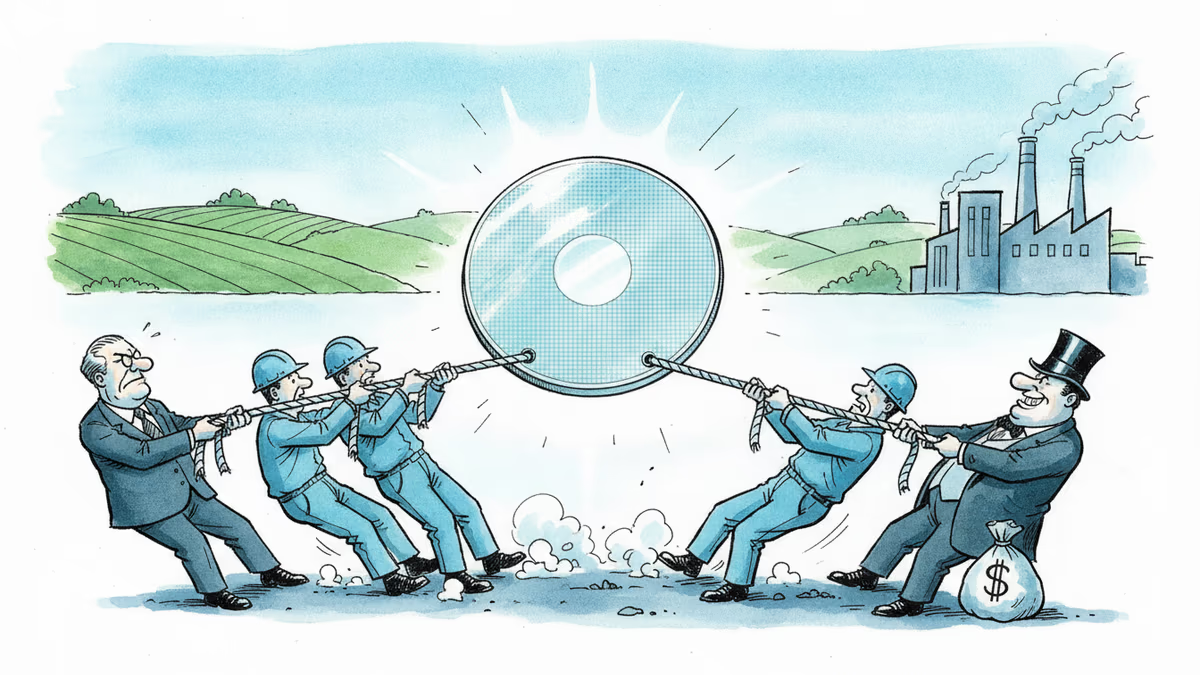
Samsung Electronics' union branch revealed that 84% of survey respondents oppose the government's roughly $290 billion (₩400 trillion) semiconductor megaproject in Gwangju. Government, management, the union and shareholders are all reading the same national project in sharply different ways.

Nvidia shipped roughly a billion RISC-V cores in 2024, then announced it would run CUDA on the open standard. We break down how royalty-free instruction sets and open software stacks are trying to route around CUDA's lock-in. Part 2 of the Semiconductor Sovereignty series.

US AI-chip export controls split into three layers in the first half of 2026 — January easing, a May crackdown on circumvention, and a pending bill. Nvidia erased China from its guidance and still posted a record $81.6 billion quarter. A look at the export policy that both shields and cages it.
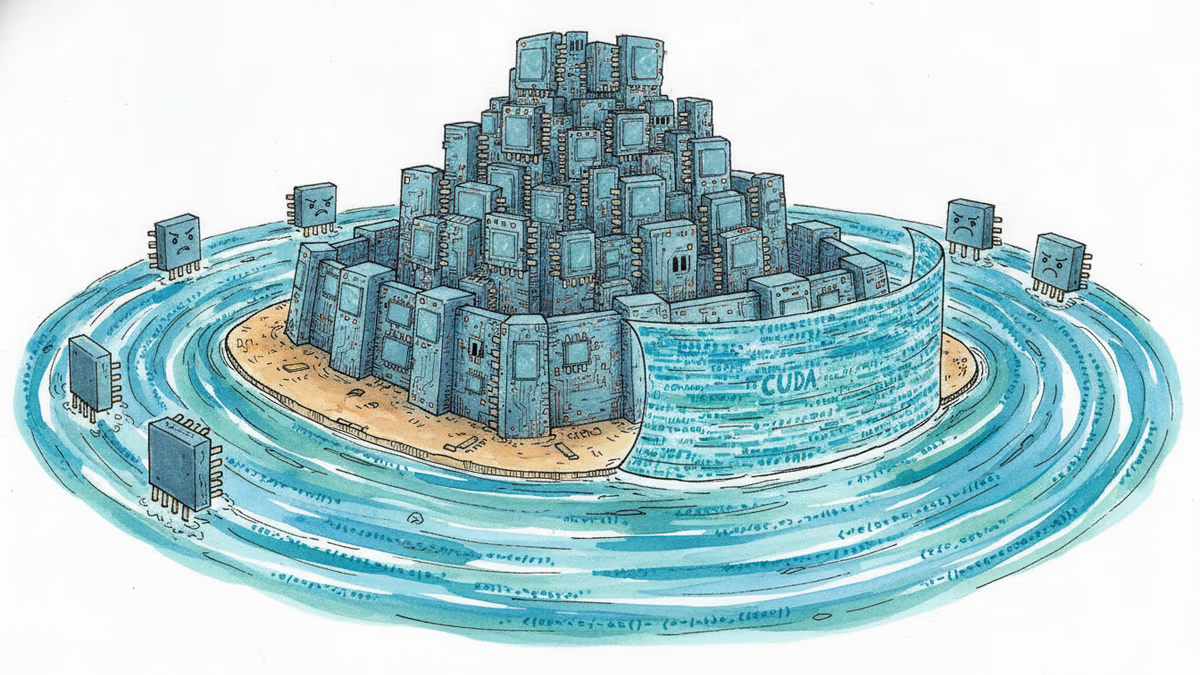
AMD's MI325X matches or beats Nvidia on memory and bandwidth — yet Nvidia's 86-92% share holds. The real moat is CUDA, 20 years in the making. Part 1 of 4.
Samsung Electronics' union branch revealed that 84% of survey respondents oppose the government's roughly $290 billion (₩400 trillion) semiconductor megaproject in Gwangju. Government, management, the union and shareholders are all reading the same national project in sharply different ways.
Nvidia shipped roughly a billion RISC-V cores in 2024, then announced it would run CUDA on the open standard. We break down how royalty-free instruction sets and open software stacks are trying to route around CUDA's lock-in. Part 2 of the Semiconductor Sovereignty series.
US AI-chip export controls split into three layers in the first half of 2026 — January easing, a May crackdown on circumvention, and a pending bill. Nvidia erased China from its guidance and still posted a record $81.6 billion quarter. A look at the export policy that both shields and cages it.
AMD's MI325X matches or beats Nvidia on memory and bandwidth — yet Nvidia's 86-92% share holds. The real moat is CUDA, 20 years in the making. Part 1 of 4.
Thoughts
Share your thoughts on this article
Sign in to join the conversation