
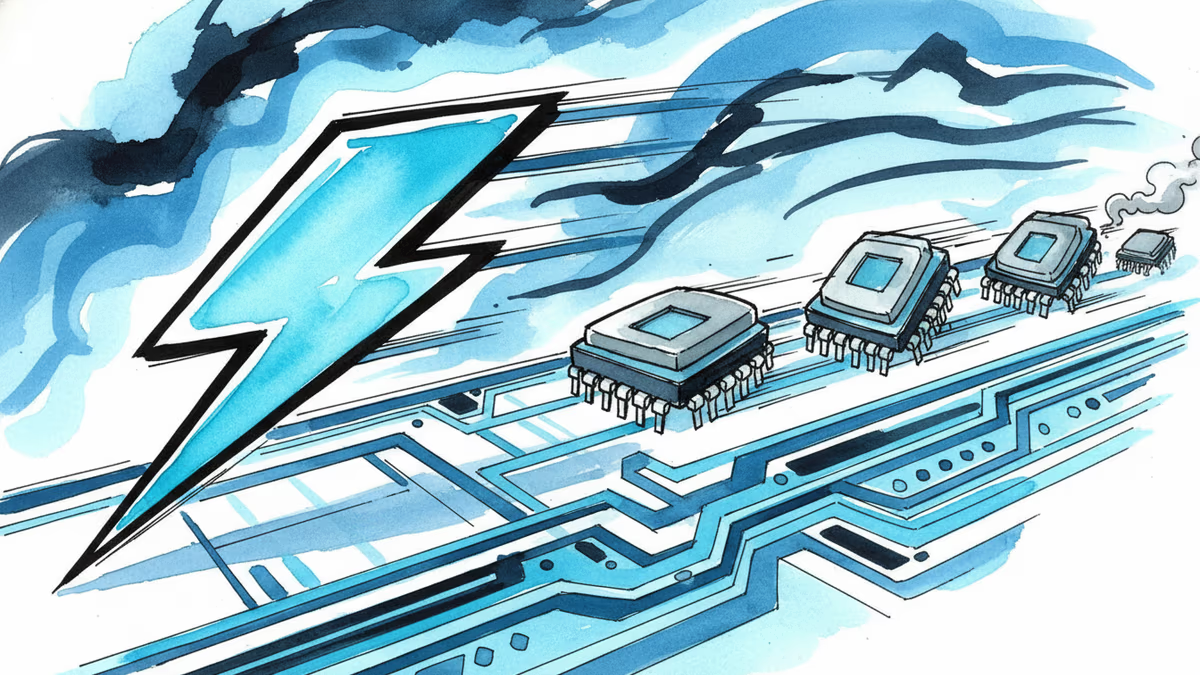
The Speed Wars Begin: OpenAI's $10B Bet on Lightning-Fast AI
OpenAI launches GPT-5.3-Codex-Spark with Cerebras chips, marking a shift from model power to inference speed in the AI race. What does this mean for developers?
Sam Altman's cryptic tweet about something that "sparks joy" wasn't just wordplay—it was a preview of AI's next battleground. On Thursday, OpenAI unveiled GPT-5.3-Codex-Spark, a lightweight coding assistant powered by Cerebras'4-trillion-transistor chips. But this isn't just another model launch. It's the opening shot in what could reshape how we think about AI performance.
The Need for Speed Revolution
For months, the AI industry has obsessed over making models smarter. Bigger parameters, better reasoning, more capabilities. Codex-Spark flips that script entirely. Instead of raw intelligence, OpenAI is betting on something developers desperately need: speed.
The new model runs on Cerebras' Wafer Scale Engine 3, a chip so massive it requires an entire silicon wafer to manufacture. While the original GPT-5.3 handles complex, long-running coding tasks, Spark focuses on "rapid iteration" and "real-time collaboration"—the kind of instant feedback developers crave when prototyping.
"Codex that works in two complementary modes," OpenAI explained. Think of it as having both a marathon runner and a sprinter on your development team.
The $10 Billion Infrastructure Bet
This launch represents the first major milestone in OpenAI's$10-billion, multi-year partnership with Cerebras—a deal that signals how seriously the company takes hardware optimization. While competitors like Google and Anthropic rely primarily on NVIDIA chips, OpenAI is diversifying its compute stack.

Cerebras, valued at $23 billion after raising $1 billion last week, has spent over a decade perfecting wafer-scale computing. Their approach: instead of connecting thousands of smaller chips, build one enormous processor that eliminates communication bottlenecks.
"What excites us most is discovering what fast inference makes possible," said Sean Lie, Cerebras' CTO. "New interaction patterns, new use cases, and a fundamentally different model experience."
The Developer Divide
But speed comes with trade-offs. Spark is currently limited to ChatGPT Pro users—a $200/month subscription tier that puts it out of reach for many independent developers. Meanwhile, free alternatives like GitHub Copilot and Cursor continue gaining ground with broader accessibility.
Enterprise developers, however, are intrigued. "Latency is everything in our CI/CD pipeline," explains one startup CTO who requested anonymity. "If Spark can cut code review cycles from minutes to seconds, it's worth the premium."
The real test will come when OpenAI expands availability. Can they maintain ultra-low latency at scale, or will performance degrade as usage grows?
Hardware Wars Heat Up
OpenAI'sCerebras partnership also represents a strategic hedge against NVIDIA's dominance in AI chips. As Jensen Huang's company faces increasing competition from AMD, Intel, and custom silicon from tech giants, alternative architectures like wafer-scale computing could gain momentum.
Cerebras has already announced IPO intentions, positioning itself as the anti-NVIDIA. Their approach trades versatility for raw performance in specific workloads—exactly what AI inference demands.
Authors
Related Articles

OpenAI has reorganized for the second time in a month, merging ChatGPT and Codex into a single agentic platform under president Greg Brockman's unified product leadership.

After two weeks of witnesses calling him a liar, OpenAI CEO Sam Altman testified in his own defense, claiming Elon Musk tried to kill the company twice.

Sam Nelson, 19, died after following ChatGPT's advice to mix Kratom and Xanax. His parents are suing OpenAI for wrongful death, raising urgent questions about AI trust, liability, and design.
OpenAI's new Daybreak initiative uses the Codex AI agent to find and patch security vulnerabilities before attackers do—putting it in direct competition with Anthropic's secretive Claude Mythos.
OpenAI has reorganized for the second time in a month, merging ChatGPT and Codex into a single agentic platform under president Greg Brockman's unified product leadership.
After two weeks of witnesses calling him a liar, OpenAI CEO Sam Altman testified in his own defense, claiming Elon Musk tried to kill the company twice.
Sam Nelson, 19, died after following ChatGPT's advice to mix Kratom and Xanax. His parents are suing OpenAI for wrongful death, raising urgent questions about AI trust, liability, and design.
OpenAI's new Daybreak initiative uses the Codex AI agent to find and patch security vulnerabilities before attackers do—putting it in direct competition with Anthropic's secretive Claude Mythos.
Thoughts
Share your thoughts on this article
Sign in to join the conversation