
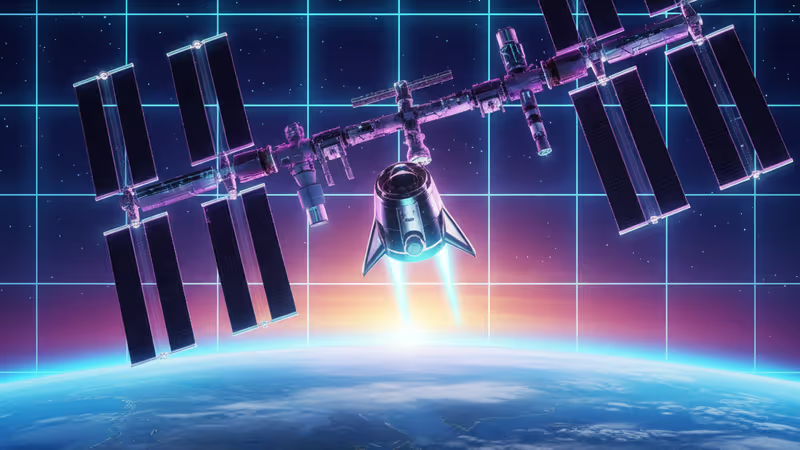
Space Emergency: NASA to Launch SpaceX Crew 11 Medical Evacuation from ISS
NASA has initiated an emergency medical evacuation for SpaceX Crew 11 from the ISS. Discover why Zena Cardman and her crew are returning a month early.
It's an unexpected U-turn in orbit. NASA just announced that the four members of SpaceX Crew 11 are coming home early from the International Space Station due to a pressing medical issue.
Why the NASA SpaceX Crew 11 Medical Evacuation is Happening Now
According to reports from Boing Boing, one of the astronauts is facing an undisclosed medical condition that requires immediate attention on Earth. While NASA hasn't released specific details to protect the individual's privacy, the decision to evacuate the entire crew underscores the seriousness of the situation.
The crew includes NASA astronauts Zena Cardman and Michael Fincke, JAXA astronaut Kimiya Yui, and Russian Cosmonaut Oleg Platonov. They've been living aboard the ISS since August 2nd, 2025, and weren't originally scheduled to return until mid-February 2026.

Health Risks and Space Logistics
Operating in a microgravity environment for over five months takes a toll on the human body. Experts suggest that having a reliable commercial taxi like SpaceX's Crew Dragon docked at the station provides a critical safety net for these exact scenarios.
Authors
Related Articles
American Airlines just signed Starlink for 500+ aircraft. It's not just about faster inflight internet — it's a calculated move in the run-up to what could be the largest IPO in history.

SpaceX's upgraded Starship V3 completed its first test flight, deploying 20 Starlink simulators but losing the Super Heavy booster. With an IPO weeks away, the stakes just got higher.

SpaceX's IPO filing puts AI at the center, claiming a $26.5 trillion market opportunity. But can Grok compete with OpenAI and Anthropic for enterprise customers?

SpaceX filed a nearly 400-page S-1 with the SEC, targeting an IPO as early as June 12. Here's what the filing reveals—and what it doesn't.
American Airlines just signed Starlink for 500+ aircraft. It's not just about faster inflight internet — it's a calculated move in the run-up to what could be the largest IPO in history.
SpaceX's upgraded Starship V3 completed its first test flight, deploying 20 Starlink simulators but losing the Super Heavy booster. With an IPO weeks away, the stakes just got higher.
SpaceX's IPO filing puts AI at the center, claiming a $26.5 trillion market opportunity. But can Grok compete with OpenAI and Anthropic for enterprise customers?
SpaceX filed a nearly 400-page S-1 with the SEC, targeting an IPO as early as June 12. Here's what the filing reveals—and what it doesn't.
Thoughts
Share your thoughts on this article
Sign in to join the conversation