

NASA's Moon Landing Delay Reveals More Than Just Schedule Changes
NASA pushes Artemis moon landing to 2028 after safety concerns, but the real story lies in what this delay means for the future of space exploration.
When $93 Billion Hits the Snooze Button
Friday's NASA press conference delivered news that space enthusiasts have been dreading: the Artemis III moon landing is sliding from 2027 to 2028. What was supposed to be humanity's triumphant return to lunar soil is now downgraded to a "test flight," while the actual landing waits another year.
NASA tried to sweeten the pill, promising to "increase mission cadence" with an additional test flight in 2027 and "at least one surface landing every year thereafter." But behind this reshuffling lies a more complex story about modern space exploration.
The Safety Report That Changed Everything
This delay didn't happen in a vacuum. Earlier this month, NASA's Aerospace Safety Advisory Panel (ASAP) dropped a bombshell report highlighting "serious safety risks" with the current Artemis program. While the specific details remain classified, the fact that NASA chose schedule flexibility over deadline pressure signals a fundamental shift in priorities.
The issues are multifaceted: SpaceX's Starship still hasn't mastered orbital reentry, Boeing's spacesuit development faces ongoing challenges, and the SLS rocket system continues to encounter technical hurdles. Each component represents a critical failure point that could jeopardize crew safety.
China's 2030 vs America's 2028: The New Space Race Math

This delay reshapes the geopolitical landscape of lunar exploration. With China targeting 2030 for their crewed moon landing, America's lead has shrunk to just two years. Gone are the days of overwhelming technological superiority that characterized the Apollo era.
Yet this narrowing gap might actually benefit the broader space community. Competition breeds innovation, and China's aggressive timeline is pushing NASA to maintain momentum despite setbacks. The question isn't just who gets there first, but who builds a sustainable lunar presence.
Private Industry: Savior or Bottleneck?
The Artemis program represents NASA's biggest bet on commercial partnerships. SpaceX handles the lunar lander, private contractors develop life support systems, and commercial launch providers supplement government rockets. This distributed approach promises cost savings and innovation—but also introduces coordination complexity.
When SpaceX faces Starship delays, the entire timeline shifts. When Boeing struggles with spacesuits, astronaut safety hangs in the balance. The interdependence that makes modern space exploration affordable also makes it vulnerable to cascading delays.
The Apollo 1 Shadow
NASA's willingness to delay reflects hard-learned lessons from the 1967 Apollo 1 fire that killed three astronauts. The agency's culture transformed from "failure is not an option" to "safety is the only option." This philosophical shift explains why NASA chose transparency about delays over maintaining unrealistic deadlines.
Modern space exploration operates under different constraints than the 1960s. Public scrutiny is intense, international partnerships require consensus, and commercial partners have their own timelines and priorities.
The moon has waited 4.5 billion years. What's another year or two?
Authors
Related Articles

NASA's Artemis III has been redesigned as an Earth-orbit mission. SpaceX and Blue Origin say their landers won't be ready until late 2027. What does this mean for the future of lunar exploration?

Flying to Mars means navigating without trees, wind, or GPS. Here's the surprisingly elegant physics behind how spacecraft measure their own velocity in the void.

Artemis II splashed down successfully in the Pacific, marking humanity's first crewed deep space mission in over 50 years. But the harder question isn't whether we can go back — it's why we should.
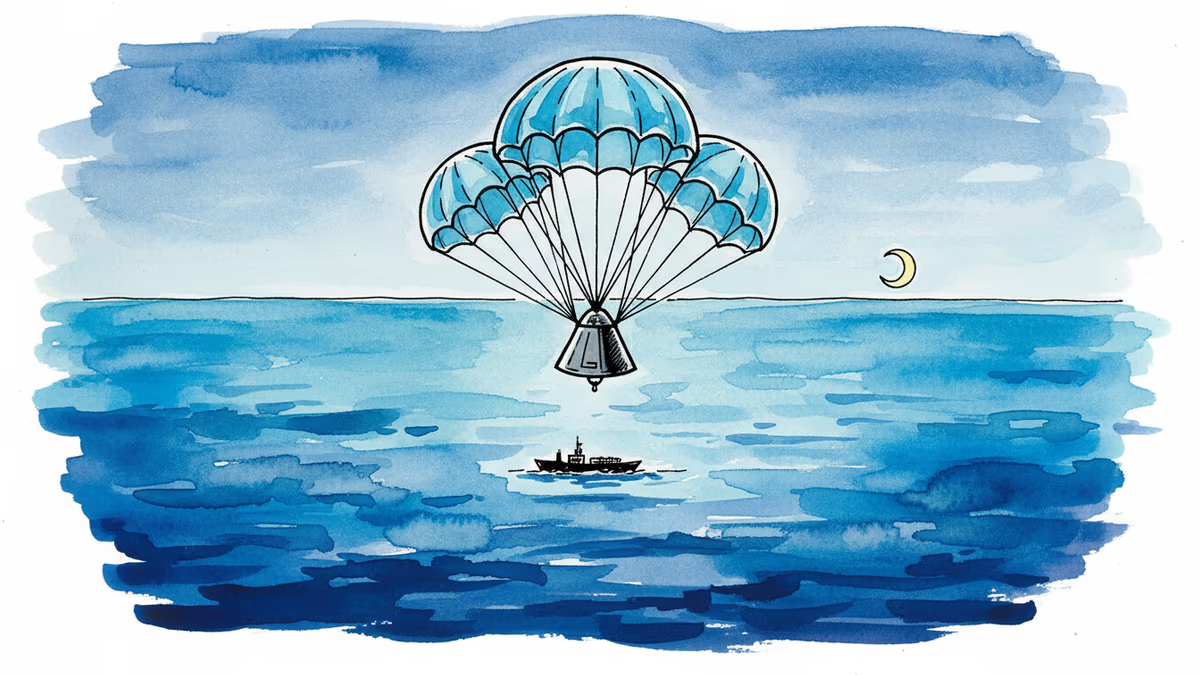
NASA's Orion capsule splashed down safely after humanity's first crewed lunar voyage in 54 years. The mission succeeded. Now the harder questions begin.
NASA's Artemis III has been redesigned as an Earth-orbit mission. SpaceX and Blue Origin say their landers won't be ready until late 2027. What does this mean for the future of lunar exploration?
Flying to Mars means navigating without trees, wind, or GPS. Here's the surprisingly elegant physics behind how spacecraft measure their own velocity in the void.
Artemis II splashed down successfully in the Pacific, marking humanity's first crewed deep space mission in over 50 years. But the harder question isn't whether we can go back — it's why we should.
NASA's Orion capsule splashed down safely after humanity's first crewed lunar voyage in 54 years. The mission succeeded. Now the harder questions begin.
Thoughts
Share your thoughts on this article
Sign in to join the conversation