
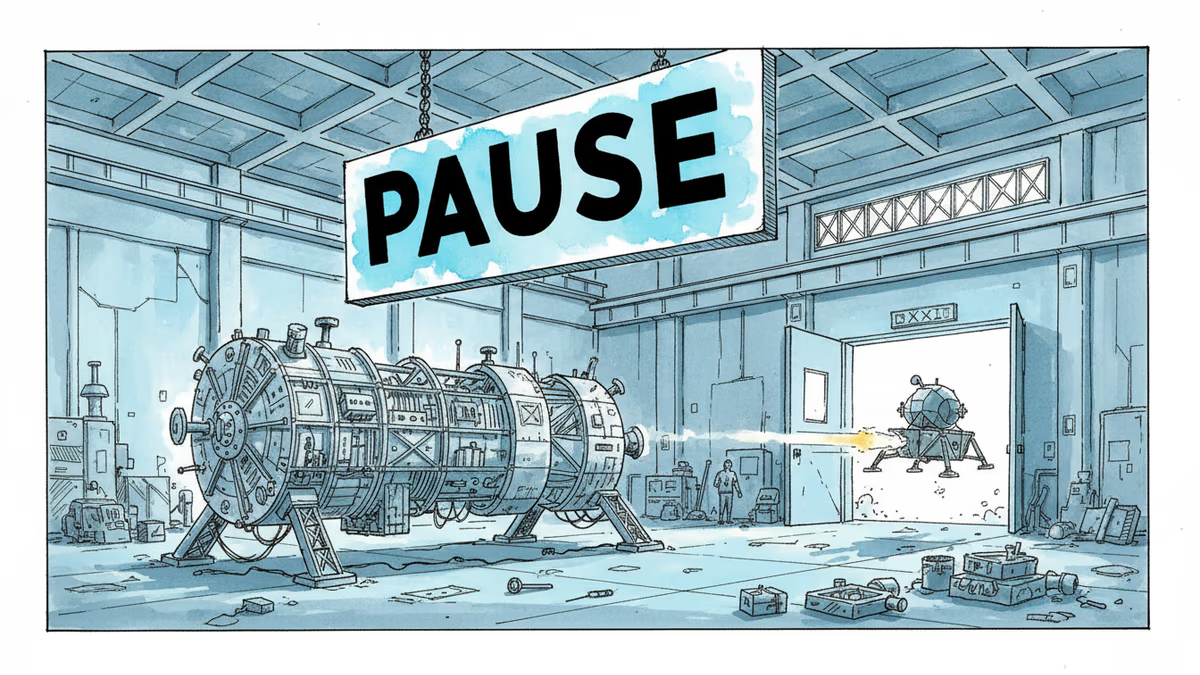
NASA's $4.5B Moon Station Is on Hold. What Happens to the Hardware?
NASA has officially paused the Gateway lunar space station program, pivoting to a Moon surface base. With $4.5 billion already spent, the fate of nearly-complete hardware raises urgent questions.
$4.5 billion in. Seven years in. And now: pause.
What NASA Just Announced
On Tuesday, NASA unveiled a revamped lunar exploration roadmap at an all-day event at its Washington headquarters. The headline: the Gateway program — a planned human-tended space station in lunar orbit — is being put on hold. The new priority is building a base directly on the Moon's surface.
For anyone watching the Trump administration's space policy signals, this wasn't a surprise. What is a surprise — or at least a serious complication — is the sheer amount of hardware already in progress.
Since Gateway's official launch in 2019, NASA has spent close to $4.5 billion developing the outpost. Components are being built and tested in factories across the United States, Europe, Canada, and Japan. Some of that hardware is nearly ready.
The most advanced piece is the Power and Propulsion Element (PPE) — the station's core module. Rather than scrap it, NASA's new roadmap proposes repurposing the PPE for a nuclear-electric propulsion demonstration in deep space. It's a pivot, not a trash bin.
Why This Happened Now
The shift reflects a broader philosophical divide in how to approach the Moon. Gateway was designed as a staging post — a waypoint in lunar orbit from which astronauts could descend to the surface and return. Critics, including voices aligned with SpaceX and Elon Musk, argued this added complexity and cost without proportional benefit. Why build a pit stop when you can drive straight to the destination?

The Trump administration has leaned toward the direct-to-surface approach, prioritizing speed and tangibility over the phased, internationally coordinated architecture that Gateway represented. With SpaceX's Starship theoretically capable of landing directly on the Moon, the orbital waystation starts to look like a detour.
But detours cost money — and this one already has.
Three Ways to Read This Decision
For international partners, this is more than a policy tweak. The European Space Agency, Canadian Space Agency, and JAXA have each committed resources and technology to Gateway — habitat modules, robotic arms, communication systems. When NASA pivots, their roadmaps pivot too. In space cooperation, credibility is a resource that doesn't replenish quickly.
For the aerospace industry, the calculus is mixed. Northrop Grumman and Maxar Technologies, both holding Gateway-related contracts, face uncertainty. But a Moon surface base means new contracts, new requirements, new competitions. SpaceX and Blue Origin — already deep into lunar lander development — stand to benefit from a strategy that plays to their strengths.
For taxpayers and policymakers, the harder question is accountability. $4.5 billion spent on a program now described as 'paused' is a number that demands explanation. Repurposing the PPE for a deep-space propulsion demo is a reasonable salvage plan — nuclear-electric propulsion is genuinely valuable for future Mars missions. But it also raises the question: if the destination was always the Moon's surface, why did it take seven years and billions of dollars to arrive at that conclusion?
The Bigger Picture: Space Policy's Four-Year Problem
This isn't the first time a NASA program has been redirected by a change in administration. The Constellation program — NASA's previous attempt at Moon return — was cancelled in 2010 after $9 billion in spending. Artemis itself has survived two administrations but is now being reshaped by a third.
The pattern raises a structural question that no single administration can answer alone: how do you build a multi-decade space program when political priorities reset every four years? The Gateway pause is, in one sense, a rational reallocation of resources. In another, it's the latest chapter in a recurring story of ambition outpacing institutional continuity.
The PPE's repurposing as a nuclear-electric propulsion testbed is genuinely interesting — this technology could eventually cut travel time to Mars significantly. But it's worth noting that the module wasn't designed for that mission. Adaptation has costs, both financial and technical.
Authors
Related Articles

NASA's Artemis III has been redesigned as an Earth-orbit mission. SpaceX and Blue Origin say their landers won't be ready until late 2027. What does this mean for the future of lunar exploration?
Flying to Mars means navigating without trees, wind, or GPS. Here's the surprisingly elegant physics behind how spacecraft measure their own velocity in the void.

Artemis II splashed down successfully in the Pacific, marking humanity's first crewed deep space mission in over 50 years. But the harder question isn't whether we can go back — it's why we should.

NASA's Orion capsule splashed down safely after humanity's first crewed lunar voyage in 54 years. The mission succeeded. Now the harder questions begin.
NASA's Artemis III has been redesigned as an Earth-orbit mission. SpaceX and Blue Origin say their landers won't be ready until late 2027. What does this mean for the future of lunar exploration?
Flying to Mars means navigating without trees, wind, or GPS. Here's the surprisingly elegant physics behind how spacecraft measure their own velocity in the void.
Artemis II splashed down successfully in the Pacific, marking humanity's first crewed deep space mission in over 50 years. But the harder question isn't whether we can go back — it's why we should.
NASA's Orion capsule splashed down safely after humanity's first crewed lunar voyage in 54 years. The mission succeeded. Now the harder questions begin.
Thoughts
Share your thoughts on this article
Sign in to join the conversation