
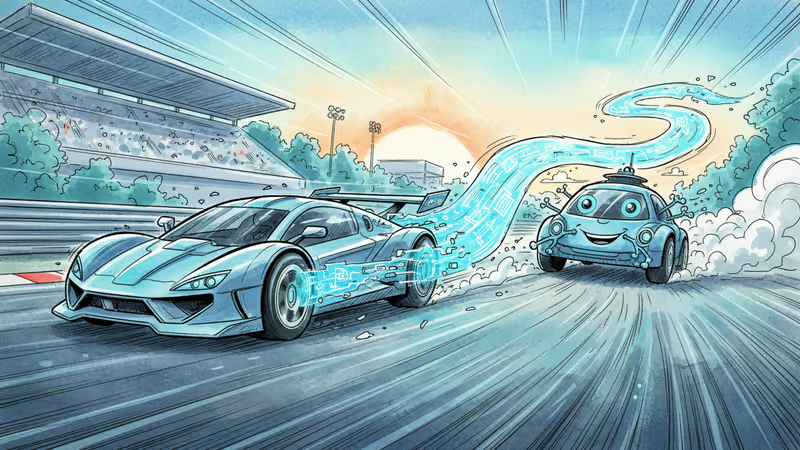
Race Cars Generate 1,600 Data Channels. Now They're Teaching Road Cars How to Think
IMSA's new data lab transforms racing telemetry into automotive simulation gold, bridging the gap between track performance and everyday driving technology.
Sixty race cars. Twenty-four hours. 1,600 data channels per vehicle. At this year's Rolex 24 at Daytona, something more valuable than trophies was being generated—a treasure trove of real-world performance data that could revolutionize how we develop the cars we drive every day.
The International Motor Sports Association (IMSA) has launched IMSA Labs, an initiative designed to transform racing telemetry into automotive simulation tools. While Formula 1 cars grab headlines for their technological sophistication, IMSA's GTP prototypes and even the road-car-based GTD machines are quietly collecting data that could bridge the gap between track performance and everyday driving.
From Seatbelts to Simulation
Racing has always been automotive's laboratory. Seatbelts, turbochargers, aerodynamics, and dual-clutch transmissions all migrated from racetracks to our driveways. But in recent decades, that technology transfer seemed to slow down. The innovations were becoming more intangible—the benefit of having motorsports-trained engineers collaborating with road car teams over lunch rather than direct hardware transfers.
The data revolution changes this equation entirely. Each GTP car at Daytona monitors everything from tire pressure fluctuations to aerodynamic load variations, suspension travel to energy recovery efficiency. Multiply that by 60 cars running for 24 hours, and you're looking at an unprecedented dataset of vehicles operating at their absolute limits.
What makes this particularly valuable is the diversity of the data sources. While the hybrid GTP prototypes push technological boundaries, the GTD class features cars based on production models—Porsche's 911, Chevrolet's Corvette, and others. This creates a unique spectrum of performance data, from cutting-edge prototypes to enhanced road cars.
The Simulation Gold Rush

IMSA Labs represents a shift from physical technology transfer to digital intelligence transfer. Traditional automotive testing involves expensive, time-consuming real-world scenarios. Racing provides those extreme scenarios naturally, at no additional cost to manufacturers. A 24-hour race subjects components to stress cycles that might take months to replicate in controlled testing.
The timing isn't coincidental. As automotive development increasingly relies on simulation—for everything from crash testing to aerodynamic optimization—the quality of that simulation becomes crucial. Racing data offers something laboratory testing cannot: genuine unpredictability. Real weather changes, real tire degradation, real driver variability, and real mechanical stress.
For automotive and technology companies, this represents a shortcut to better simulation models. Instead of spending years developing theoretical models, they can calibrate their systems against data from vehicles that have already been pushed to their breaking points.
Beyond the Obvious Applications
While the immediate applications seem obvious—better suspension tuning, improved aerodynamics, enhanced powertrains—the implications run deeper. Modern vehicles are increasingly software-defined, with algorithms controlling everything from stability systems to energy management. Racing data could train these systems to handle edge cases that traditional testing might never encounter.
Consider autonomous vehicle development. Current self-driving systems struggle with unpredictable scenarios because their training data comes from controlled environments. Racing data includes split-second decision-making under extreme conditions—exactly the kind of edge-case learning that could make autonomous systems more robust.
The initiative also reflects a broader trend in motorsports. As traditional sponsorship models evolve, racing organizations are seeking new value propositions. IMSA Labs transforms racing from pure entertainment into a research and development platform, potentially attracting technology partnerships beyond traditional automotive sponsors.
Authors
Related Articles
Samsung Electronics' union branch revealed that 84% of survey respondents oppose the government's roughly $290 billion (₩400 trillion) semiconductor megaproject in Gwangju. Government, management, the union and shareholders are all reading the same national project in sharply different ways.

Nvidia shipped roughly a billion RISC-V cores in 2024, then announced it would run CUDA on the open standard. We break down how royalty-free instruction sets and open software stacks are trying to route around CUDA's lock-in. Part 2 of the Semiconductor Sovereignty series.

US AI-chip export controls split into three layers in the first half of 2026 — January easing, a May crackdown on circumvention, and a pending bill. Nvidia erased China from its guidance and still posted a record $81.6 billion quarter. A look at the export policy that both shields and cages it.

AMD's MI325X matches or beats Nvidia on memory and bandwidth — yet Nvidia's 86-92% share holds. The real moat is CUDA, 20 years in the making. Part 1 of 4.
Samsung Electronics' union branch revealed that 84% of survey respondents oppose the government's roughly $290 billion (₩400 trillion) semiconductor megaproject in Gwangju. Government, management, the union and shareholders are all reading the same national project in sharply different ways.
Nvidia shipped roughly a billion RISC-V cores in 2024, then announced it would run CUDA on the open standard. We break down how royalty-free instruction sets and open software stacks are trying to route around CUDA's lock-in. Part 2 of the Semiconductor Sovereignty series.
US AI-chip export controls split into three layers in the first half of 2026 — January easing, a May crackdown on circumvention, and a pending bill. Nvidia erased China from its guidance and still posted a record $81.6 billion quarter. A look at the export policy that both shields and cages it.
AMD's MI325X matches or beats Nvidia on memory and bandwidth — yet Nvidia's 86-92% share holds. The real moat is CUDA, 20 years in the making. Part 1 of 4.
Thoughts
Share your thoughts on this article
Sign in to join the conversation