

NASA's $30 Billion Rocket: A Decade of Delays and the Price of Government Innovation
NASA's Space Launch System has consumed over $30 billion in 15 years while struggling with cost overruns and delays. The contrast with private space companies raises questions about government-led innovation in the modern era.
$30 billion. That's enough money to fund Harvard University for an entire decade. Instead, NASA has poured this astronomical sum into a single rocket program that, after 15 years, still can't seem to get off the ground reliably.
The Space Launch System (SLS) represents everything that's both ambitious and problematic about government-led innovation in the 21st century. It's the world's most powerful rocket—when it works. But getting it to work has proven to be an exercise in bureaucratic endurance that would test even the most patient taxpayer.
The Endless Cycle of "Almost Ready"
Remember March 2022? NASA triumphantly rolled the massive orange rocket out of its hangar, promising an imminent launch. What followed was a comedy of errors that would be funny if it weren't so expensive. Three failed fueling tests. A slow, costly retreat back to the hangar in April. Another emergence in June, like a groundhog checking for its shadow.
The culprit isn't just the rocket itself—it's the entire ecosystem built around it. The SLS uses hydrogen fuel, which requires an incredibly complex and finicky ground support system. Every component must be coddled, monitored, and maintained with the precision of a Swiss watch and the cost of a Manhattan penthouse.
The Private Sector's Silent Revolution
While NASA has been wrestling with its hydrogen-fueled behemoth, SpaceX has been quietly revolutionizing space access. The Falcon Heavy has completed multiple successful missions at a fraction of the cost. Blue Origin and other private companies are advancing rapidly with their own heavy-lift capabilities.

This isn't just about rockets—it's about fundamentally different approaches to innovation. Private companies iterate quickly, fail fast, and learn faster. Government programs, constrained by political cycles and risk-averse bureaucracies, move at the speed of congressional appropriations.
The Accountability Question
Here's what $30 billion could have funded instead: the entire annual budget of the National Science Foundation. Or full college tuition for nearly 600,000 students. Or comprehensive healthcare for 2 million Americans for a year.
This isn't an argument against space exploration—it's a question about method and efficiency. When private companies can achieve similar or better results at lower costs, what's the justification for continuing down the same expensive path?
The SLS program employs thousands of people across multiple states, creating a political constituency that makes cancellation nearly impossible. But is job creation the primary goal of a space program, or should it be advancing human presence in space as quickly and cost-effectively as possible?
Beyond the Launch Pad
The SLS delays reflect a broader challenge facing government innovation in an era of rapid technological change. Traditional procurement processes, designed for an industrial age of stable technologies and predictable timelines, struggle to keep pace with the exponential improvements in computing, materials science, and manufacturing.
Other nations are watching closely. China's space program, while government-led, operates with different constraints and timelines. Europe's space efforts increasingly rely on commercial partnerships. The question isn't whether government should be involved in space—it's how that involvement should evolve.
Authors
Related Articles

NASA's Artemis III has been redesigned as an Earth-orbit mission. SpaceX and Blue Origin say their landers won't be ready until late 2027. What does this mean for the future of lunar exploration?

Artemis II splashed down successfully in the Pacific, marking humanity's first crewed deep space mission in over 50 years. But the harder question isn't whether we can go back — it's why we should.

NASA's Orion capsule splashed down safely after humanity's first crewed lunar voyage in 54 years. The mission succeeded. Now the harder questions begin.
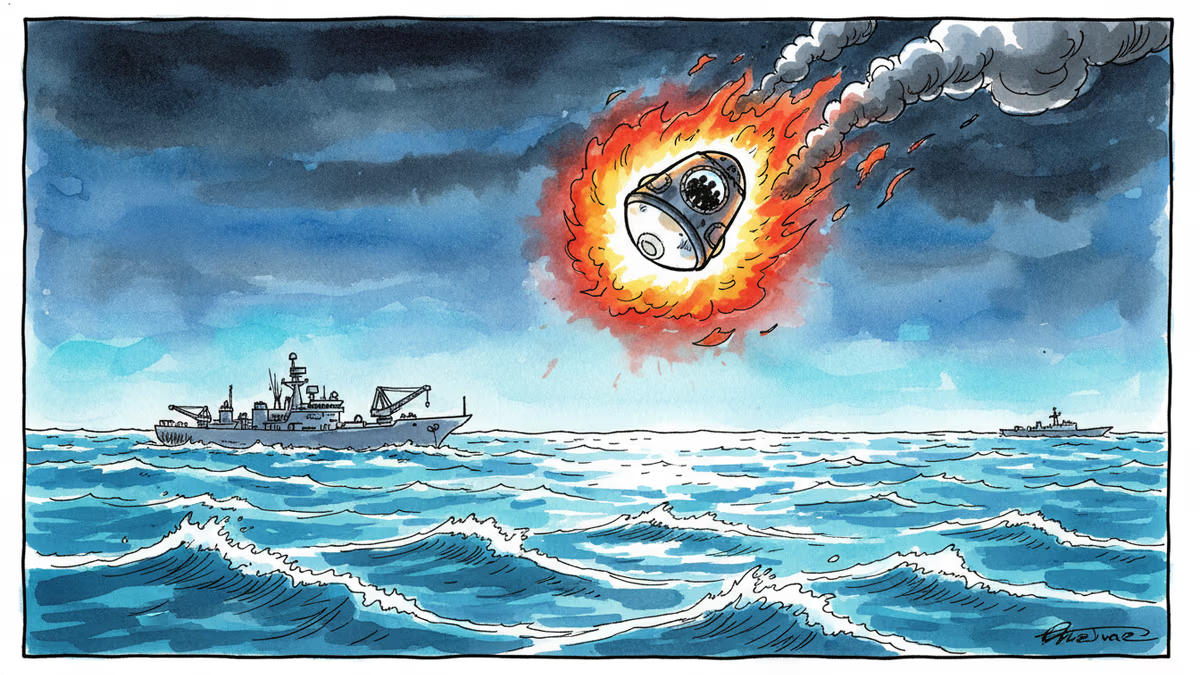
Artemis II's four astronauts are returning to Earth Friday night. The splashdown off Southern California isn't the anticlimax it sounds—it's the most technically perilous moment of the entire lunar journey.
NASA's Artemis III has been redesigned as an Earth-orbit mission. SpaceX and Blue Origin say their landers won't be ready until late 2027. What does this mean for the future of lunar exploration?
Artemis II splashed down successfully in the Pacific, marking humanity's first crewed deep space mission in over 50 years. But the harder question isn't whether we can go back — it's why we should.
NASA's Orion capsule splashed down safely after humanity's first crewed lunar voyage in 54 years. The mission succeeded. Now the harder questions begin.
Artemis II's four astronauts are returning to Earth Friday night. The splashdown off Southern California isn't the anticlimax it sounds—it's the most technically perilous moment of the entire lunar journey.
Thoughts
Share your thoughts on this article
Sign in to join the conversation