
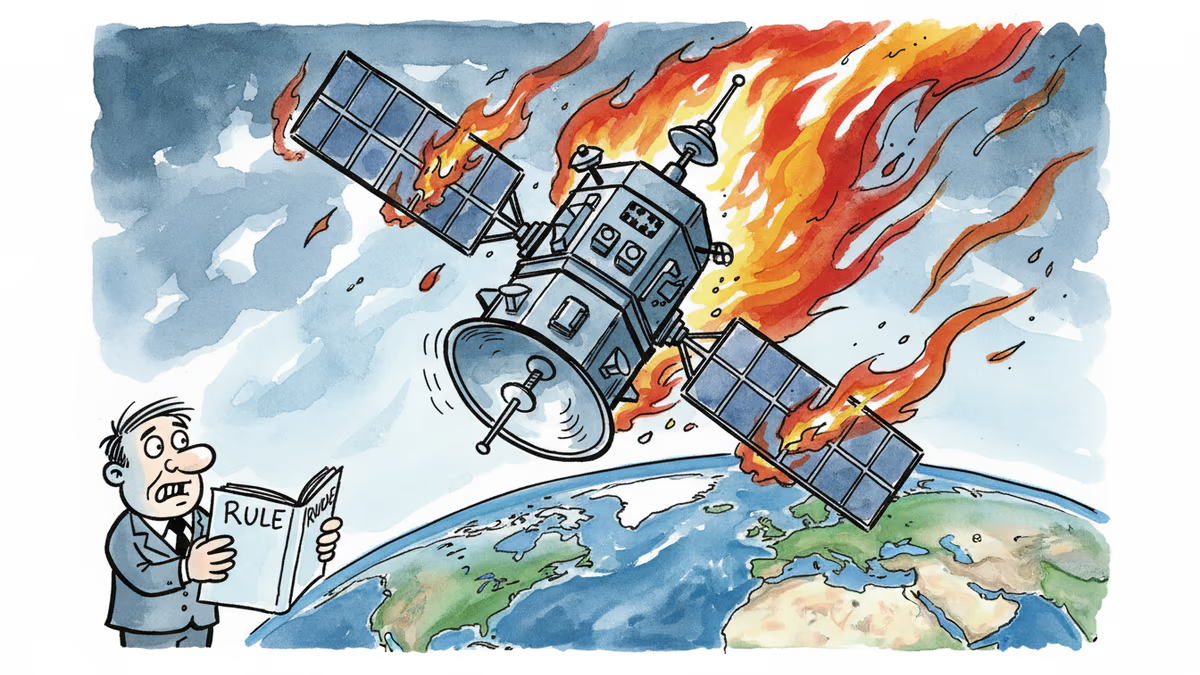
NASA's Satellite Falls Outside Its Own Safety Rules
A NASA satellite is set to reenter Earth's atmosphere uncontrolled, with debris casualty odds that exceed the US government's own safety threshold. What does that say about space debris governance?
The odds are 1 in 4,200. That sounds reassuringly small—until you learn the US government's own safety standard is 1 in 10,000. A NASA satellite is about to fall back to Earth, and by the agency's own reckoning, it shouldn't be allowed to.
What's Actually Happening
A NASA research satellite that spent over a decade orbiting Earth through the Van Allen radiation belts is making an uncontrolled reentry into the atmosphere. The spacecraft weighs roughly 600 kilograms (1,323 pounds). Most of it will burn up on the way down. But some fragments are expected to survive the heat and reach the surface.
The problem isn't the debris itself—it's the unpredictability. In an uncontrolled reentry, engineers can narrow down the landing zone only within hours of impact. Ocean, desert, or city block: the math doesn't care.
NASA has acknowledged the risk of a casualty stands at approximately 1 in 4,200—more than twice the 1 in 10,000 threshold the US federal government sets for acceptable risk from uncontrolled reentries. In other words, the agency responsible for the satellite is publicly admitting it doesn't meet the standard its own government wrote.
How Did We Get Here
This satellite was designed and launched in an earlier era of space regulation. The rules around end-of-life disposal—controlled deorbit burns, graveyard orbits, zero-debris design principles—have tightened significantly in recent years. This spacecraft predates those stricter norms, and there's no retrofitting a satellite already in orbit.

Uncontrolled reentries aren't rare. A recent study found that objects of comparable mass reenter Earth's atmosphere multiple times per month. Most are old rocket bodies or defunct satellites that splash down in oceans or remote terrain without incident. What makes this case different is the source: it's not an obscure piece of Cold War hardware. It's a NASA science mission, and the agency is openly disclosing that it exceeds its own risk threshold.
The Governance Gap Nobody Wants to Talk About
Here's the uncomfortable part: the rules existed. NASA knew them. The US government wrote them. And the satellite is still falling on the wrong side of those rules.
This isn't a failure of intent—it's a failure of foresight and enforcement lag. Regulations updated after a satellite is already in orbit can't reach backward. The result is a growing inventory of objects in space that were designed under older, looser standards and will eventually come down however physics dictates.
That inventory is enormous. Tens of thousands of objects—active satellites, spent rocket stages, and fragments—currently circle Earth. SpaceX's Starlink constellation alone operates thousands of satellites, with plans to expand to tens of thousands. Amazon's Project Kuiper is ramping up. The European Space Agency has set a zero-debris target for new missions by 2030, and the US Federal Communications Commission has tightened its post-mission disposal rules. But the backlog of legacy hardware already up there remains ungoverned by these newer standards.
Who Bears the Risk
When a satellite falls, the liability picture gets murky fast. The 1972 Outer Space Treaty holds launching states responsible for damage caused by their space objects. In practice, enforcement is nearly nonexistent—no country has ever successfully claimed compensation under the treaty's liability convention for debris damage.
For the average person on the ground, the risk from this particular satellite is genuinely low. But risk is a cumulative calculation. One in 4,200 multiplied across dozens of uncontrolled reentries per year adds up. As launch rates accelerate—driven by commercial constellations, national space programs, and cheaper rockets—the frequency of these events will only increase. The question isn't whether the rules are written. It's whether the rules can keep pace with the hardware.
Authors
Related Articles

SpaceX's upgraded Starship V3 completed its first test flight, deploying 20 Starlink simulators but losing the Super Heavy booster. With an IPO weeks away, the stakes just got higher.

NASA's Artemis III has been redesigned as an Earth-orbit mission. SpaceX and Blue Origin say their landers won't be ready until late 2027. What does this mean for the future of lunar exploration?
Blue Origin's New Glenn nailed its second booster landing, but AST SpaceMobile's BlueBird 7 satellite ended up in the wrong orbit—effectively useless. What this split outcome reveals about the space race.
Blue Origin's Endurance and China's Chang'e 7 are both headed to the Moon's south pole this year. The race for lunar water ice is no longer theoretical.
SpaceX's upgraded Starship V3 completed its first test flight, deploying 20 Starlink simulators but losing the Super Heavy booster. With an IPO weeks away, the stakes just got higher.
NASA's Artemis III has been redesigned as an Earth-orbit mission. SpaceX and Blue Origin say their landers won't be ready until late 2027. What does this mean for the future of lunar exploration?
Blue Origin's New Glenn nailed its second booster landing, but AST SpaceMobile's BlueBird 7 satellite ended up in the wrong orbit—effectively useless. What this split outcome reveals about the space race.
Blue Origin's Endurance and China's Chang'e 7 are both headed to the Moon's south pole this year. The race for lunar water ice is no longer theoretical.
Thoughts
Share your thoughts on this article
Sign in to join the conversation