
Mui Board Smart Home Controller: A Post-Screen Minimalist Revolution
The Mui Board smart home controller brings a screen-free, minimalist aesthetic to your living room. Discover how this 2019 CES concept finally became reality.
What if your home's brain wasn't a glowing glass rectangle, but a warm piece of natural wood? The future of smart home control is moving away from the screen and back toward the tactile world.
The Mui Board Smart Home Controller: From Concept to Reality
Being a tech journalist means watching bold ideas struggle through the 'valley of death' before they reach a consumer's hands. The Mui Board, first demoed at CES 2019, has finally made that transition. Developed by Kyoto-based Mui Lab, this minimalist controller isn't just a gadget; it's a furniture-grade interface designed to disappear when not in use.

Functional Art Meets Matter Compatibility
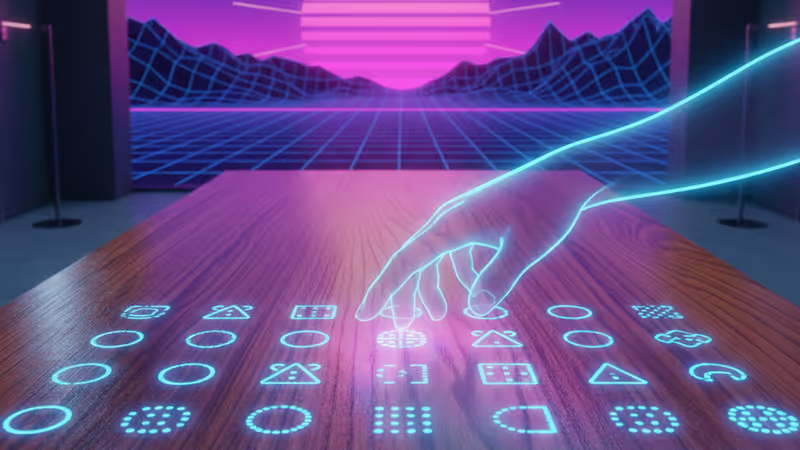
According to reports from The Verge, the device utilizes an etched wooden surface that allows LED lights to shine through, creating a hidden-until-lit interface. It works with Matter, the industry standard for smart home connectivity, allowing it to control lights, thermostats, and speakers across different ecosystems. It's a striking contrast to the high-resolution, high-distraction displays we're used to.
Authors
Related Articles

The Mui Board Gen 2 sleep tracking platform uses millimeter-wave sensors to monitor your sleep without wearables. Learn about this wooden smart home innovation.

Samsung Electronics' union branch revealed that 84% of survey respondents oppose the government's roughly $290 billion (₩400 trillion) semiconductor megaproject in Gwangju. Government, management, the union and shareholders are all reading the same national project in sharply different ways.

Nvidia shipped roughly a billion RISC-V cores in 2024, then announced it would run CUDA on the open standard. We break down how royalty-free instruction sets and open software stacks are trying to route around CUDA's lock-in. Part 2 of the Semiconductor Sovereignty series.

US AI-chip export controls split into three layers in the first half of 2026 — January easing, a May crackdown on circumvention, and a pending bill. Nvidia erased China from its guidance and still posted a record $81.6 billion quarter. A look at the export policy that both shields and cages it.
The Mui Board Gen 2 sleep tracking platform uses millimeter-wave sensors to monitor your sleep without wearables. Learn about this wooden smart home innovation.
Samsung Electronics' union branch revealed that 84% of survey respondents oppose the government's roughly $290 billion (₩400 trillion) semiconductor megaproject in Gwangju. Government, management, the union and shareholders are all reading the same national project in sharply different ways.
Nvidia shipped roughly a billion RISC-V cores in 2024, then announced it would run CUDA on the open standard. We break down how royalty-free instruction sets and open software stacks are trying to route around CUDA's lock-in. Part 2 of the Semiconductor Sovereignty series.
US AI-chip export controls split into three layers in the first half of 2026 — January easing, a May crackdown on circumvention, and a pending bill. Nvidia erased China from its guidance and still posted a record $81.6 billion quarter. A look at the export policy that both shields and cages it.
Thoughts
Share your thoughts on this article
Sign in to join the conversation