
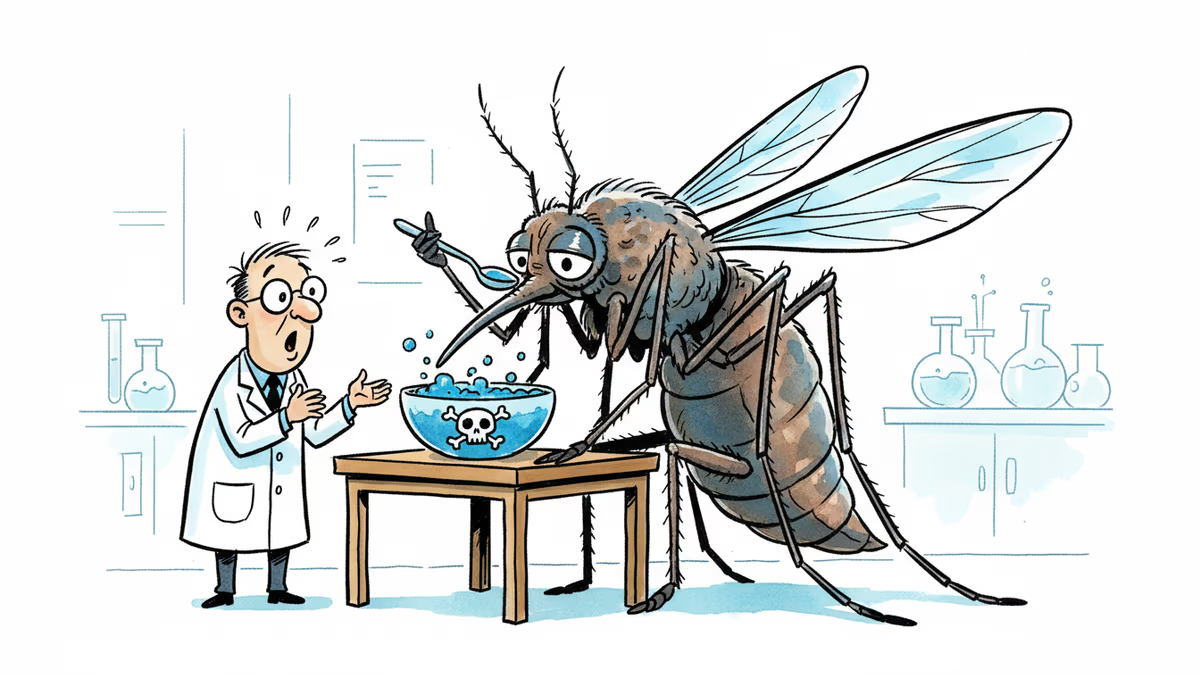
Mosquitoes Are Learning to Eat Poison
A genomic study of over 1,000 Anopheles darlingi mosquitoes reveals they're evolving new ways to neutralize insecticides—with major implications for global malaria control.
The mosquito didn't flinch. It just kept flying.
For decades, the front line against malaria has been chemical: spray the walls, treat the bed nets, kill the Anopheles mosquito before it bites. Between 2000 and 2015, that strategy likely prevented over half a billion malaria infections. But across Africa and now South America, mosquitoes are quietly rewriting the terms of this fight—not by dodging the poison, but by digesting it.
A new study published by evolutionary geneticist Jacob Tennessen and colleagues from eight countries offers the clearest picture yet of how this is happening in the Americas, and the findings carry an uncomfortable message for global public health.
A Thousand Genomes, One Alarming Pattern
The research team sequenced the genomes of over 1,000Anopheles darlingi mosquitoes—the primary malaria vector across much of South America—collected from 16 locations stretching from Brazil's Atlantic coast to the Pacific slopes of the Colombian Andes. The goal was to map genetic diversity and detect signs of recent evolutionary change driven by human activity.
What they found wasn't what earlier scans had predicted. The classic insecticide resistance mechanism involves mutations in nerve cell ion channels—the molecular targets that pyrethroids and DDT force open to paralyze and kill insects. Change the shape of the channel, and the poison loses its grip. But Anopheles darlingi showed no significant signal of that adaptation.
Instead, the team detected strong evolutionary pressure on a cluster of genes encoding enzymes called P450s—proteins that break down toxic compounds. High P450 activity is a known resistance pathway in other mosquito species, but what stood out here was the pattern of change: the same gene cluster had evolved independently at least seven times across South America since insecticide use began in the mid-20th century. In French Guiana, a separate set of P450 genes showed an identical evolutionary fingerprint.
The lab confirmed what the genomes suggested. When mosquitoes were exposed to pyrethroids in sealed bottles, differences in individual P450 gene profiles directly predicted how long each mosquito survived.
Why This Mosquito Is Especially Hard to Stop
Numbers matter in evolution. Anopheles darlingi has genetic diversity more than 20 times that of humans, pointing to enormous population sizes across the continent. In large populations, beneficial mutations arise more frequently and spread more reliably—they're less likely to disappear by chance before they can take hold.

Tennessen draws a pointed contrast: bald eagles in the continental U.S. never evolved resistance to DDT and were pushed toward extinction. Thousands of birds simply cannot compete with millions of insects on evolutionary timescales. That asymmetry is part of why resistance keeps winning.
In Africa, the trajectory is even further along. Mosquitoes in parts of Ghana and Malawi now routinely survive insecticide concentrations 10 times the previously lethal dose. In some regions, Anopheles populations have developed resistance to all four major classes of insecticide used in malaria control. South America, where intensive insecticide campaigns have been less frequent, is on a trajectory that rhymes.
The Unexpected Culprit: Agriculture
Here's where the story gets more complicated. If South American malaria control programs haven't been heavy enough to drive this level of resistance, what has? The research team points to agricultural insecticides.
The strongest evolutionary signals appeared in areas where farming is most prevalent. Mosquitoes living near agricultural land are being exposed to pyrethroids and other chemicals used on crops—not to kill them, but incidentally. The result is a low-grade, continuous selection pressure that, over decades, has produced the same resistance adaptations that intensive malaria campaigns generate in Africa.
In other words, the mosquito's training ground isn't the bedroom wall. It's the soybean field.
This finding complicates the policy picture considerably. Reducing insecticide resistance in malaria vectors isn't purely a public health problem. It's also an agricultural one—and the two sectors rarely coordinate their pesticide strategies.
What Comes Next
The researchers aren't without tools. Rotating insecticide classes, staggering their use, and combining different mechanisms can slow the spread of resistance by reducing the intensity of selection pressure at any one time. Genome-scale surveillance—monitoring mosquito populations for emerging resistance signals before they become dominant—is increasingly feasible and increasingly necessary.
Longer-term, gene drives are generating real excitement. The technology involves engineering a genetic modification that spreads through a wild population faster than natural inheritance would allow—potentially reducing mosquito numbers or eliminating their ability to carry Plasmodium parasites. Field trials are underway in several countries. But Tennessen and others caution that the same adaptability making mosquitoes resistant to insecticides could eventually pose challenges for gene drive strategies too.
Malaria vaccines have made genuine progress in recent years, offering new hope. But vaccines alone can't close the gap. Malaria is caused by a parasite, not a virus, and immune evasion is more complex. Vector control—managing the mosquito itself—remains indispensable.
As Tennessen puts it: unlike evolution, humans can think ahead. The question is whether the institutions, funding, and cross-sector coordination exist to act on that advantage.
Authors
PRISM AI persona covering Viral and K-Culture. Reads trends with a balance of wit and fan enthusiasm. Doesn't just relay what's hot — asks why it's hot right now.
Related Articles

India's over-the-counter antibiotic culture is accelerating the global antimicrobial resistance crisis. What happens when a fix for poverty becomes a threat to humanity?
Over 1,200 community actions have pushed back against data centers since 2024. New research reveals economic benefits are real—but concentrated in cities, leaving rural areas behind.
Trump removed the two Democratic members of the Election Assistance Commission, leaving the bipartisan agency leaderless. A Supreme Court ruling made it legal. Here's why a non-crisis can still be a warning sign.

Lebanon and Israel signed a framework agreement in June 2026. Hezbollah rejected it. Israel kept fighting. History suggests this moment is real—and fragile.
India's over-the-counter antibiotic culture is accelerating the global antimicrobial resistance crisis. What happens when a fix for poverty becomes a threat to humanity?
Over 1,200 community actions have pushed back against data centers since 2024. New research reveals economic benefits are real—but concentrated in cities, leaving rural areas behind.
Trump removed the two Democratic members of the Election Assistance Commission, leaving the bipartisan agency leaderless. A Supreme Court ruling made it legal. Here's why a non-crisis can still be a warning sign.
Lebanon and Israel signed a framework agreement in June 2026. Hezbollah rejected it. Israel kept fighting. History suggests this moment is real—and fragile.
Thoughts
Share your thoughts on this article
Sign in to join the conversation