
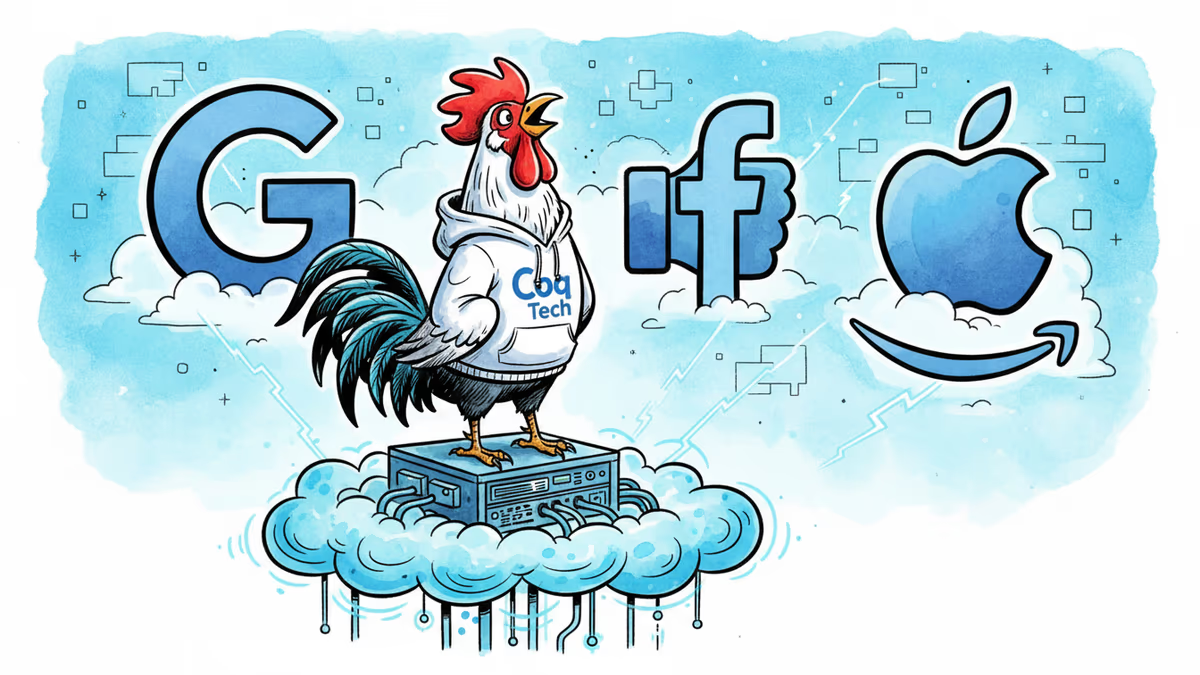
Mistral's First Acquisition Signals War for AI Infrastructure
French AI unicorn Mistral acquires Koyeb to become full-stack player, challenging US cloud giants while building European AI sovereignty infrastructure
A $13.8 Billion Unicorn Makes Its First Move
Mistral AI just dropped its first acquisition bomb. The target? Koyeb, a Paris-based startup that makes deploying AI apps feel effortless. On paper, it's a modest deal—13 employees joining a much larger company. In reality, it's Mistral's declaration of war against the cloud infrastructure giants.
Until now, Mistral has been the scrappy French challenger to OpenAI, focused purely on building large language models. But this acquisition confirms what industry insiders have been whispering: Mistral wants to own the entire AI stack, from model to deployment.
From Serverless Pioneer to AI Infrastructure Play
Koyeb wasn't just any startup. Founded in 2020 by three Scaleway veterans, it pioneered the "serverless" approach—letting developers process data without wrestling with server management. As AI workloads became more demanding, this philosophy proved prescient.
Their recent launch of AI Sandboxes created isolated environments for deploying AI agents, already supporting models from Mistral and competitors. Now, that expertise flows directly into Mistral's engineering team under CTO Timothée Lacroix.
The integration plan is ambitious: deploy models on clients' own hardware, optimize GPU usage, and scale AI inference—the process that turns trained models into real-time responses. Koyeb's platform will continue operating but evolve into a "core component" of Mistral Compute over the coming months.

Europe's Answer to American Cloud Dominance
This isn't just about technology—it's about sovereignty. Serena VC's Floriane de Maupeou called the combination key to "building the foundations of sovereign AI infrastructure in Europe." Days before the acquisition, Mistral announced a $1.4 billion data center investment in Sweden, signaling serious infrastructure ambitions.
The timing isn't coincidental. As geopolitical tensions rise and data sovereignty concerns mount, European companies increasingly seek alternatives to US-dominated cloud infrastructure. Mistral recently crossed $400 million in annual recurring revenue, partly driven by this "digital sovereignty" trend.
David vs. Multiple Goliaths
But can a French startup really challenge Amazon AWS, Microsoft Azure, and Google Cloud? The incumbents have decades of infrastructure investment, global reach, and enterprise relationships that took years to build.
Mistral's bet is different. Instead of competing on scale alone, they're positioning as the privacy-conscious, regulation-compliant alternative. European data stays in Europe. AI governance aligns with EU regulations. For enterprises navigating complex compliance requirements, that's increasingly valuable.
Yet questions remain. Will European companies pay premium prices for sovereignty? Can Mistral's infrastructure match the reliability and performance of established players? The company's hiring push for infrastructure roles suggests they're taking these challenges seriously.
Analysis based on TechCrunch reporting and industry sources.
Authors
Related Articles

Samsung and SK unveiled a chip and AI investment package worth thousands of trillions of won on June 29. The headline number swings wildly by outlet, but the real contest isn't capital — it's water and power.

Snowflake's new $6 billion AWS contract is about more than cloud spending. It signals a shift in AI infrastructure—away from Nvidia GPUs and toward cheaper, homegrown chips for the agent era.

Viral videos show 2026 graduates jeering executives who praise AI at commencement ceremonies. It's not just rudeness — it's a signal about who pays for technological optimism.

Filipino virtual assistants using AI to ghost-manage LinkedIn profiles for executives is now a structured industry. 30 comments a day, fake engagement rings, and a platform struggling to tell real from fabricated.
Samsung and SK unveiled a chip and AI investment package worth thousands of trillions of won on June 29. The headline number swings wildly by outlet, but the real contest isn't capital — it's water and power.
Snowflake's new $6 billion AWS contract is about more than cloud spending. It signals a shift in AI infrastructure—away from Nvidia GPUs and toward cheaper, homegrown chips for the agent era.
Viral videos show 2026 graduates jeering executives who praise AI at commencement ceremonies. It's not just rudeness — it's a signal about who pays for technological optimism.
Filipino virtual assistants using AI to ghost-manage LinkedIn profiles for executives is now a structured industry. 30 comments a day, fake engagement rings, and a platform struggling to tell real from fabricated.
Thoughts
Share your thoughts on this article
Sign in to join the conversation