
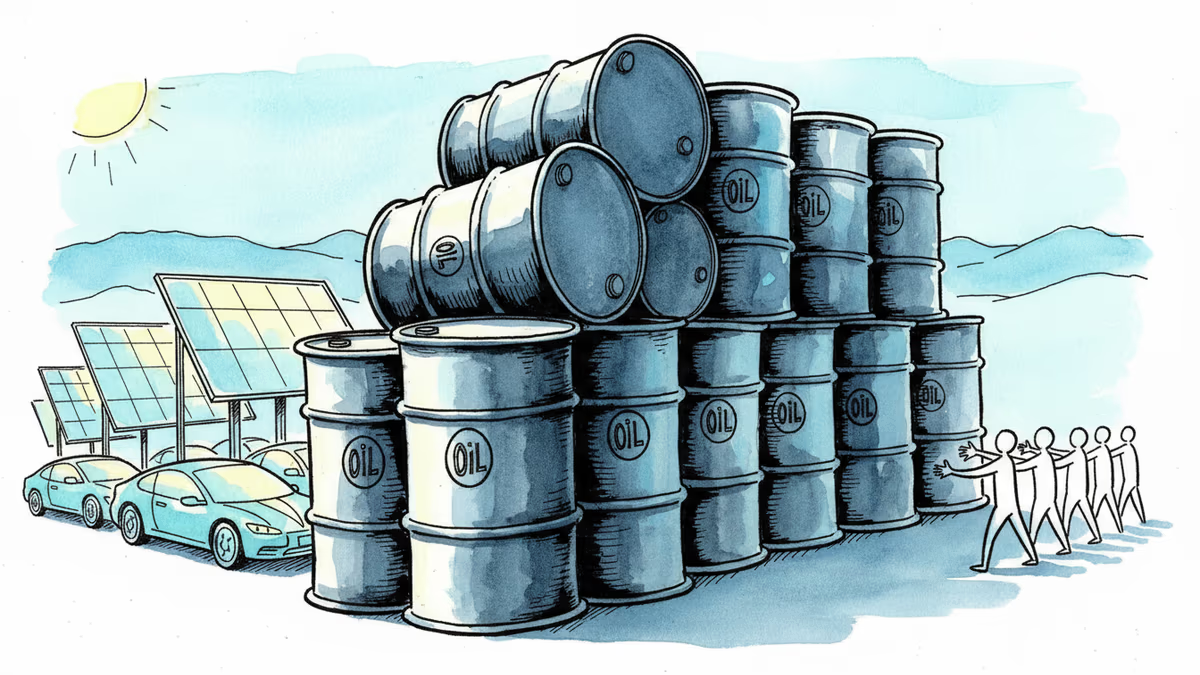
Michigan's Bold Gambit: Suing Big Oil for Market Manipulation, Not Climate Lies
Michigan takes a different approach to climate litigation, accusing oil giants of antitrust violations to suppress clean energy competition
$400 Billion Industry Faces New Kind of Legal Challenge
Michigan just threw a curveball at Big Oil. Instead of joining the chorus of states suing ExxonMobil, Chevron, BP, and Shell for climate deception, Michigan's targeting them for something potentially more damaging: antitrust violations.
Attorney General Dana Nessel filed the lawsuit in federal court last month, alleging these oil giants conspired with the American Petroleum Institute to suppress competition from solar power and electric vehicles. The twist? She's arguing they didn't just lie about climate change—they actively rigged the market to keep cheaper, cleaner alternatives from reaching consumers.
This isn't just another climate lawsuit. It's a direct attack on Big Oil's business model, using the language corporations understand best: market competition and consumer harm.
The Conspiracy Allegations: Four Decades of 'Innovation Suppression'
Michigan's case reads like a corporate thriller. The state alleges oil companies have systematically delayed the energy transition since the 1980s, not through legitimate competition, but through coordinated market manipulation.
The lawsuit claims these companies:
- Blocked solar technology development in the 1980s and 1990s
- Coordinated campaigns against EV infrastructure in the 2000s
- Spread "range anxiety" propaganda during Tesla's rise in the 2010s
- Used trade associations to funnel anti-renewable messaging
"This isn't about lobbying or advocacy," Nessel explained. "This is about collusion to maintain market dominance at consumers' expense."
The state points to internal documents and coordinated industry campaigns as evidence of explicit agreements to suppress clean energy competition.
Industry Pushback: 'Market Forces, Not Manipulation'
Oil companies aren't taking this lying down. The API immediately signaled plans to seek dismissal, calling the allegations "baseless and politically motivated."

Their defense strategy is predictable but potentially effective: "Consumers choose oil and gas because they're reliable and affordable. We compete on merit, not manipulation."
ExxonMobil spokesperson Sarah Johnson emphasized the company's $15 billion investment in low-carbon technologies over the past five years. "We're leading the energy transition, not blocking it," she said.
Shell pointed to its $6 billion renewable energy investments in 2025 alone as evidence of genuine commitment to diversification.
Legal Experts Split on Success Odds
The legal community is divided on Michigan's chances.
The Optimists: Stanford Law's antitrust expert Michael Weinstein sees promise in the approach. "Proving conspiracy is often easier than proving climate causation. If Michigan has smoking-gun evidence of coordination—emails, meeting minutes, joint strategy documents—they could win."
The Skeptics: Harvard's Susan Rose warns that "proving a 40-year conspiracy across multiple companies is extraordinarily difficult. Companies acting in parallel isn't the same as explicit collusion."
The key difference: antitrust law requires proof of explicit agreements to restrain trade, not just similar behavior patterns.
Why This Case Could Be a Game Changer
If Michigan succeeds, the implications extend far beyond legal precedent. A victory could:
- Accelerate clean energy adoption by removing artificial barriers
- Lower energy costs for consumers through genuine competition
- Create liability for decades of suppressed innovation
- Inspire similar lawsuits in other states and countries
More importantly, it could shift the entire framing of climate action from environmental responsibility to consumer protection and fair competition.
The Global Ripple Effect
This lawsuit isn't happening in isolation. European regulators are already investigating similar allegations, and China's rapid clean energy deployment has raised questions about whether Western markets were artificially constrained.
If Michigan proves market manipulation, it could provide legal ammunition for governments worldwide to accelerate energy transitions and potentially seek damages for delayed climate action.
The timing is crucial: as clean energy costs plummet globally, evidence of artificial market barriers becomes more compelling to judges and juries.
Authors
Related Articles

A federal jury ruled Live Nation operated as an illegal monopoly. Slack messages mocking customers, a possible Ticketmaster breakup, and what it means for every concert ticket you've ever bought.
NRC approves first nuclear reactor in a decade. TerraPower's sodium-cooled design could reshape energy, but faces steep cost challenges.
The US approves its first nuclear reactor construction in nearly a decade. Can TerraPower's radical sodium-cooled design reshape America's energy future?

The DOJ takes on Live Nation-Ticketmaster's alleged monopoly grip on the concert industry. A landmark antitrust case reveals the 'flywheel' strategy that locks out competition.
A federal jury ruled Live Nation operated as an illegal monopoly. Slack messages mocking customers, a possible Ticketmaster breakup, and what it means for every concert ticket you've ever bought.
NRC approves first nuclear reactor in a decade. TerraPower's sodium-cooled design could reshape energy, but faces steep cost challenges.
The US approves its first nuclear reactor construction in nearly a decade. Can TerraPower's radical sodium-cooled design reshape America's energy future?
The DOJ takes on Live Nation-Ticketmaster's alleged monopoly grip on the concert industry. A landmark antitrust case reveals the 'flywheel' strategy that locks out competition.
Thoughts
Share your thoughts on this article
Sign in to join the conversation