
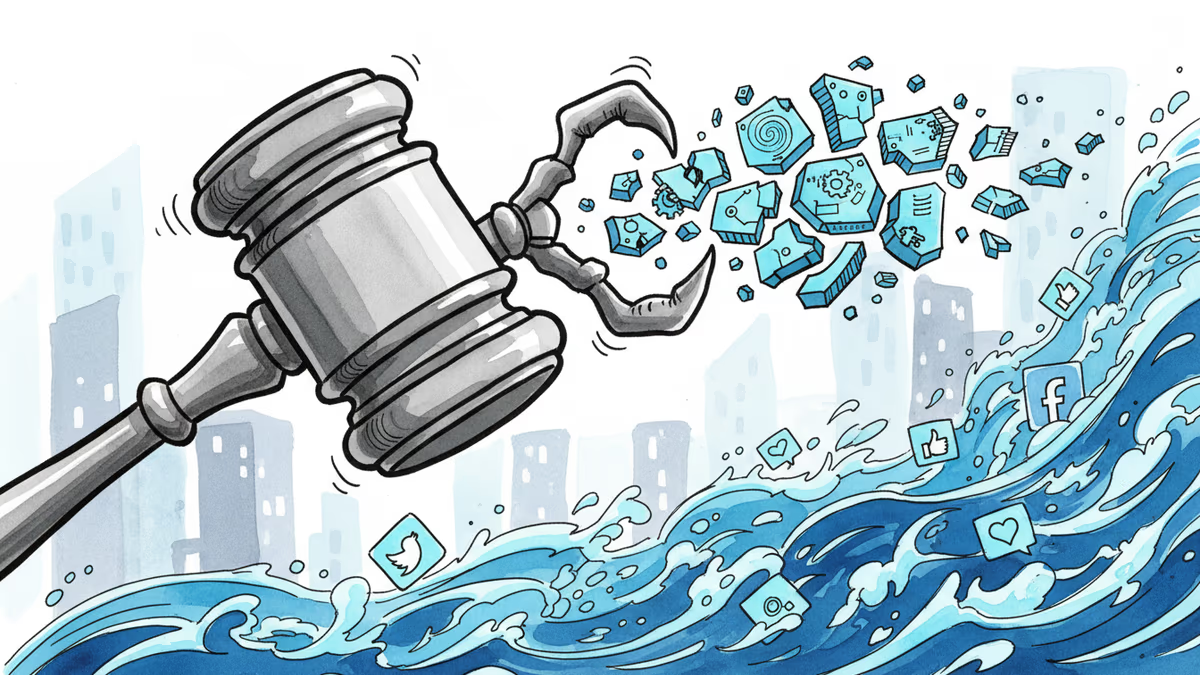
Meta's Oversight Board Faces Its AI Reckoning
As AI-generated content floods social media, Meta's Oversight Board struggles to adapt its slow, case-by-case approach to the speed of algorithmic moderation.
Millions In, Dozens Out
Meta's Oversight Board receives millions of case submissions each month. It reviews dozens. In an era where 7 out of 10 social media images are AI-generated and 8 out of 10 content recommendations rely on algorithms, can a "supreme court" model that takes months per decision still matter?
The math is stark: 21 board members overseeing content decisions for 3 billion users across Facebook, Instagram, and Threads. Sudhir Krishnaswamy, the board's only Indian member, admits the writing's on the wall: "Maybe because of the gen-AI space, some of our work would be less individual case-based and more structured."
It's a fundamental shift for a body designed to deliberate like judges, not respond like algorithms.
Where Machines Excel—And Where They Fail
Machine moderation isn't new, but it's getting more sophisticated. The results are mixed in telling ways.
AI excels at detecting adult nudity and gathering context signals at scale. But hate speech, misinformation, and disinformation remain "too complicated" for machines, according to Krishnaswamy. The complexity multiplies outside Western contexts, where cultural and linguistic nuances trip up even advanced models.
Consider the board's intervention on the Arabic word shaheed (martyr). Meta's blanket ban treated it as terrorist glorification, ignoring its everyday use across Arabic, Urdu, Persian, and other languages. In Kenya, the board overturned a decision that misclassified political criticism as ethnic slurs.

These cases reveal a pattern: AI moderation often works for universal categories but stumbles on cultural context—precisely where human oversight matters most.
The Global South Gets Left Behind
Rachel Adams, founder of the Global Center on AI Governance, cuts to the core issue: "The volume, velocity, and cross-language nature of problems have exploded." Yet the board's capacity hasn't scaled to match.
The numbers tell the story. Facebook didn't implement a hate speech classifier for Bengali—one of the world's most spoken languages—until 2020, years after Western languages. AI frequently misses disability-related slurs in Hindi. The global majority bears the cost of this "critically uneven" moderation.
"What won't work," Krishnaswamy warns, "is if you see some of the early AI safety boards that some of the big majors set up—they've got all American boards. That is not going to work in Turkey, it's not going to work in India, it is not going to work in Somalia."
When Humans and AI Agents Share the Same Platform
The future complicates things further. Social media platforms are evolving into spaces where humans, AI-assisted humans, and pure AI agents coexist. Agent-only platforms like Moltbot might seem radical, but they're previewing a reality where distinguishing human from artificial becomes increasingly difficult.
"The complicated cases will arise when the platforms share humans and agents," Krishnaswamy predicts. The board currently has "no mandate on gen-AI, but it's something we're trying to understand."
Meta has implemented all the board's binding decisions and 75% of its recommendations over five years. But tracking broader policy adoption remains murky, especially as AI moderation scales beyond human oversight.
Authors
Related Articles

Snap, YouTube, and TikTok settled a landmark school district lawsuit over social media addiction. With 1,000+ similar cases pending, this could reshape Big Tech's liability landscape.
New Mexico already won $375 million from Meta. Now it wants something harder to give: a court order forcing Facebook, Instagram, and WhatsApp to redesign themselves. A three-week trial starts Monday.
A small pro-Iran team is racking up millions of views with AI-generated Lego videos that mock Trump — and Americans are sharing them. What does that tell us about information warfare?
Reddit CEO Steve Huffman announced human verification for suspicious accounts. As AI bots flood the internet, one platform is drawing a line — but the line keeps moving.
Snap, YouTube, and TikTok settled a landmark school district lawsuit over social media addiction. With 1,000+ similar cases pending, this could reshape Big Tech's liability landscape.
New Mexico already won $375 million from Meta. Now it wants something harder to give: a court order forcing Facebook, Instagram, and WhatsApp to redesign themselves. A three-week trial starts Monday.
A small pro-Iran team is racking up millions of views with AI-generated Lego videos that mock Trump — and Americans are sharing them. What does that tell us about information warfare?
Reddit CEO Steve Huffman announced human verification for suspicious accounts. As AI bots flood the internet, one platform is drawing a line — but the line keeps moving.
Thoughts
Share your thoughts on this article
Sign in to join the conversation