
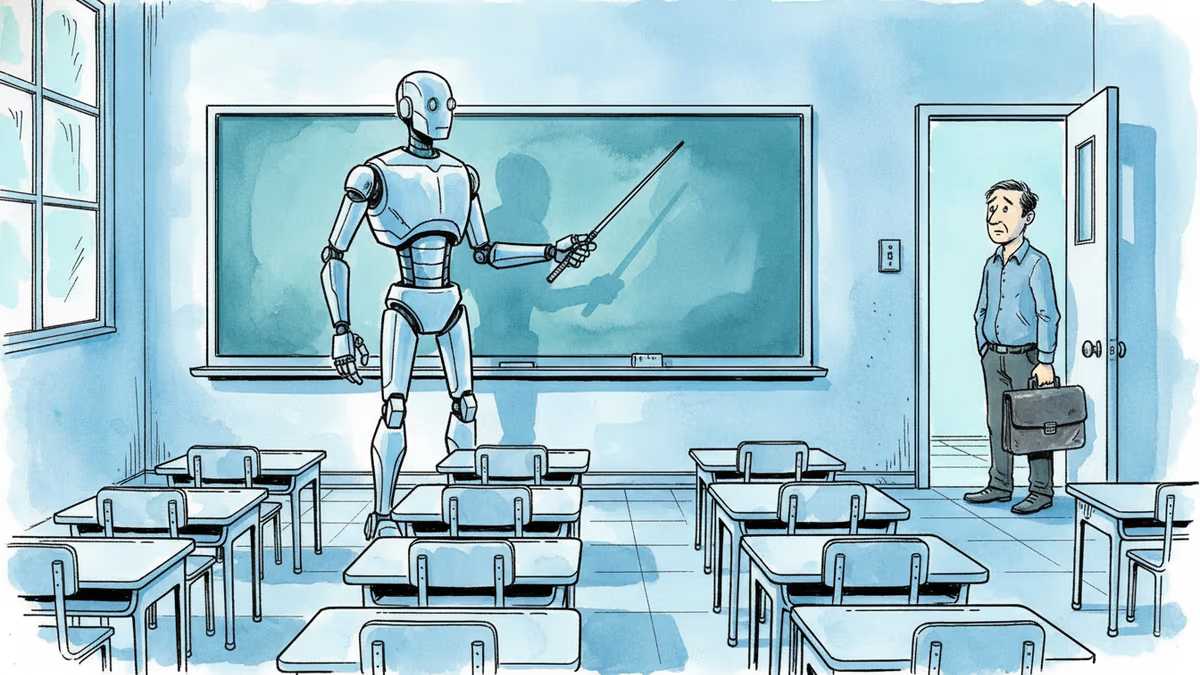
Melania's Robot Teacher: Utopia or Inequality Engine?
A humanoid robot walked the White House red carpet with Melania Trump. It's a preview of an ed-tech vision that could reshape — or fracture — how children learn.
"Imagine a humanoid educator named Plato."
The First Lady wasn't speaking at a tech conference. She was at the White House, standing next to an actual humanoid robot that had just walked the red carpet beside her. The machine from Figure AI delivered a short, chirpy speech — "I am grateful to be part of this historic movement to empower children with technology and education" — then quietly left the room. The whole thing lasted under two minutes.
But what it signaled could last much longer.
What Actually Happened
On Wednesday, Melania Trump hosted the Fostering the Future Together global summit, inviting international leaders to discuss AI and educational technology for children. The event doubled as the clearest articulation yet of where the Trump administration wants American education to go: away from public institutions, and toward tech-driven, privately run alternatives.
The First Lady's vision of "Plato" was detailed. This AI educator would deliver literature, science, philosophy, mathematics, and history — "humanity's entire corpus of information" — personalized to each child, always patient, always available, accessible from home. On the same day, the White House announced a separate tech advisory council stocked with Silicon Valley executives.
To be clear: this isn't where the technology is today. Current humanoid robots cannot autonomously run a classroom. Figure AI's bot was more symbol than substance. But the ideology driving the event is already reshaping policy in concrete ways.
The Policy Behind the Performance

The administration's embrace of Alpha School — a private school network that uses AI to accelerate learning and charges upward of $40,000–$50,000 per year — offers a window into the real-world version of this vision. Education Secretary Linda McMahon, who is simultaneously overseeing the dismantling of the Department of Education, visited an Alpha School campus and praised its "opportunity." The administration called it a model for "equipping students with practical AI skills."
The through-line is consistent: defund and delegitimize public education, then position private, tech-powered alternatives as the upgrade. The robot at the White House wasn't just a PR stunt. It was a mascot for a policy direction.
Three Ways to Read This
If you're a parent in a high-income household, the pitch is genuinely appealing. An AI tutor that adapts to your child's pace, available at 2 a.m. before a test, never frustrated, never distracted — that's a real value proposition. Early adopters of AI tutoring tools already report measurable gains in test performance.
If you're a public school teacher, the optics are harder to stomach. Teachers' unions in the U.S. have pushed back sharply, arguing that education isn't just knowledge transfer. The social and emotional dimensions of learning — conflict resolution, resilience, human mentorship — aren't things an algorithm can replicate. The fear isn't just job displacement. It's that a generation of children might grow up optimized for test scores but underprepared for human complexity.
If you're looking at this from the developing world, the calculus shifts again. More than 300 million children globally lack access to any qualified teacher. For them, an AI tutor isn't a replacement — it's the first option. Organizations like Khan Academy have already deployed AI tutoring tools in low-resource environments with measurable impact. The same technology reads very differently depending on what it's replacing.
The Inequality Problem No One Addressed
Here's what the White House summit didn't mention: access.
Alpha School's tuition makes it available to a narrow slice of American families. The AI tools being celebrated require reliable internet, devices, and — crucially — parents with the time and resources to navigate them. If the public school system is defunded while premium AI education scales up, the result isn't democratized learning. It's a two-tier system where your zip code, or your parents' income, determines whether your "Plato" is a cutting-edge adaptive AI or a crumbling classroom with a burned-out substitute teacher.
The robot walked the red carpet. Most kids won't.
Authors
Related Articles
The Trump administration has gutted the DOJ's Voting Section, pushing out two dozen experienced lawyers and replacing them with loyalists. With 2026 midterms approaching, what does this mean for American democracy?
A public Quizlet set apparently leaked confidential CBP security procedures near Kingsville, Texas. It stayed live for weeks—until a journalist sent a text.
Two days after launching the first crewed lunar mission in over 50 years, the Trump administration proposed cutting NASA's budget by 23%. What does this mean for the future of space exploration?
The Trump administration struck a deal to buy back offshore wind leases from TotalEnergies for $1 billion, redirecting that money into fossil fuel projects. What this means for energy markets, grid reliability, and the future of U.S. climate policy.
The Trump administration has gutted the DOJ's Voting Section, pushing out two dozen experienced lawyers and replacing them with loyalists. With 2026 midterms approaching, what does this mean for American democracy?
A public Quizlet set apparently leaked confidential CBP security procedures near Kingsville, Texas. It stayed live for weeks—until a journalist sent a text.
Two days after launching the first crewed lunar mission in over 50 years, the Trump administration proposed cutting NASA's budget by 23%. What does this mean for the future of space exploration?
The Trump administration struck a deal to buy back offshore wind leases from TotalEnergies for $1 billion, redirecting that money into fossil fuel projects. What this means for energy markets, grid reliability, and the future of U.S. climate policy.
Thoughts
Share your thoughts on this article
Sign in to join the conversation