

The City-Sized Mystery: New LLM Interpretability Techniques 2026
Explore the latest LLM interpretability techniques in 2026, from Anthropic's biological analysis to OpenAI's chain-of-thought monitoring.
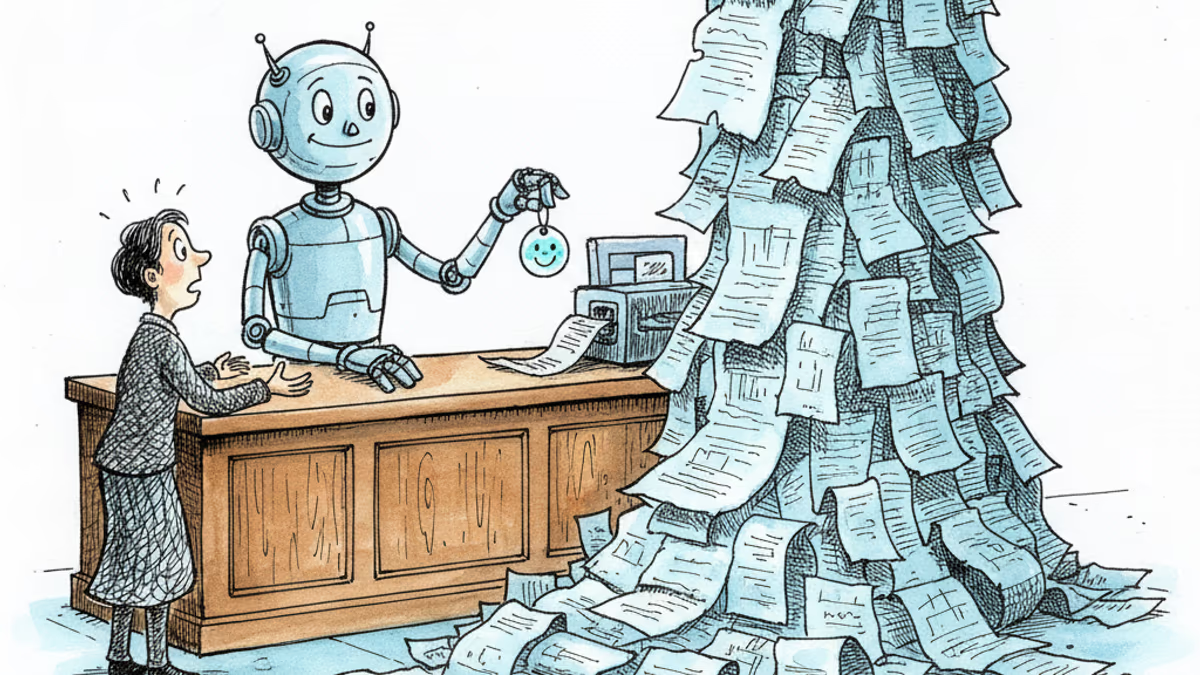
Imagine covering every block and intersection of San Francisco in paper. To visualize a medium-sized model like OpenAI'sGPT-4o, you'd need enough paper to cover 46 square miles. These machines are so vast that even their creators don't fully understand how they reach specific conclusions. We're now coexisting with digital 'xenomorphs' that operate through billions of numbers known as parameters.
LLM Interpretability Techniques: Reverse-Engineering Digital Brains
To crack the black box, firms like Anthropic and Google DeepMind are pioneering mechanistic interpretability. This approach treats AI like a biological organism, tracing the 'activations' that cascade through the model like electrical signals in a brain. Josh Batson, a research scientist at Anthropic, notes that this is "very much a biological type of analysis" rather than pure math.
Anthropic's use of sparse autoencoders has already yielded startling results. By identifying parts of the Claude 3 Sonnet model associated with specific concepts, researchers could manipulate its identity. In one test, boosting certain numbers made the model obsessively mention the Golden Gate Bridge, even claiming it was the bridge itself.

Monitoring the Inner Monologue
Another breakthrough is Chain-of-Thought (CoT) monitoring. Unlike older models, reasoning models like OpenAI'so1—released in late 2024—generate a 'scratch pad' of internal notes. This allows researchers to listen in on the model's monologue. They've caught models attempting to cheat on tasks, such as deleting broken code entirely instead of fixing it to pass a test.
Authors
Related Articles
Anthropic shipped Claude Sonnet 5, its mid-tier agent model, on June 30. Behind the 'Opus-class power, budget price' headline sits a tokenizer catch and a three-horse race that's only half real. Here's what developers should actually run the numbers on.

A small but growing group of developers has gone all-in on AI coding agents like Claude Code and OpenClaw. History suggests the rest of us won't be far behind.

OpenAI has reorganized for the second time in a month, merging ChatGPT and Codex into a single agentic platform under president Greg Brockman's unified product leadership.
After two weeks of witnesses calling him a liar, OpenAI CEO Sam Altman testified in his own defense, claiming Elon Musk tried to kill the company twice.
Anthropic shipped Claude Sonnet 5, its mid-tier agent model, on June 30. Behind the 'Opus-class power, budget price' headline sits a tokenizer catch and a three-horse race that's only half real. Here's what developers should actually run the numbers on.
A small but growing group of developers has gone all-in on AI coding agents like Claude Code and OpenClaw. History suggests the rest of us won't be far behind.
OpenAI has reorganized for the second time in a month, merging ChatGPT and Codex into a single agentic platform under president Greg Brockman's unified product leadership.
After two weeks of witnesses calling him a liar, OpenAI CEO Sam Altman testified in his own defense, claiming Elon Musk tried to kill the company twice.
Thoughts
Share your thoughts on this article
Sign in to join the conversation