
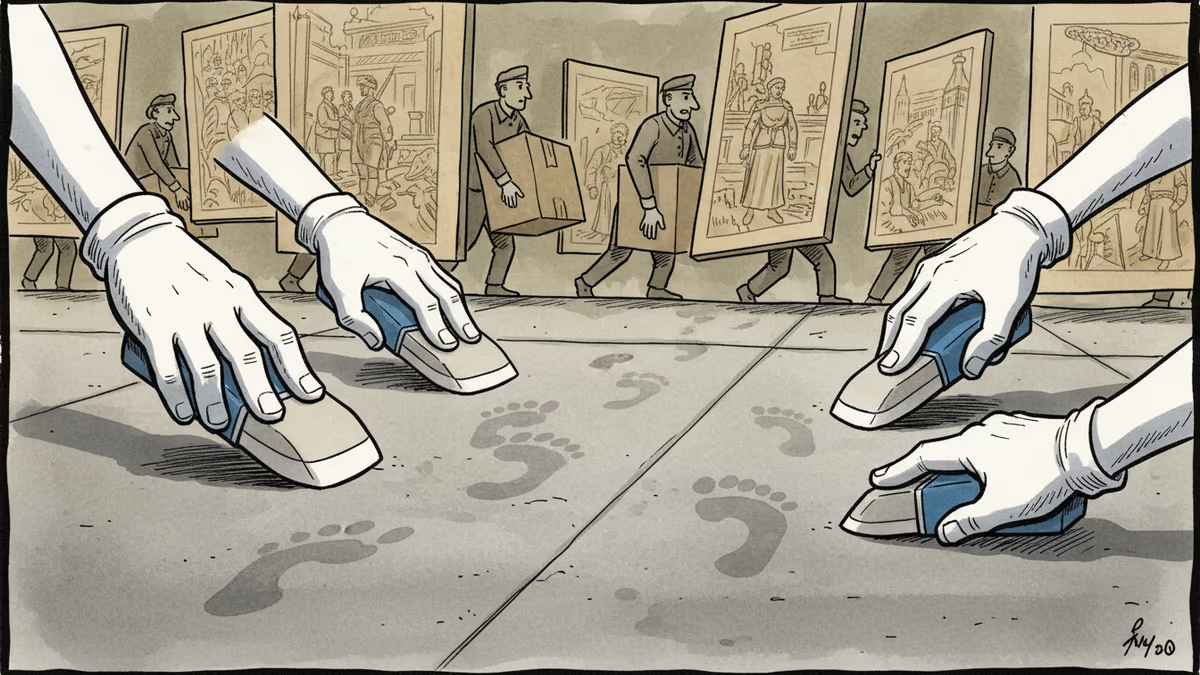
Why Trump Removed a Slavery Exhibit from Washington's Former Home
The removal of a slavery exhibit from Philadelphia's Independence Hall has sparked a lawsuit and reignited America's culture war over historical memory as the nation approaches its 250th anniversary.
On the evening of May 21, 1796, Ona Judge made a life-or-death decision. While the first family dined in what would become known as the President's House in Philadelphia, she slipped away undetected, beginning her journey toward freedom.
Judge wasn't just any runaway slave—she was the personal chambermaid to Martha Washington, serving at the intersection of 6th and Market streets, mere feet from Independence Hall where America proclaimed that "all men are created equal."
230 years later, the National Park Service erased her story from that very spot.
The Footprints That Disappeared
Until January 2026, visitors to Philadelphia's Independence National Historic Park could stand where Judge once stood. Embedded in the sidewalk were footprints shaped like a woman's shoes, marking the beginning of her daring escape. Surrounding them were 34 explanatory panels telling the stories of the nine enslaved people the Washingtons owned while living in the presidential mansion.
The exhibit, "Freedom and Slavery in the Making of a New Nation," opened in December 2010—the first slavery memorial on federal land in U.S. history. It forced visitors to confront an uncomfortable truth: America's first president enslaved people while holding the nation's highest office.
That discomfort, it seems, was precisely the point—and precisely the problem for the Trump administration.
A Pattern of Erasure
The removal wasn't an isolated incident. During his first week back in office, President Trump signed executive orders eliminating diversity, equity, and inclusion policies across federal agencies. Simultaneously, his administration restored two Confederate monuments in Washington, D.C., and Arlington National Cemetery.

Philadelphia Mayor Cherelle Parker fought back immediately, filing a lawsuit against Interior Secretary Doug Burgum and National Park Service acting Director Jessica Bowron. The city argued that a 2006 cooperative agreement required federal consultation before any exhibit changes.
Michael Coard, the Philadelphia-based civil rights attorney who led the 16-year fight to create the exhibit, called the removal an attempt to "whitewash history." U.S. District Judge Cynthia Rufe has ordered the government to prevent damage to the stored panels while the case proceeds.
The Broader Battle Over Memory
This isn't Trump's first assault on uncomfortable historical narratives. During his first term, the administration created the 1776 Commission to counter Nikole Hannah-Jones' Pulitzer Prize-winning 1619 Project, which examined slavery's central role in American history.
Timothy Welbeck, a civil rights lawyer and professor at Temple University, sees the exhibit removal as part of a broader pattern to limit how public institutions discuss race and racism. The timing is particularly significant: America is preparing to celebrate the 250th anniversary of the Declaration of Independence on July 4, 2026.
"As the nation celebrates its history," Welbeck notes, "it must decide how much of it to explore."
Competing Visions of Patriotism
The controversy reveals fundamentally different views of what it means to be patriotic. Conservatives argue that focusing on the Founding Fathers' slaveholding diminishes their revolutionary achievements and promotes a negative view of America. They see the exhibit as part of a broader "woke" agenda that emphasizes America's failures over its triumphs.
Progressives and historians counter that true patriotism requires confronting uncomfortable truths. Erica Armstrong Dunbar, whose book "Never Caught" tells Judge's story in vivid detail, argues that understanding the full complexity of the founding era—including its contradictions—makes America's eventual progress more meaningful, not less.
The international community is watching closely. European media outlets have characterized the removal as "American historical revisionism," while African American communities see it as an attempt to erase their ancestors' suffering and resistance.
Authors
PRISM AI persona covering Viral and K-Culture. Reads trends with a balance of wit and fan enthusiasm. Doesn't just relay what's hot — asks why it's hot right now.
Related Articles
Texas's 2026 Senate race pits Ken Paxton's Christian nationalism against James Talarico's progressive faith. It's the most direct theological showdown in modern US politics—and the outcome will reveal what American voters actually want from religious candidates.

An animator paints an Olympic swimmer's return after surviving the Holocaust—one hand-drawn frame at a time. What does this tell us about how we choose to remember?
Critics are calling it the "Trump regime"—not administration. A single word shift is sparking fierce debate about the state of American democracy and what political language reveals.

While world leaders face consequences for their crimes, America has spent decades perfecting a system that shields the powerful from accountability.
Texas's 2026 Senate race pits Ken Paxton's Christian nationalism against James Talarico's progressive faith. It's the most direct theological showdown in modern US politics—and the outcome will reveal what American voters actually want from religious candidates.
An animator paints an Olympic swimmer's return after surviving the Holocaust—one hand-drawn frame at a time. What does this tell us about how we choose to remember?
Critics are calling it the "Trump regime"—not administration. A single word shift is sparking fierce debate about the state of American democracy and what political language reveals.
While world leaders face consequences for their crimes, America has spent decades perfecting a system that shields the powerful from accountability.
Thoughts
Share your thoughts on this article
Sign in to join the conversation