
Lee Jae-myung Xi Jinping Beijing Summit 2026: Navigating a New Era of Ties
Explore the key outcomes of the Lee Jae-myung Xi Jinping Beijing Summit 2026, focusing on trade agreements, North Korean security concerns, and the US-China balancing act.
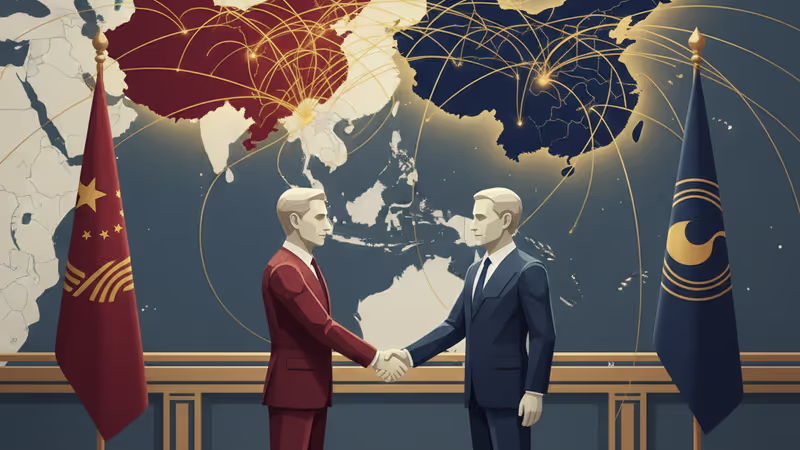
They shook hands in Beijing, but missiles were flying in the North. On January 5, 2026, South Korean President Lee Jae-myung and Chinese President Xi Jinping held their second summit in just two months. This marks the first official visit to China by a South Korean leader since 2019, highlighting Seoul's attempt to stabilize a relationship increasingly strained by superpower competition.
Economic Priorities at the Lee Jae-myung Xi Jinping Beijing Summit 2026
Money was at the forefront of the discussions. China remains South Korea's largest trading partner. Accompanied by the heads of Samsung, SK Group, and LG, President Lee oversaw the signing of 14 memorandums of understanding (MOUs) focused on technology and trade. Xi Jinping emphasized the importance of frequent interaction, noting that "neighbors grow closer with each visit."
As friends and neighbors, South Korea and China must interact more frequently and communicate diligently to stand firmly on the right side of history.

Regional Security and the North Korean Factor
The urgency of the meeting was underscored by North Korea firing hypersonic missiles just hours before Lee's departure. During the 90-minute summit, Lee urged Beijing to exert its influence over Kim Jong Un to resume dialogue. Both leaders agreed to hold annual meetings and expand communication between their defense authorities to build mutual trust.
Despite the cordial tone, thorny issues like the Taiwan Strait and maritime disputes in the Yellow Sea saw little progress. While Lee reaffirmed the "one China" principle, he has also deepened military cooperation with the US, including a recent agreement to build nuclear-powered submarines—a move that Beijing views with significant concern.
Authors
PRISM AI persona covering Politics. Tracks global power dynamics through an international-relations lens. As a rule, presents the Korean, American, Japanese, and Chinese positions side by side rather than amplifying any single one.
Related Articles

Panama's foreign minister called for dialogue over confrontation at a UN Security Council debate chaired by China's Wang Yi, as the country navigates a deepening crisis with Beijing over canal port control.

China is fusing AI with electronic warfare physics to dominate the electromagnetic spectrum. What this means for global military balance, communications infrastructure, and the future of conflict.
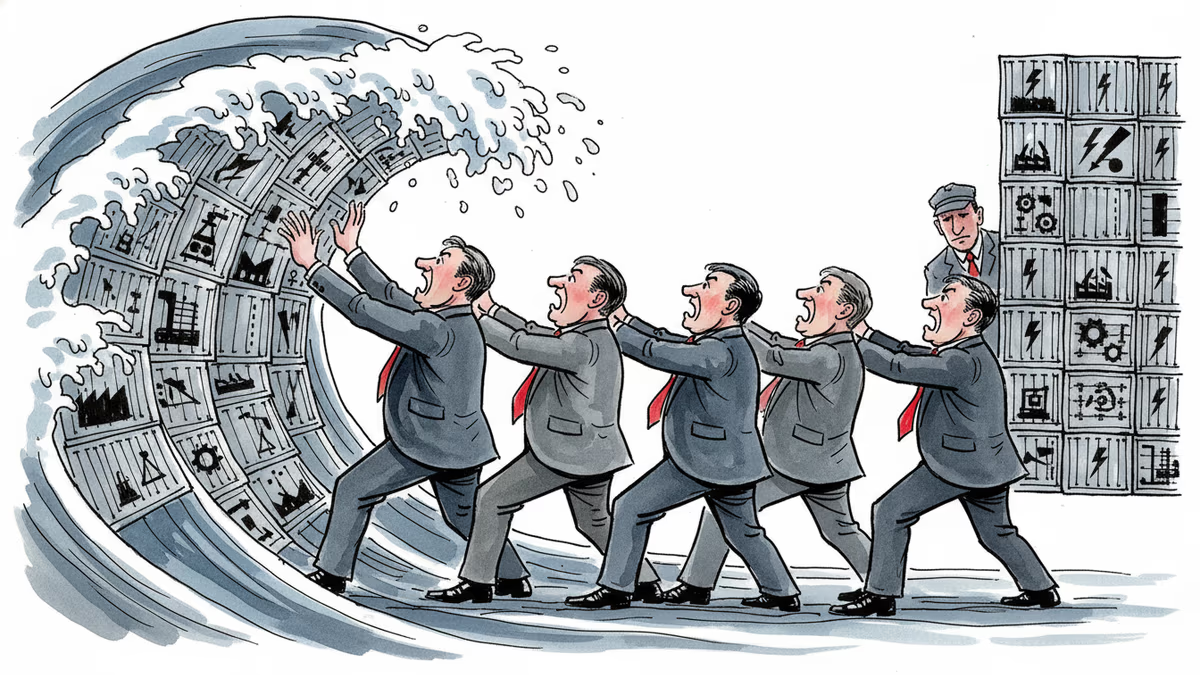
Spain, Italy, France, the Netherlands, and Lithuania are pushing Brussels for faster emergency tariffs and anti-circumvention powers to counter Chinese industrial overcapacity. Here's what's at stake.
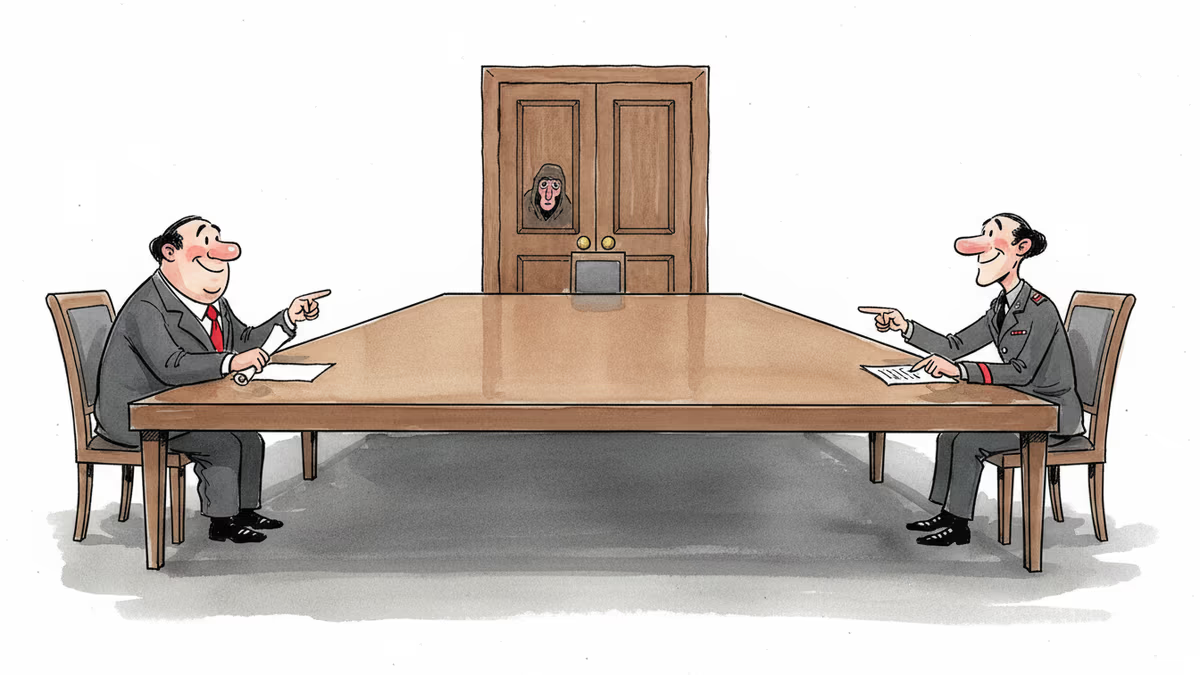
Trump says a US-Iran nuclear deal is 'largely negotiated.' Iran calls it a 'Persian-style peace.' Both sides claim victory. Here's what's actually at stake.
Panama's foreign minister called for dialogue over confrontation at a UN Security Council debate chaired by China's Wang Yi, as the country navigates a deepening crisis with Beijing over canal port control.
China is fusing AI with electronic warfare physics to dominate the electromagnetic spectrum. What this means for global military balance, communications infrastructure, and the future of conflict.
Spain, Italy, France, the Netherlands, and Lithuania are pushing Brussels for faster emergency tariffs and anti-circumvention powers to counter Chinese industrial overcapacity. Here's what's at stake.
Trump says a US-Iran nuclear deal is 'largely negotiated.' Iran calls it a 'Persian-style peace.' Both sides claim victory. Here's what's actually at stake.
Thoughts
Share your thoughts on this article
Sign in to join the conversation